





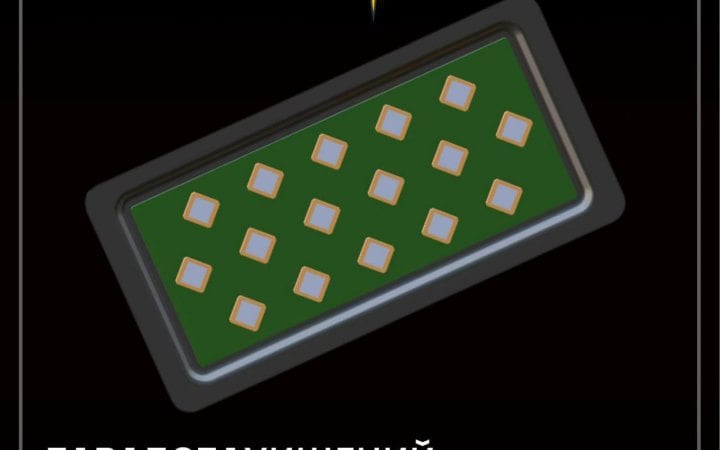
Ukraine’s Defence Intelligence Directorate (HUR), in the “Components in Weapons” section of the War&Sanctions portal, has published a list of 37 foreign-made electronic components used in the production of jam-resistant “Kometa” navigation modules, data on 28 companies involved in their manufacture and in supplying the electronic component base for them, as well as 13 items of foreign technological equipment used in their production.
One way to protect onboard systems from electronic warfare interference is to use controlled reception pattern antennas (Controlled Reception Pattern Antenna, CRPA), which can cut out interference by changing the antenna pattern and applying signal-analysis algorithms. This is the method used in “Kometa” modules.
A classic “Kometa”, used in modern Russian missiles, UAVs and guided aerial bombs, consists of two main elements: an antenna array with a specified number of patch antennas, and a signal-processing module based on an Altera Cyclone field-programmable gate array (FPGA) (a subsidiary of Intel).
The resilience of such a system to interference depends on the number of patch antennas, their placement, and the algorithm by which the FPGA separates the useful signal from interference. Having a specified number of patch antennas on the antenna panel makes it possible to obtain spatial information about the direction of incoming radiation with interference and to compensate for its impact.
At present, the Russians are using “Kometa” modules with 16 patch antennas on a mass scale, and are working to organise serial production of 20-element arrays. The use of a Chinese–Alabuga-made CRPA with 32 antennas has been confirmed.
- Recently, the Defence Intelligence Directorate of the Ministry of Defence released an interactive 3D model, information on the components and the cooperating enterprises involved in the Russian 9-S-7760 aeroballistic missile, better known as the Kh-47M2 “Kinzhal”.