





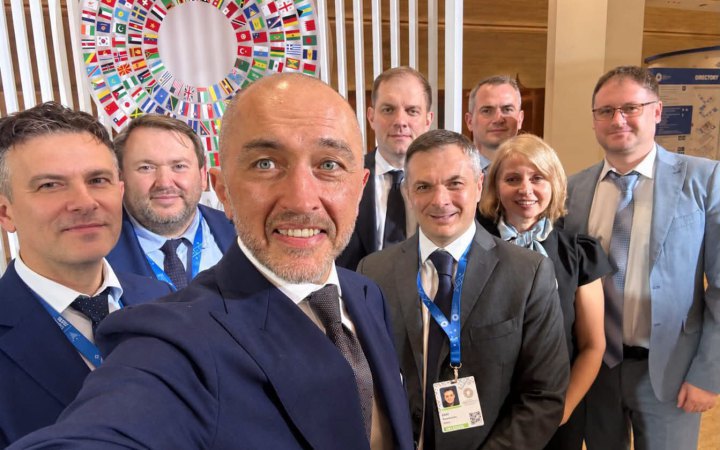
National Bank Governor Andriy Pyshnyy and his team took part in the annual meetings of the International Monetary Fund and the World Bank, held in Bangkok. They are returning to Ukraine “with agreements and new plans”, the NBU head wrote on Facebook.
“My team and I are returning from the IMF and World Bank Annual Meetings in Bangkok. The results: support for Ukraine, a demarche against Russia,” he said.
According to him, the IMF and World Bank annual meetings are of exceptional importance, and Ukraine is an active participant in the processes.
“We have our own position, experience that interests our partners, and a voice that is listened to. We defend our state’s interests, shape the agenda, propose solutions and work to ensure that international support for Ukraine is timely and sufficient,” Pyshnyy noted.
He described the details of the final day of the meetings, when the plenary session of the International Monetary and Financial Committee (IMFC) traditionally takes place, effectively summing up a week of intensive work, hundreds of meetings and discussions during which a shared view of global economic challenges is formed.
During the speech by the Russian Federation’s representative, Finance Minister Siluanov, Pyshnyi stood up and left the hall.
“I have done this before (unfortunately, Russia in one way or another has a certain level of representation at the meetings). But this time, when I looked back, I saw other participants leaving with me. Many others. Among them were my colleagues, and some are now friends too: the heads of central banks from the Nordic countries, the Baltics, Europe, Canada, the United Kingdom, France, Germany… I admit, even I did not expect it on such a scale. For the international financial community, this is an unprecedented moment. The IMF is an institution focused on global economic and financial stability issues. And central bank governors are usually extremely restrained in publicly expressing political positions. It is part of the professional culture. That is why such a collective demarche carries particular weight,” the NBU head wrote.
According to him, it was a manifestation of a shared understanding that Russian aggression has long gone beyond threats to Ukraine alone. Its consequences are felt by the global economy, and further strikes on Ukraine’s energy system, infrastructure and peaceful cities only deepen the understanding of who we are dealing with.
He also said that at the start of the meetings, during a reception for Thailand’s prime minister, European colleagues, having seen the proposed seating plan, insisted it be changed so as not to sit at the same table as Russia’s representatives. The organisers listened. As a result, the formal reception took place without the Russian deputy prime minister.
Pyshnyi noted that during his time in Bangkok he held dozens of conversations with partners.
“We are returning home with agreements and new plans. I sincerely thank the organisers of the meetings for the opportunity for such dialogue. Thank you to all our international colleagues for their support, principled stance and readiness to act,” he said.