





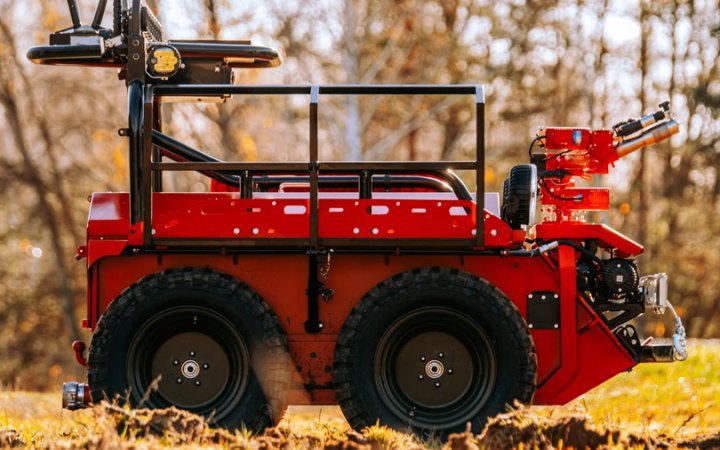
Ukrainian company Rovertech has developed a new version of its firefighting unmanned ground robotic complex — the ZMIY Firefighter 2.0. It was designed in cooperation with the State Emergency Service of Ukraine (SES), taking into account rescuers’ needs when operating in hazardous conditions, including in the absence of communications and lighting. The robot has also received equipment for evacuating casualties. This is reported by Oboronka, citing the manufacturer.
According to the developers, the platform weighs 1,300 kg, reaches speeds of up to 8 km/h and has a range of 20 to 40 km, depending on the load on the lighting system and the winch. The UGV’s rated payload is 500 kg; however, the company says it withstood loads of up to 1.5 tonnes during testing. The complex’s own tractive effort is 1,000 kg, while the winch provides 1,500–2,000 kg, provided the platform is secured.
For firefighting, the robot is equipped with a monitor nozzle with aiming angles of 110° vertically and 130° horizontally. At an operating pressure of 11 bar (design pressure 16 bar) and a water flow rate of 50 l/s, it can project a jet up to 50 metres in calm weather. To protect against overheating, the platform is fitted with six sprinklers — three spray nozzles on each side. Their total water consumption is 30 l/min.
The monitor nozzle also serves as a communications point: an antenna is mounted on it. The platform itself is fitted with a ram bumper for working in rubble and two auxiliary ramps that help it get out of mud. The connections for fire hoses have been moved to the rear and middle sections of the hull. According to the developers, this layout has improved the UGV’s cross-country capability under water pressure.
In addition, the robot has received a body with doors and a folding stretcher for evacuating casualties. For operation in low-visibility conditions, it features 360-degree lighting with a spotlight covering a 140° angle. The observation system consists of three cameras: thermal, wide-angle and narrow-angle.
Control of the complex is built on a hybrid multi-channel communications architecture with automatic signal-quality monitoring. The system can seamlessly switch to backup data-transmission channels, providing control at short, medium and ultra-long distances.
The operator controls the robot from a portable ground station that can be deployed straight out of the box. To begin work, it is enough to raise the antenna and connect the cable and power. After that, company representatives say, the UGV can be put on its wheels in less than two minutes.
According to Rovertech partnerships manager Valerii Savarin, the first version of the robot was intended primarily to deliver a fire hose and water and to provide a targeted jet. It was created on the basis of a standard logistics UGV, adding a servo drive to rotate the nozzle up and down and side to side. By contrast, the ZMIY Firefighter 2.0 was developed from scratch in line with drawings and a technical specification agreed with rescuers, and with a broader range of tasks in mind. Rovertech notes that little from the first version of the firefighting robot remains in the new complex.
The changes affected, in particular, the electronics and software. The old platform did not have enough output channels to connect the new equipment, so engineers developed a separate control unit with around 30 relays. It allows switching between two water circuits, starting the spray system, controlling the lighting, the monitor nozzle, winches and towing units. The company plans to use the universal unit on its other platforms as well.
The developers also redesigned the control console so that the operator can use it without lengthy familiarisation, including in stressful situations. It is fitted with industrial joysticks, buttons and video-stream output tools protected against water and impacts.
Another innovation is a loudspeaker with two-way audio communication. Thanks to it, the ground-station operator can hear what is happening near the robot and transmit voice messages to people in the affected area. This makes it possible to communicate with casualties during search-and-rescue operations, inform them about evacuation and provide the necessary instructions.
Rovertech is currently planning the development of a third generation of the complex and is also preparing several narrowly specialised modifications. In particular, the company is working on a separate version of the firefighting UGV for the European market, as well as a simpler, more rugged and more affordable modification for the military.
Recently, Rovertech upgraded the remotely controlled ground robotic demining complex (GRDC) “Zmiy”. The updated version received an electric powertrain, Starlink satellite communications, increased impact force and longer continuous operating time.