





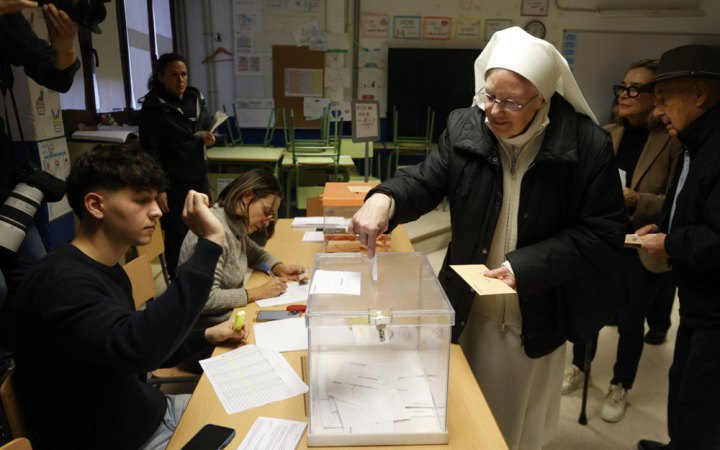
On Sunday, 29 November, Spain is holding a parliamentary election. Voters are deciding whether Prime Minister Pedro Sánchez will remain in power or whether the country will be led by a conservative party.
Polling stations will be open from 9:00 to 20:00 local time. The first preliminary results are expected about an hour after voting ends.
Spain’s parliament has 350 seats. To secure an absolute majority, a party or coalition must win at least 176 seats.
Sánchez, who has led the country since 2018, called the snap election, saying he needed to secure a parliamentary majority. This came after parliament rejected the legislative measures he proposed to tackle the housing crisis.
According to polls, Sánchez’s Spanish Socialist Workers’ Party (PSOE) is narrowing the gap with the conservative People’s Party (PP). This is partly due to voters disillusioned with the far-left. At the same time, most surveys predict a PP victory if it joins forces with the far-right Vox party.
The most likely scenario is seen as a PP–Vox coalition. If parliament fails to back any candidate for prime minister within two months of the first investiture vote, Spain will automatically call a new election.
Vox advocates tougher immigration controls, returning some powers from the regions to the central government, cutting taxes, and rolling back a number of progressive social measures.
The party also supports deporting foreigners convicted of crimes and giving Spaniards priority in housing allocation.
The People’s Party, for its part, promises to ban mass regularisation of undocumented migrants, introduce the option of returning them to third countries, and implement a points-based system for selecting legal immigrants.
During the campaign, Sánchez highlighted his government’s economic achievements. These include raising the minimum wage and a labour reform after which unemployment fell to its lowest level in nearly two decades. Spain’s economy is estimated to be among the fastest-growing in the EU. Sánchez also views immigration as a driver of economic development.
At the same time, the prime minister’s position has been weakened by corruption scandals linked to his closest circle and family, as well as a series of crises. These include two fatal rail accidents, a migration crisis in Spain’s North African enclave of Ceuta, and a nationwide power outage.
In addition, Sánchez has been criticised for granting amnesty to leaders of the Catalan independence movement in exchange for their support for his reappointment as prime minister after the 2023 election. The People’s Party won the most votes then, but was unable to form a parliamentary majority.
If Sánchez loses, only three EU countries—Denmark, Lithuania and Malta—will be left with governments led by centre-left political forces.