





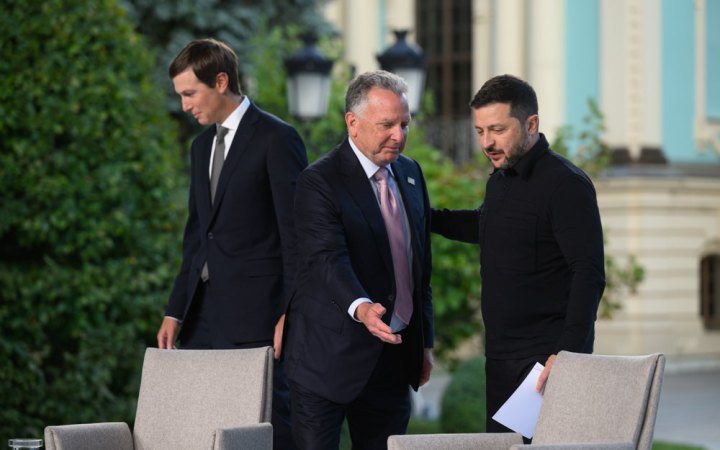
Russia has agreed to hold a trilateral meeting with Ukraine and the United States at team level. US representatives conveyed the signal to Ukraine following talks between Steve Witkoff and Vladimir Putin held today in Russia. President Volodymyr Zelenskyy said this in an audio comment to journalists.
The United States is proposing to hold the meeting as soon as possible. Ukraine supports this.
“I don’t know what the final dates for this meeting will be. The agenda is clear: to end the war, bring peace closer, and, as I understand it, prepare everything for a leaders’ meeting,” the President said.
The teams will continue their contacts. There is still no understanding of when a technical-level meeting could take place, but Ukraine is hoping for early November.
“We will support the proposal for a ceasefire, for ending the war, for an energy ceasefire, and for any ceasefire. And humanitarian initiatives, and the return of prisoners,” Volodymyr Zelenskyy said.
He recalled that Russia has repeatedly declared its readiness to be constructive, but has not kept its promises.
The President also shared details about the Oslo Summit on 20 October. At yesterday’s meeting with the Finnish President, the Norwegian Prime Minister and Witkoff, they discussed how to bring peace closer and organise a leaders’ meeting in a trilateral format with the involvement of European partners. Zelenskyy stressed that Europe’s participation in the negotiating process is important, because the agenda of any agreements will include security guarantees, post-war reconstruction and other issues that will concern different countries.
- The trilateral meetings that Russia, Ukraine and the United States held last year and in January this year stopped after the US shifted its focus to the war against Iran. The last meeting took place on 17–18 February in Geneva.
- In the talks, Ukraine and Russia, mediated by the United States, discussed a joint plan that could make it possible to end the war. The unresolved issue remained territory: Russia demanded that Ukraine hand over the whole of Donbas, Crimea and parts of Kherson and Zaporizhzhia regions. Ukraine does not agree to territorial concessions, but is willing to negotiate along the current lines with the prospect of further diplomacy.
The Oslo Summit and Its Background
In October, Washington again escalated relations with Kyiv. First, Donald Trump announced an unexpected deal to supply Russian diesel, thereby weakening anti-Russian sanctions. He once again criticised Ukraine, accusing it of driving up energy prices on the global market. However, energy-sector analysts have repeatedly pointed out that the rise in the price of diesel and other petroleum products began not because of Ukrainian strikes on refineries in Russia, but because of Iran’s destruction of oil refineries in Persian Gulf countries, which took place this year.
The United States also failed to provide Ukraine with information about Russian ballistic missile launches during several attacks. Meanwhile, Starlink satellite communications for the military began operating with speed restrictions, which made it impossible to shoot down jet-powered UAVs with interceptor drones and to carry out some mid-strike attacks. Ukraine stressed that it uses Starlink only for strikes on occupied territory, not for attacks on Russia. Washington denies any deliberate restrictions, but Volodymyr Zelenskyy said Ukraine conducted an experiment and took Starlink to an EU country. There it worked at speeds of 180 km/h and above, while in Ukraine it worked only up to 161 km/h.
On 20 October in Oslo, Volodymyr Zelenskyy, Alexander Stubb, Jonas Gahr Støre and Steve Witkoff held a meeting. They discussed proposals for establishing peace, security guarantees for Ukraine and post-war reconstruction. According to Zelenskyy, the United States agrees that security guarantees must be strong. There are different options, including an analogue of NATO’s Article 5.
Witkoff is to pass the proposals on to Putin.