





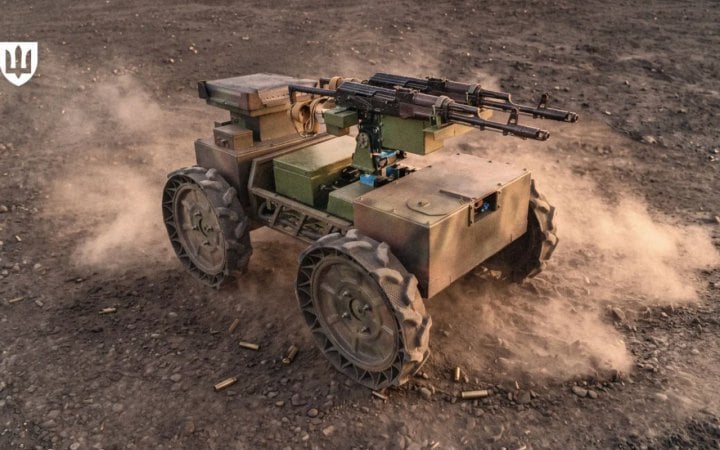
During Operation “Vivaldi”, the Third Army Corps deployed kamikaze ground robotic systems from heavy “Gryphon” bomber drones more than 10 kilometres deep behind enemy lines. A video about the operation was published on the Third Army Corps’ YouTube channel.
The tactic was developed by the NC13 strike ground-robotics unit and implemented with support from the Third Army Corps’ unmanned systems units. According to the NC13 commander, call sign “Makar”, the tactic has become systematic and has been used for the past four to five months.
The essence of the tactic is to deliver a ground system to a designated area by drone, after which the robot can independently continue carrying out the mission on the ground. Within the unit, this approach is seen, in particular, as a tool for operating behind enemy lines, disrupting its logistics and striking military targets.
During the first operation using this tactic, two ground robotic systems were delivered about 15 km from the line of contact, but the enemy detected and destroyed them.
That same day, the troops sent two more systems, taking into account the experience of the first attempt.
“We were deployed for the second time. We move towards the designated target and enter a tree line. Our task then was to destroy an enemy shelter. There was a kind of assembly point there, a forward trans-shipment base where enemy troops arrived, regrouped, rested, and then moved on. The task was successfully completed,” “Makar” said.
NC13 began working on the concept around November 2025. Engineers were tasked with adapting the ground system so that it could be transported by a heavy drone and deployed in a designated area.
The unit says this scheme makes it possible to operate in areas where the enemy primarily expects a threat from the air.
“Everyone is used to looking up at the sky, understanding that an FPV can fly 15–20 kilometres beyond the front line. But no one looks at their feet, expecting that something might be lurking there and then catch up with you and strike. We are not jammed by electronic warfare, we are not detected by interceptors, and so on. And we can sit in ambush for days deep behind enemy lines. It’s like paratroopers used to be dropped from aircraft. Now there are ground robotic systems that are deployed from heavy bombers,” “Makar” says.
In his assessment, the success rate of operations using this system is about 80%, largely thanks to good coordination between units.
The bomber drones used in the operation were named after serviceman Hryhorii Bakh, call sign “Gryphon”, who served in NC13 and went missing during fighting near Andriivka in 2023.
NC13 also expects to further expand the use of ground robotic systems. “Makar” stressed that the development of such systems should reduce the need to involve people in the most dangerous tasks on the battlefield.
In addition, as part of the offensive Operation “Vivaldi”, the Third Army Corps was the first among military units to use ground robotic systems for demining and supporting assault operations. The corps said the main goal of introducing these technologies is to replace infantry with robots in the most dangerous areas, in order to preserve the lives of Ukrainian servicemen as much as possible.
As a reminder, on 15 September, the commander of the Third Army Corps, Andrii Biletskyi, announced that the unit in Donetsk region is conducting an offensive operation called “Vivaldi”. During the first season of the operation, the Third Army Corps eliminated enemy infiltration across an area of 75 km², de-occupied 10 km² of Ukrainian territory and captured Russian soldiers. During the second phase of the offensive, fighters of the Third Army Corps liberated the settlements of Shandryholove and Derylove, and also established full control over Drobyshcheve. Overall, at this stage, 125 km² of Ukrainian territory has already been returned to Ukrainian control.