





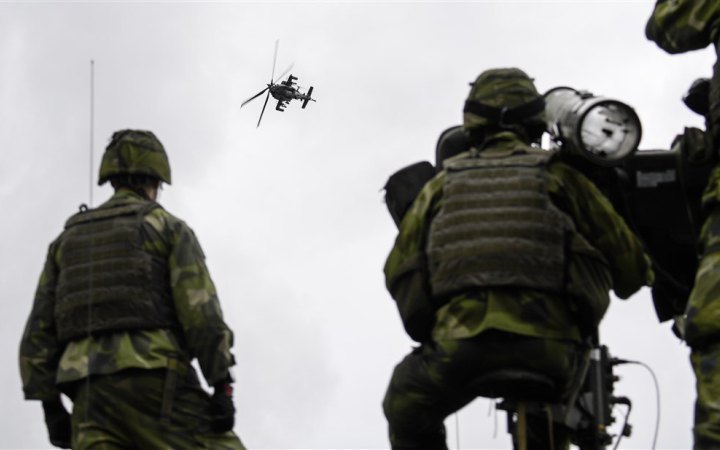
Finland, Poland, Estonia, Latvia and Lithuania share more than 3,500 kilometres of land border with Russia and Belarus. Together with Sweden, which includes the strategically important island of Gotland in the Baltic Sea, these countries are stepping up preparedness for a possible armed conflict.
This is reported by the French newspaper Le Monde.
Finland has resumed safety testing of bomb shelters for the first time since 1992. In mid-September, the Finnish military detonated explosive charges near shelters close to the city of Rovaniemi, about 100 kilometres from the Russian border. The aim of the tests is to check how well the shelters protect against modern military threats.
Since Russia launched its full-scale invasion of Ukraine in 2022, states have not only strengthened their armies and cooperation with allies, but also stepped up preparations for the civilian population.
Mikael Frisell, Director General of the Swedish Civil Contingencies Agency, stressed that one of the country’s main takeaways was the realisation that society itself can also become a battlefield.
European countries are restoring old shelters, building new ones and converting existing premises to protect the public.
In Poland, after some Cold War-era bomb shelters fell into disrepair, a civil defence law was adopted in 2025. It launched a large-scale programme to restore shelters and build new ones.
According to Le Monde, Poland currently has 86,000 bomb shelters, which can accommodate almost 25 million people out of the country’s 38 million residents.
Sweden has 64,000 shelters designed for seven million people out of a population of ten million. After abandoning the “total defence” system in the late 1990s, the country returned to this model in 2015 and is now restoring bomb shelters.
Finland has 50,500 shelters, which can accommodate up to 4.8 million people out of the country’s 5.6 million residents. In September, the Helsinki authorities also announced plans to invest €400 million in building underground hospitals, which are to be completed by 2030.
Estonia, Latvia and Lithuania have drawn up large-scale plans to refurbish public buildings and equip shelters. At the same time, residents are being told how to protect themselves at home during danger: in particular, they are advised to take cover in basements, windowless rooms or corridors.
Countries in the region have introduced phone alerts and created websites and mobile apps intended to warn of danger and help people find the nearest shelters.
Particular attention is being paid to informing the public. In Finland, Sweden and Poland, the authorities are distributing brochures with recommendations on what to do in emergencies.
In 2018, around 4.8 million Swedish households received a brochure titled “If Crisis or War Comes”. It explained what supplies people should keep at home and why citizens should be prepared to provide for themselves for a week.
In 2024, Sweden distributed an updated version of the brochure, stressing that the country cannot rule out the possibility of an armed attack.
In Lithuania, civic organisations and schools run civil defence classes. People are taught first aid, how to pack an emergency evacuation bag, and how to cope without electricity.
In Poland, at the beginning of 2026, the “Academy for Public Protection and Civil Defence” programme was launched. By September, more than 400,000 people had completed training under it.
European states are also preparing their economies to operate in wartime conditions. Governments are seeking to ensure the uninterrupted functioning of energy, transport, healthcare, telecommunications and other critical sectors.
In Latvia, the Ministry of Defence sets out on its website approaches to mobilisation and to integrating different areas of activity into a single defence system, including through cooperation with business.
In Lithuania, strategic documents emphasise that companies can be involved in supporting the army even in peacetime.
Finland is developing a “comprehensive security” system that provides for cooperation between state institutions, local authorities and business. Representatives of ministries and civil protection organisations meet at least once a month at the Security Committee, where they assess the country’s risks and needs.
After the start of Russia’s full-scale war against Ukraine, Finland also increased its strategic grain reserves. Where they previously were meant to cover six months of consumption, they now cover nine. In addition to grain, the country stores seeds, agricultural machinery and medicines.
Taking into account Kyiv’s experience of continuing to function despite Russian strikes on the power grid, the Finns also decided to create a network of 300 supermarkets that will be able to operate during emergencies thanks to backup generators.
Since 2025, Poland has been taking measures to ensure uninterrupted supplies of water, food, fuel and medical equipment needed for critical infrastructure to function. The government is also funding the development of strategically important enterprises in the energy, telecommunications and transport sectors.
In Estonia, a new security doctrine published in May defines economic security and the uninterrupted operation of essential services as priorities on a par with military defence.
In January, Sweden urged companies with more than five employees to prepare for the worst-case scenario. The authorities identified 12 key sectors, including energy, transport, healthcare and financial services. In addition, 500,000 Swedes have already received notifications about possible conscription for military service in the event of an armed conflict.
Estonia, Latvia and Lithuania have identified evacuation as one of the main directions of civil defence. In particular, they are considering the possibility of moving people out of the country in the event of a large-scale invasion.
In October 2025, Lithuania held exercises during which it practised evacuating residents from 30 municipalities to other parts of the country, as well as to Poland, Germany, Sweden, Switzerland and the United Kingdom.
In early October, Poland and Lithuania also announced plans to build a centre to receive refugees in the Lithuanian city of Lazdijai, near the Polish border.
As Le Monde notes, Ukraine’s experience and Russia’s numerous hybrid attacks have prompted European countries to rethink their approaches to security. The changes cover the military, social, political and economic spheres.
- Against the backdrop of security challenges, Germany announced in 2023 plans to permanently station a combat-ready brigade in Lithuania. It is expected to become operational by 2027 and to comprise around 5,000 military personnel and civilian staff.
- As NATO Military Committee Chair Admiral Giuseppe Cavo Dragone said, NATO is ready to respond to a possible escalation by Russia on the eastern flank. The Alliance has around 4,000 pages of military plans to defend the eastern flank — from scenarios involving a minimal crisis to an incursion into territory.