





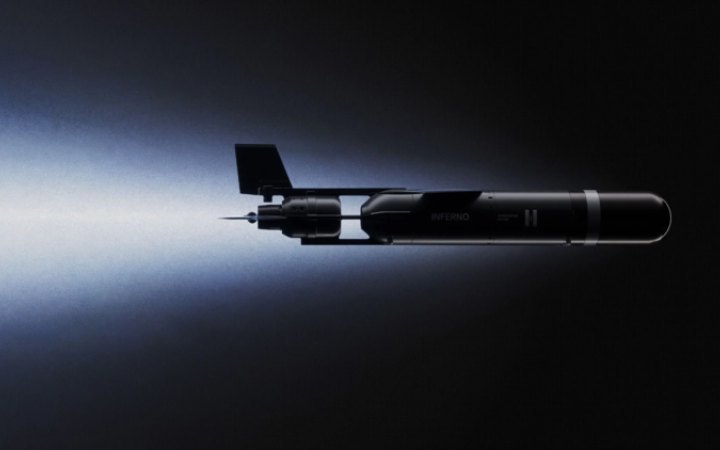
German defence company Helsing has unveiled the AD-1 Inferno jet-powered interceptor drone, designed to destroy high-speed attack drones and cruise missiles. This was reported by Militarnyi, citing a presentation in Berlin by Helsing co-founder Gundbert Scherf.
According to the company, the AD-1 Inferno is equipped with a jet engine. It can patrol a designated area of airspace while awaiting targets, operate as part of a group of interceptors, and re-engage a target if necessary.
During the mid-course phase of flight, the drone receives guidance commands from radar stations. In the terminal phase, it uses its own radar seeker to detect and engage the target. According to the developer, this approach allows the interceptor to be used in a range of weather conditions and at any time of day, including at night.
During the presentation, Helsing representatives noted that countering modern aerial threats requires interceptors capable of operating at altitudes of up to 9–10 km.
The AD-1 Inferno will be launched using containerised launchers. According to the manufacturer, a single container can hold around 20 interceptors.
The containers can be transported by standard lorries or by rail. The company said this should simplify transport, deployment and the supply of air-defence assets to units.
Production of the interceptors is planned at Helsing Resilience Factories. The company expects that scaling up production will make the unit cost of the AD-1 Inferno significantly lower than that of traditional surface-to-air missiles.
AD-1 Inferno as Part of the Contra System
The new interceptor is being developed as one of the components of Contra—an autonomous air-defence system that uses artificial intelligence to fuse information from different sensors and coordinate engagement assets.
According to Helsing, Contra is designed to simultaneously detect, track and intercept hundreds or even thousands of aerial targets. The system is intended to help counter mass drone and missile attacks.
The backbone of the complex is the Altra C2 command-and-control platform. It coordinates the system’s components while leaving operators in control of decision-making and the designation of priority targets.
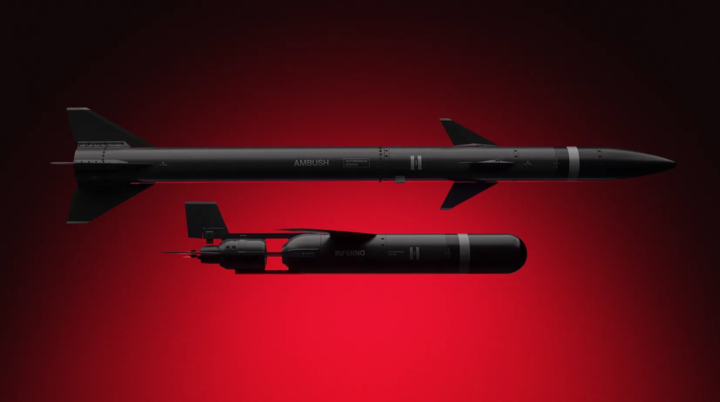
In addition to the AD-1 Inferno, Helsing is developing another interceptor, the AD-2 Ambush. It is a solid-fuel missile designed for rapid interception of aerial targets. According to the company, it can reach speeds of up to Mach 2.5 and has a range of more than 20 km.
The Contra architecture also предусматривает integration of third-party counter-drone capabilities, including other interceptor missiles, laser systems, specialised guns and net-based systems. According to Helsing, connecting compatible equipment may take only a few days.
What We Know About Helsing
Helsing is a European company specialising in artificial-intelligence software and autonomous systems for the defence sector. It was founded in Germany in 2021.
In Ukraine, the company has been operating since early 2024. Since the beginning of 2026, Helsing has supplied the Defence Forces of Ukraine with thousands of HX-2 strike drones equipped with its own artificial-intelligence system. According to the company, this technology allows the drones to operate even under satellite-navigation jamming, independently detect and re-identify targets. The stated strike range of the HX-2 is up to 100 kilometres.
In July, Helsing appointed former Deputy Defence Minister of Ukraine and former MP Andrii Shevchenko as its managing director in Ukraine.
Helsing also works with the governments of Germany, the United Kingdom and Sweden, and has partnership agreements with Airbus and Saab. In particular, the company is developing an artificial-intelligence system for Eurofighter jets to analyse radar data.
In June 2026, Helsing raised $1.6bn to develop a new CA-1 Europa drone, bringing total investment to nearly $4.4bn.
According to estimates by the Sacra research platform, at the start of 2026 the company’s annual revenue reached about €850m, and its order book exceeded €1.2bn.