





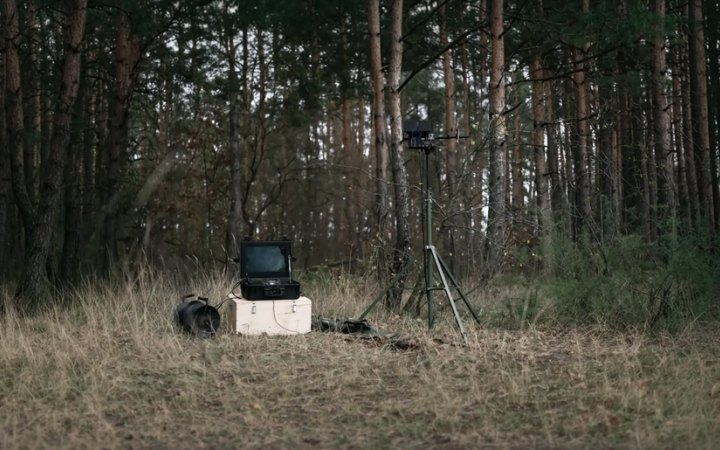
Ukrainian company Air3F has developed the T-Bone Digital, a digital ground control station for FPV drones. The developers based it on Walksnail Ascent — a digital video transmission system for drones. The company said in a press release.
When working with a ground station, the operator needs quick access to functions without lengthy menu hunting. T-Bone Digital is designed so that the controls are intuitive from the first minutes, and the number of unnecessary actions is kept to a minimum. Below is how the station is set up, where the operator is positioned, and how field work is organised.
T-Bone Digital consists of two parts: an operator case and a remote “Viper” unit. The “Viper” houses a Walksnail VRX video receiver, VRX / TX1 / TX2 modules, two horn antennas and a control antenna. The unit is mounted on a mast and connected to the case via two separate lines: VIDEO and SERVICE. Each line is 25, 50, 75 or 100 m long on separate reels. This makes it possible to raise the antennas to height while the operator remains under cover at a safe distance, the developers explain.
Power is also separated: the case and the “Viper” have their own 6S2P batteries, and the voltage of both units is displayed on the screen at the same time. The operator can immediately see the status of both power sources and does not depend on what is happening on the mast, the developers note.
Key functions are brought out to the front panel of the case: menu navigation, switching on VRX, TX1 and TX2, BIND and REC commands, as well as power for the “Viper”. The main power switch for the case itself is located on the rear panel so it cannot be turned off accidentally. The station supports two ways of switching frequency — via toggle switches on the controller or on the case through the classic Walksnail menu.
The 2.42-inch display shows only what is genuinely needed during operation: the status of the service link between the case and the “Viper”, controller activity, the voltage of both batteries, the statuses of VRX, TX1 and TX2, as well as signal level (RSSI), channel and frequency. The operator can immediately see the difference between the station being switched on and there being an actual link to the aircraft: if the TX module is active but there is no signal reading, there is no connection to the aircraft
If the service link between the case and the “Viper” is lost, a large, clearly visible icon appears in the centre of the screen. And if the voltage on any battery drops to 16 V or lower, the system warns which specific unit is discharging and reminds the operator of the risk of power loss.
Video is output via HDMI — an internal 1×2 splitter allows two devices to be connected at the same time, for example the pilot’s goggles and a monitor. There is also a USB output for video capture and four 5 V USB ports to power peripherals. Recording is made to microSD (up to 256 GB) in the VRX module — this makes it possible to save video without unnecessary losses over a long cable run, the developers explain.
For preparing and servicing the station, there is a built-in Wi-Fi network. Via the web interface, you can check the board status and the selected TX, configure telemetry and channels, and update the firmware of the case and the “Viper” without dismantling the housing or using a programmer.