





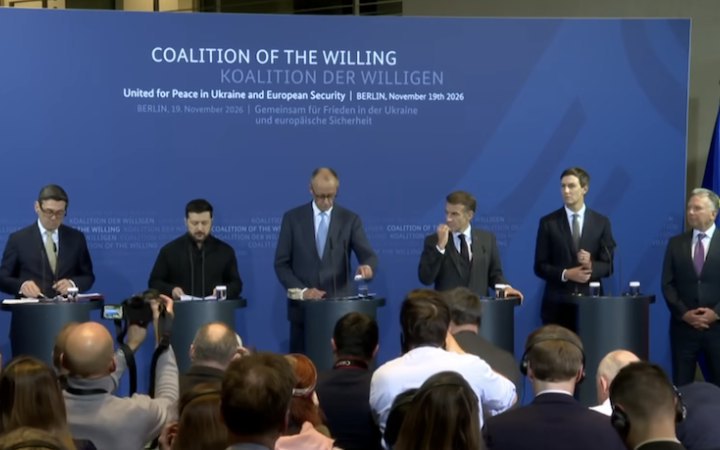
At a meeting of the Coalition of the Willing on 19 November in Berlin, a common position on security in Europe was formed. The coalition will support Ukraine for as long as it takes. Yesterday, the European Commission proposed an additional €45bn for Ukraine for next year, and today the proposal received broad European backing.
Only talks involving Ukraine and Europe can be successful, German Chancellor Friedrich Merz said at a press conference after the summit. The Yalta format is unlikely to bring peace, he added, referring to today’s meeting of the leaders of China, Russia and the United States, where, among other things, the war against Ukraine was discussed.
About 40 countries took part in the meeting of the Coalition of the Willing, most of them at leader level.
“Today I gave each guest a fragment of the Berlin Wall. This wall stood a few metres from this place and for many years divided our country, the continent and the whole world. This wall brought unfreedom, uncertainty and discord, and that is what Yalta symbolised. And with the fall of the wall we associate a different world,” Merz said.
He urged Putin to end the war in Ukraine and to seek diplomatic solutions together.
“We do not want to live in a divided Europe. We want to live in peace together with Ukraine,” the German chancellor said.
The starting point for agreements in talks with Russia should be the line of contact, Merz added. The chancellor stressed that the gradual lifting of sanctions on Russia is possible only if it meets the conditions.
“First, peace in Ukraine, then agreements on Euro-Atlantic security. Moscow knows that the maximal demands of December 2021 are unrealistic. After peace is achieved in Ukraine, Europe must be safer than before, so we need a stronger and more European NATO. However, in due course it will be necessary to talk to Moscow about military communication channels, about risk reduction and transparency — this serves the interests of both sides,” he said.
Joint military exercises by the Coalition of the Willing demonstrate the high level of readiness of these forces, Merz believes.