





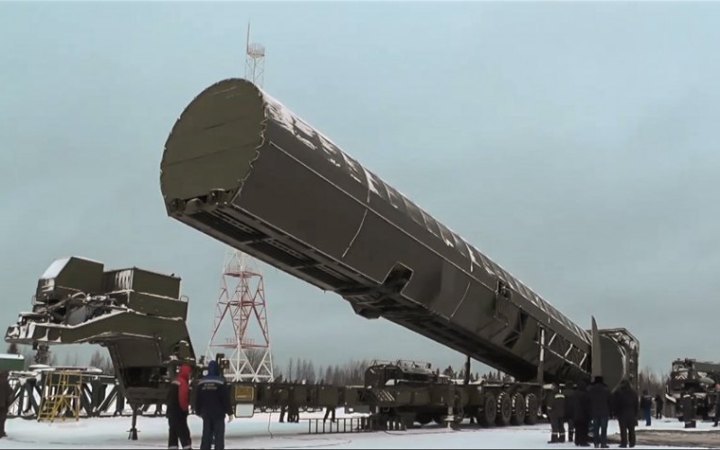
Russia has begun deploying new RS-28 Sarmat intercontinental ballistic missiles within the Strategic Missile Forces. This is indicated by satellite images of Russian missile bases analysed by specialists at the International Institute for Strategic Studies, Military reports.
The analysis used satellite images dated 6 June 2026. They show at least six transport and support vehicles near open launch silo No. 13C close to the town of Uzhur in Krasnoyarsk Krai.
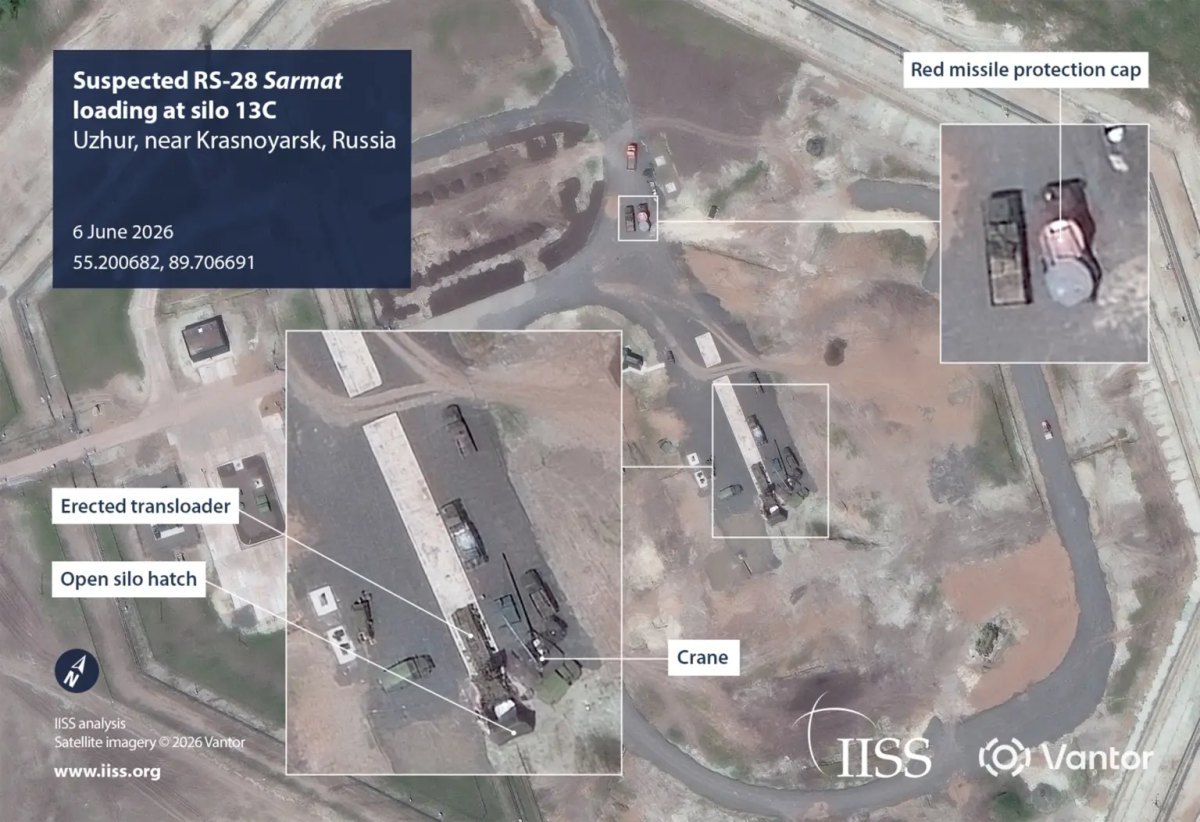
This area is home to the 62nd Missile Division of the Strategic Missile Forces, which is due to receive the new missiles.
Right next to the silo, a specialised transporter-erector was spotted, designed to carry and load sections of intercontinental missiles. Its cargo platform was almost vertical, but the missile section was no longer on it.
Another vehicle was also seen carrying a red protective structure about three metres in diameter, used when transporting parts of the missile.
According to the IISS, these signs may indicate that one of the Sarmat’s sections has already been loaded into the launch silo.
Read alsoAt a meeting with Putin and Trump, Xi called nuclear weapons a “sword of Damocles” and urged their complete elimination
The deployment comes after prolonged problems with the missile’s development and testing. The first successful Sarmat launch took place in April 2022, the second on 12 May 2026.
Between these tests, Russia suffered at least two failures. In September 2024, the missile exploded directly in its launch silo at the Plesetsk test site.
In November 2025, according to preliminary assessments, Sarmat lost control after leaving the silo and crashed nearby.
After the successful May test, Strategic Missile Forces commander Sergei Karakayev told Putin that the missile system could go on combat duty by the end of 2026.
One reason for the haste may be the condition of Russia’s existing missile arsenal. Russia has extended the service life of its liquid-fuel intercontinental ballistic missiles by more than 20 years, which, the authors of the report believe, increases the risks of their continued use and reduces reliability.
The RS-28 Sarmat is a Russian ICBM that Moscow has been developing since the early 2000s to replace the Soviet R-36M2 Voyevoda—the same missile the West dubbed Satan. Voyevoda has been in service since 1988 and has long exceeded its intended service life. Sarmat was meant to replace it—and, by design, to become the most powerful ballistic missile in the world.
According to official Russian data, the missile weighs more than 200 tonnes, can carry up to 10–15 nuclear warheads, and has a range of more than 10,000 kilometres.
Putin has cited even more dramatic figures: following the May tests, he announced a range of 35,000 km. According to him, the missile has virtually “no range limitations” and can fly on a suborbital trajectory—meaning it could strike a target not via the North Pole but from the opposite side of the Earth, bypassing missile defence systems.