







Ontological war: the struggle for reality
“Ontological war is not a war for territory; it is a war for reality – for our narratives, meanings and worldview. It is a question of who we are, what we want, and where we are going,” says Dmytro Zolotukhin.
He emphasises that after 2022, Ukrainians found themselves in a situation where the old landmarks no longer worked, while new ones had not yet been created. “We cannot just say ‘we must hold out’. That is not a goal – it is a process. We need a master plan, an understanding of where we are heading. We must create our own model of the world – one that is meaningful, humane and value-based.”
For him, this war is not only military but, above all, meaningful: “If we do not shape reality ourselves, it will be shaped for us. And then we will live in someone else’s history.”
“Ukro-Buddhism” as a way to stay centred
Zolotukhin discusses the new identity of Ukrainians, ironically referring to it as “Ukro-Buddhism”. In the interview, CultHub editor Kateryna Hladka speaks with him about his text, in which he introduces this concept with a note of irony.
“It’s not about indifference. It’s about observation – about the ability to stand at the epicentre of pain without turning it into hatred. It’s a philosophy that allows you not to break down, not to lose meaning when the world is burning.”
He explains that “Ukrainian Buddhism” is not an escape from reality but rather its acceptance with dignity. “We are learning to see the war not as an end but as a path. And that is what saves us.”
Greater Europe and our home
“There is no Ukraine against Russia. There is Ukraine within the common space of Greater Europe. We cannot survive without Western support because we belong to this cultural and value orbit,” Zolotukhin asserts.
He believes that the United States is losing its role as the moral core of the world, and that Ukraine must therefore seek support within the European context: “Today, the US is no longer the source of meaning it once was. The only real union is the European Union – with all its contradictions, crises and weaknesses. But this is our home.”
In his view, Ukraine today serves as a mirror for Europe, reflecting its true face. “We remind Europe that its values come at a high price – and we pay for them with blood.”
European dignity and the Ukrainian choice
Zolotukhin makes an insightful observation that online “fights” are part of the Ukrainian mentality – not necessarily in a negative sense: “Europeans have placed dignity above life, yet they fear conflict. Ukrainians are the opposite: we defend our dignity daily through conflict, even on social media. This is our way of testing the boundaries of dignity.”
According to him, Ukrainians are “emotional Europeans” – and this is where their strength lies:
“We are alive because we make emotional choices. We do not flee from pain; we transform it into energy. We pay for our dignity with the most precious thing we have – our lives. And that is why we have the moral right to speak of a new Europe that already includes us.”
Survive or be right
“We either want to be right or we want to survive. If we want to survive, we have to change our behaviour,” says Zolotukhin.
In his view, this principle applies not only to state policy but also to the everyday behaviour of every Ukrainian. “Do you want the truth, or do you want to survive? If you want to survive, you must understand Poland – its political processes – accept reality, and allow others to say things we do not like. That is part of being an adult.”
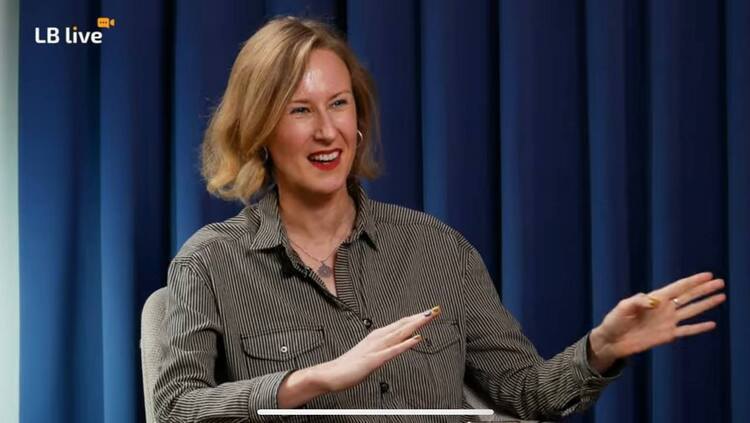
During the interview, Kateryna Hladka refers to an article published on LB.ua featuring research from a European analytical centre. The study examines how the image of Ukrainians is formed in the Polish segment of the internet and how this influences political and cultural-diplomatic decisions.
Dmytro Zolotukhin comments: “Social networks are a business. They show what they are paid for – and they are paid for, in particular, by special services.”
He is convinced that the wave of antipathy between Poles and Ukrainians is the result of planned information and psychological operations: “Russia and Belarus are actively working to make us lose trust in one another. This is not a conflict between societies – it is a conflict between algorithms.”
Europe’s shift to the right
Zolotukhin views Europe’s political shift to the right as part of deeper civilisational processes: “The rise of the far right is not only the result of Russian influence. Perhaps Homo sapiens is not as good a creature as we thought.”
However, given the often controversial developments in neighbouring countries, he believes Ukrainians must learn to engage in more pragmatic dialogue. “If we do not learn to talk to the right wing, we are in for trouble. Demonisation is a dead end.”
“Culture is a way of recreating reality. If we stop seeing the world the way we want to, we are defeated,” he says.
Zolotukhin stresses that culture is not a decoration of life but its infrastructure. “The Ministry of Culture does not produce culture – it merely administers the budget. True culture is born of pain, experience and inner work. It is created not by ministers, but by people who risk their sense of meaning every day.”
He adds: “Artists are not civil servants. Their mission is to ask uncomfortable questions. If artists become ‘effective managers’, we lose culture as a living organism.”
He is also convinced that the state’s task is to create conditions for freedom, not loyalty:
“Culture is not about loyalty – it is about memory, language and worldview. If it is destroyed, the army will not save us.”