






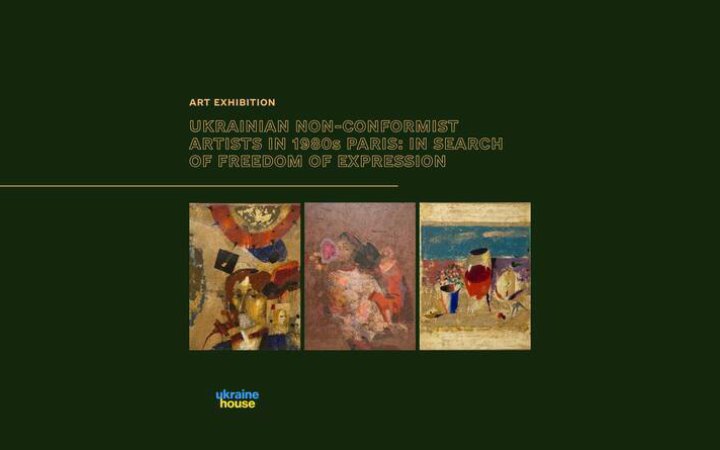
The Ukrainian House in Washington has presented an exhibition entitled Ukrainian Nonconformist Artists of the 1980s: Paris: In Search of Freedom of Expression, featuring works by four Ukrainian artists: Volodymyr Makarenko, Anton Solomukha, Volodymyr Strelnikov, and Vitaliy Sazonov.
In the 1970s, they gained recognition as young artists in the then USSR. Living behind the “iron curtain” of Soviet censorship, they dreamed of escaping to the West. Although they received academic training in socialist realism at leading art academies of the USSR, they fundamentally refused to create Soviet revolutionary scenes or images of communist leaders and workers.
Instead, the artists produced paintings — both figurative and abstract — that reflected their vision of the “Free World”: the beauty of the female nude, pastiches of Renaissance compositions, surrealist Duchampian scenography, and colour fields in the spirit of Rothko.
The exhibition demonstrates the artists’ aspiration for visual freedom and their inspiration drawn from compatriots who had achieved success in Paris, such as Wassily Kandinsky, an active participant in the Izdebsky Salon and the Independent Odesans group, and Sonya Delaunay, one of the founders of Orphism.
The central question posed by the exhibition is: “Can an artist raised under Soviet propaganda be free?” For all the artists represented, the answer is affirmative.
The exhibition will run until 19 January.