





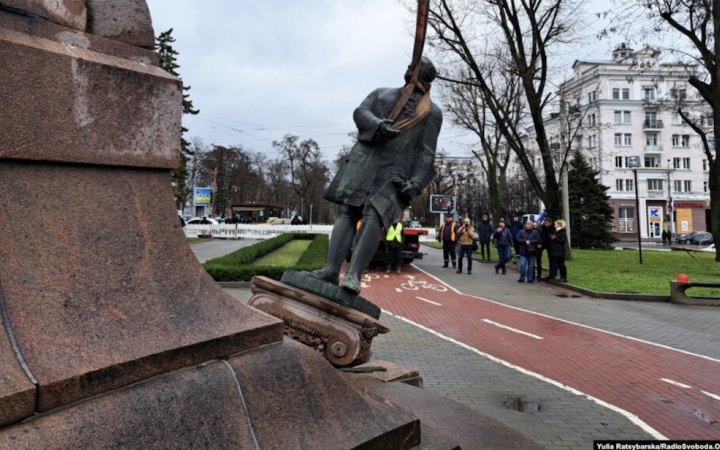
Lithuania’s Ministry of Education, Science and Sport has removed from school curricula the works of Russian Enlightenment-era figures — scientist and writer Mikhail Lomonosov and poet Gavrila Derzhavin. This was reported by LRT, citing the BNS news agency.
The changes will take effect from the current academic year in the native language and literature programme for the Russian national minority for Year 9.
“There will be neither Lomonosov nor Derzhavin left,” the ministry told BNS.
As a reminder, earlier Lithuania’s Prime Minister Mindaugas Sinkevicius called for the removal from general secondary education programmes of works by the Russian scientist and writer Mikhail Lomonosov, who, among other things, glorified the military conquests of the Russian Empire.
Sinkevicius also proposed adding works by Taras Shevchenko to the programme. In his view, this would help Lithuanian young people better understand the national identity of the Ukrainian people and the literature that shaped it.
As LRT notes, the official’s initiative received a positive assessment from Ukraine’s Ministry of Education and Science. However, Shevchenko has not yet been included in the curricula. According to the ministry, a deeper analysis of the programme is needed to make such a decision.
The ministry also added that this year it plans to pay particular attention to reviewing the authors listed in the native language and literature programme for the Russian national minority.
“It is not enough simply to strike out one surname or another and write in a new one,” the ministry said.
The institution stressed the need for a professional assessment of which authors and their literary works shape the worldview of pupils from Lithuania’s Russian national minority, and how their values are formed.
In addition, the institution emphasised that the works of new authors must be accessible to schools.
About Mikhail Lomonosov:
- a Russian encyclopaedic scholar, poet and language reformer (1711–1765), founder of Moscow University, and author of scientific discoveries in physics, chemistry and astronomy (including the discovery of Venus’s atmosphere);
- in poetry he is known for laudatory odes; some of them, including Ode on the Capture of Khotyn (1739), glorify the military conquests of the Russian Empire;
- in his work Ancient Russian History he defended the “anti-Normanist” theory of the origin of Rus’, denying the role of the Varangian Scandinavians and insisting on the ancient autochthonous origin of the Slavs; he presented the entire subsequent development of the Slavs as the history of the “Russian people”, without distinguishing Ukrainians or Belarusians as independent communities.
About Gavrila Derzhavin:
- a Russian Enlightenment-era poet who lived from 1743 to 1816;
- became known as the author of the ode Felitsa, which praises Catherine II.