





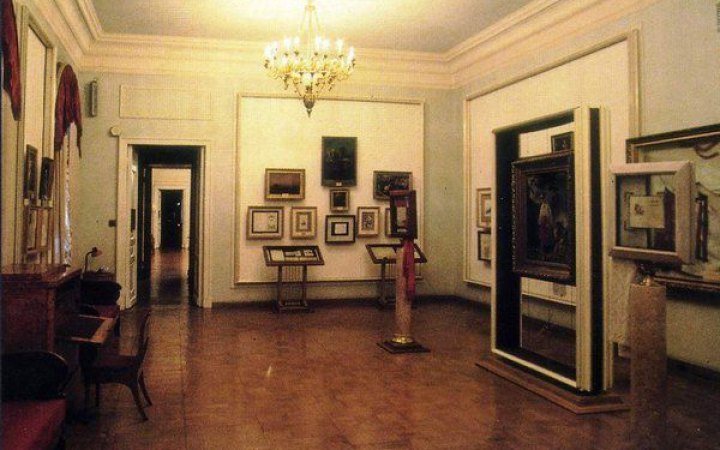
All seven employees of the exhibition department at the National Taras Shevchenko Museum have resigned after long-running problems in their dealings with management. Among the reasons they cite are communication difficulties, the devaluation of professional work, and safety concerns.
This was reported by former museum employees Mariia Shcherbak and Myron Hordiichuk, according to Suspilne.Culture.
Myron Hordiichuk, who headed the Shevchenko House-Museum in Kyiv until his mobilisation in 2022, said on social media that all seven researchers in the exhibition department had resigned.
“The entire exhibition department, seven out of seven researchers, have resigned. Bright, inspired, proactive people, involved in many delivered projects. In an instant, the institution’s potential has been drained. A little more, and the team of researchers could be lost entirely. A team is about the value of preserving and promoting the museum’s collection, not just a workplace,” he wrote.
Mariia Shcherbak, who worked at the museum for five and a half years, explained on Radio Kultura that her decision to resign was the result of long-standing problems in her dealings with management, rather than a single conflict.
“I genuinely started spending more time not on my professional potential, but on a constant struggle with management—explaining why we should do things this way or that, and, if possible, simply trying to work normally without the constant complaints about the department’s work and about me in particular,” Shcherbak said.
According to her, staff repeatedly tried to discuss work organisation, communication, safety, and attitudes towards the team. However, the former employee claims their arguments were dismissed, and management was not ready for dialogue.
Shcherbak stressed that each of the seven employees made the decision to resign independently. At the same time, colleagues discussed the situation and supported one another.
“We did not set out to leave the entire department without staff. We simply no longer saw any possibility for ourselves to continue working under the conditions created by the administration and management,” she said.
Shcherbak also separately mentioned safety issues during the intensification of Russian strikes on Kyiv. She said staff had to resolve some aspects of their own safety on their own.
“You would think that in a state cultural institution, staff safety should be one of the priorities: clear action protocols, appropriate training, proper communication, and readiness to respond to risks. Instead, we had to deal with a significant part of our own safety issues ourselves. The solutions proposed by the administration raised more questions than answers, and responsibility for actions in dangerous situations, in my view, was effectively shifted onto the staff themselves,” the former museum employee noted.
During her time at the museum, Shcherbak was involved in research work, the visual design of exhibitions, graphic design, developing exhibition solutions, and producing printed and souvenir products. After resigning, she continues to work as a graphic designer and to collaborate with civic organisations and cultural projects.
“I didn’t want the story of my resignation and that of my colleagues to remain just a staffing statistic, because behind each of these resignations are years of work and experience delivering projects,” Shcherbak explained.
In her post, Shcherbak appealed to the Ministry of Culture. She recalled that the state strategy for cultural development through to 2030 предусматривает overcoming the staffing crisis, attracting young specialists, and preserving human potential. In her view, it is also important to assess the managerial skills of leaders.
Myron Hordiichuk stressed that a team is not just employees, but the continuity of generations of museum professionals and the people responsible for preserving and promoting the collection. He urged the Ministry of Culture not to ignore the situation.
The situation was also commented on by Bohdan Tykholoz, director of the Ivan Franko Museum in Lviv.
“For every leader—or rather, for every team—it is people who are the greatest treasure, especially people who are (self-)resilient, (self-)authentic, (self-)dedicated, (self-)motivated and (self-)resourceful. I know for sure that no one in a museum is kept there by money, positions or career prospects, but by the drive (...) When young, smart, critically thinking and hardworking people leave a museum, it’s not just painful and upsetting—it’s a catastrophe,” he wrote on Facebook.
- During a Russian attack on Kyiv, on 29 September the National Taras Shevchenko Museum in the city centre was damaged.
- The National Taras Shevchenko Museum is the main literary and art museum preserving the memory of Shevchenko’s life and work.