





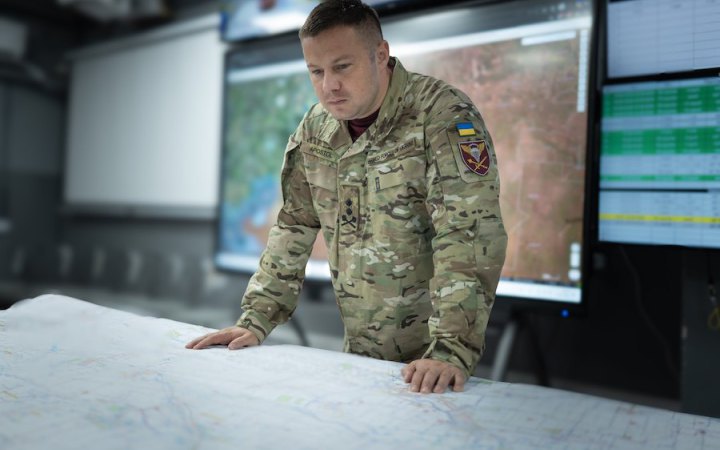
Following two offensive operations by the Defence Forces, Ukrainian troops regained control of more than 800 square kilometres of territory. However, the methodology for calculating the results of one of the operations will be revised, Air Assault Forces Commander Oleh Apostol told journalists in response to a DeepState question about the reliability of the figures.
He explained that the initial figures for one stage of the operation were higher, but were later revised. The reason was a change in the approach to accounting for areas where fighting was ongoing and enemy presence was recorded.
The Air Assault Forces commander stressed that regaining control of territory does not guarantee it can be held. To do so, defences must be prepared in advance and coordination between units ensured, with an organised handover of responsibility for the occupied lines.
Answering a question about possible risks after offensive actions end, the commander emphasised that an operation’s effectiveness is determined not only by troop advances. He said it is important that units transitioning to defence receive prepared positions, the necessary support, and clearly defined tasks. Apostol highlighted the importance of commanders’ responsibility for the situation in their sectors of the front.
The Air Assault Forces commander also explained the logic behind choosing directions for an offensive. Ukrainian forces should plan offensive operations with real prospects of achieving results in mind, rather than focusing solely on how difficult the situation is in particular sectors of the front. Where the enemy concentrates significant forces, the immediate task may be to stabilise the defence.
In response to a question about why the Ukrainian command chooses some directions for offensives while the situation remains difficult in others, Apostol explained the general principle behind planning such operations.
“You have to attack where there is an opportunity, where you can succeed,” the commander stressed.
He noted that launching an offensive against a well-prepared and numerically stronger enemy grouping may fail to deliver the required result.
In Apostol’s view, it is important to distinguish between the tasks of offensive actions and stabilising the front. In the first case, the aim is to achieve a specific military result; in the second, to contain the enemy and wear down its offensive capabilities.
The commander underlined that the effectiveness of operations is determined not only by territorial gains, but also by their impact on the overall situation at the front. He also drew attention to the effect of the Ukrainian offensive on the state of negotiations. Ukrainian counter-offensive actions refute Russian claims that further resistance is impossible and strengthen Ukraine’s arguments in its engagement with international partners.
Apostol cited the Dobropillia operation as an example, saying its results influenced US opinion.
- This year, Ukrainian defenders carried out two large-scale offensive operations. In September, the 3rd Army Corps reported on Operation “Vivaldi” in the north of Donetsk Region. As a result of the operation, control was restored over 16 settlements, and the enemy suffered heavy losses.
- “Khartiia” carried out the underground offensive operation “Veles” on the Kupiansk axis, preventing the enemy from using underground gas pipelines to advance.