





The impact of Ukraine joining the Single Euro Payments Area (SEPA) will be felt virtually from day one.
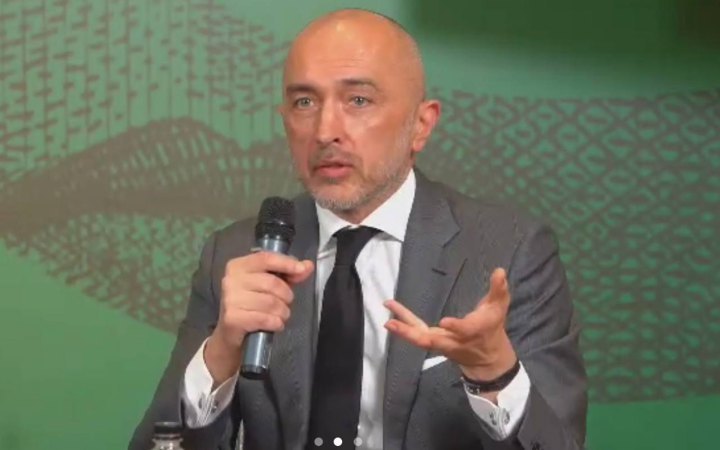
National Bank Governor Andriy Pyshnyi said this at the roundtable discussion “Follow the Money: When Will Ukrainians Get ‘Financial Visa-Free Travel’?”, an LB.ua correspondent reports.
“At the National Bank, we have been championing Ukraine’s accession to the single euro payments area for quite some time. At times, I could not understand what exactly was standing in the way,” he said.
Pyshnyi drew a parallel with visa-free travel with the EU. According to him, back then everyone saw how close the EU is to Ukraine “not only geographically, but also mentally”, and in many ways it was precisely this that fuelled European integration aspirations.
“Today we are talking about the next step — financial visa-free travel. At the National Bank, we are convinced that the benefits of Ukraine joining the single SEPA payments area will be felt virtually from day one,” the NBU Governor stressed.
According to him, estimates of the economic impact vary, ranging from tens to hundreds of millions of euros. At the same time, he said, a colleague from Moldova’s central bank (a country that has got ahead of Ukraine at the starting line on this issue) cited a figure at one meeting that struck him.
“The average basic cost of a euro transaction fell from €20 to €1.2. So we can talk about completely different, much larger figures for the economic impact,” Pyshnyi said.
He stressed that this is also about more fundamental changes.
“The shared euro payments area and SEPA rules are, first and foremost, a shared space. A shared space not only for payment solutions — it is a shared space of trust. Ukrainian business today needs access to this market. Ukrainian exporters today need a completely different level of perception,” the NBU Governor said.
According to him, joining the euro payments area delivers a synergistic economic effect even for countries that are not EU members. It is not only savings on transactions: partners in the European Union choose those with whom they are “on the same page” and within the same system.
“This is what will open the door,” Pyshnyi said.
He stressed that this is exactly what the Ukrainian economy needs today, as export channels are constrained by constant attacks on logistics infrastructure. In his view, Ukrainian business will go through that door — business that over nearly five years of full-scale war has shown not only resilience but also “absolutely unique adaptability”.
“There are no arguments today for why this bill should not be supported through to the second reading,” the NBU Governor said.
He added that it is currently “very important that the bill we receive after the final vote does not differ from the requirements our European partners expect from us. So that nothing gets in the way on the home straight,” Pyshnyi said.
According to him, the National Bank’s role is important: after the bill is adopted, the key tasks will be preparing the application itself and readying the banking system.
“The banking system did not wait. The banking system was preparing,” he stressed.
Pyshnyi noted that during the period of the full-scale invasion, the level of equivalence of the banking system with EU requirements rose from 50% to 82%. In addition, he said, Ukraine’s electronic payments system operates around the clock, and Ukraine has introduced instant payments.
“We are technologically ready,” the NBU Governor said.
He added that Ukrainian banks have already begun talks with European partners on the practical technological implementation of solutions that will allow SEPA to be launched as quickly as possible. Banks want to see themselves in a market that brings together 500 million consumers.
“I assure you, there will be no delays on the part of the banking system. SEPA means new standards, SEPA means new opportunities. SEPA means rapid savings on costs that should be working for the Ukrainian economy,” Pyshnyi said.
- By way of reminder, on 10 November the Verkhovna Rada adopted at first reading draft law No. 14327-d on bringing legislation into line with EU law and the criteria of the European Payments Council in order to join SEPA (249 votes in favour).