





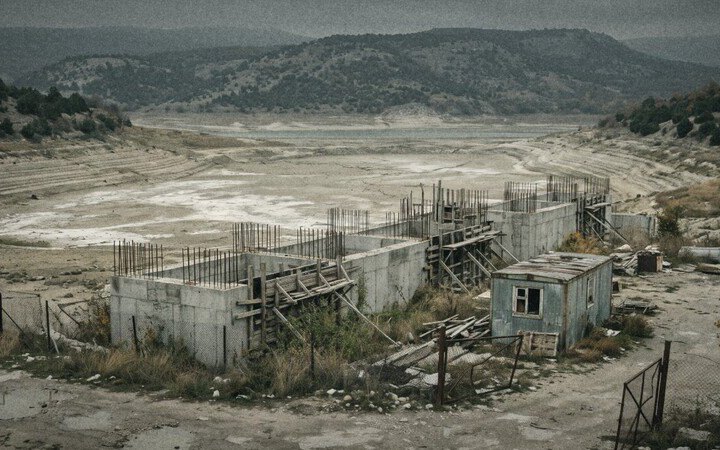
The crisis over fresh water in Russian-occupied Crimea remains a serious source of discontent among local residents, the Defence Intelligence of Ukraine (HUR) stresses.
Earlier, the invaders declared plans to implement two projects purportedly aimed at resolving the peninsula’s water crisis — particularly on the southern coast, where Yalta and Alushta are located.
Thus, the Russian occupation administration approved the construction of two large artificial mountain-type impoundments: the Soniatnohirske Reservoir (fed by the Ulu-Uzen River) and the Martivske Reservoir (the Marta River), with useful capacities of 8.6 and 6.5 million cubic metres respectively.
However, both projects have faced a major budget deficit due to cuts in funding for so-called “federal programmes”. Moscow has reduced spending on occupied Crimea. The occupation administration has already admitted it will not be able to complete and commission the reservoirs within the set deadlines.
Another important factor deepening the water crisis in Crimea is the enormous level of corruption within the Russian occupation administration: a significant portion of the budget has disappeared in an unknown direction.
As a result, over the past two years the estimated cost of the Soniatnohirske Reservoir project has increased several-fold and is now put at several tens of billions of roubles.
As of autumn 2026, implementation of the Martivske Reservoir project is also significantly delayed — for the same reasons. The reservoir’s design documentation has been “revised” repeatedly due to errors in assessing the geological stability of the slopes — there is an extremely high risk of landslides when the reservoir basin is filled. At present, in the area where the occupiers supposedly plan to create an artificial reservoir, forest stands have been cleared and initial earthworks carried out.
In effect, the Martivske and Soniatnohirske reservoir projects are currently frozen.
Construction remains unfinished on the water-supply route from the Nizhynske (village of Nizhynske, Nyzhnohirskyi District), Novohryhorivske (Nyzhnohirskyi District) and Prostorne (city of Dzhankoi) underground water intakes to the cities of Feodosia and Kerch.
Thus, as of the end of October, spending under the occupation programme “Socio-Economic Development of the Republic of Crimea and the City of Sevastopol” amounted to 88.0 billion roubles. This is 3.7% below the figures planned for 2026 (91.4 billion roubles) and 22% less than was spent last year (112.9 billion roubles).
Over 2027–2029, Moscow plans to continue cutting funding for the programme. So it appears the Russian occupiers have no intention whatsoever of resolving Crimea’s fresh-water crisis.
- In addition, the Russian occupation administration continues the large-scale and haphazard pumping of water from underground wells in Crimea. This leads to mineralisation and has a negative impact on the peninsula’s environment. At the same time, the technical infrastructure (canals, pumping stations, reservoirs and so on) is partly destroyed and in critical condition.