





What does the Democratic Party’s victory mean for the US?
In Oksana Markarova’s view, the Democrats’ victory in the so-called midterms is the result of real domestic economic problems in the United States that are not being addressed systematically. Instead, the public is being sold “easy solutions”.
However, this time, the former ambassador says, the midterms had one distinctive feature — people voted not for a party, but directly for a candidate.
“If during the previous elections everyone focused on their key audience, their core electorate, these elections showed that victory was delivered by the ‘middle’. Wins in some districts showed that people voted not for a party, but for specific individuals they knew. Especially at regional level.
They voted for commissioners (members of district councils. — Ed.), mayors, governors — that is, for people who give others hope. We trust most those who are around us — in America this is very strongly developed,” Markarova says.
She believes the next two years — ahead of the next presidential election — will be full of surprises.
“Americans expect real problems to be solved. And real problems are healthcare, education, the property market, which has become unaffordable, and many other things that worry young people.
Whoever finds, or at least shows, a path to resolving these issues will gain an advantage. I don’t think international issues will be among the key ones at the next election. The only thing Americans will demand is not to send American money and troops to places that most Americans can’t even find on a map,” the former ambassador notes.
And here, Markarova stresses, it is very important for Ukraine to show that supporting us in the war with Russia is a matter of national security for the United States itself.
Does the reshaping of the House of Representatives change anything for Ukraine?
Over the next year or two, Europe will nevertheless remain Ukraine’s main partner in providing military and other forms of assistance, Oksana Markarova is convinced.
“But this opens up new opportunities for us to build stronger bipartisan support. I emphasise bipartisan: not only with Democrats, but first and foremost with Republicans, because the overwhelming majority of Republicans also support us. So that Congress, as an expression of the people’s will, on a bipartisan basis, can return to the issue of providing assistance to us and imposing stronger sanctions,” the former ambassador notes.
She considers America’s provision of weapons and tougher sanctions to be the only formula that will force Putin into real negotiations instead of the imitation he is demonstrating now.
“It seems to me this is our main task in working with Congress, the administration, at all levels — with governors, communities, church-to-church work, university-to-university work, and especially business-to-business — so that, perhaps not very quickly, but to bring any administration in the United States to this outcome,” Oksana Markarova said.
How should Ukraine work with the Trump administration?
Separately, the former ambassador noted the need for active co-operation with Donald Trump’s administration.
“We need to show constructiveness. We cannot afford to appear — in their view — unconstructive. We need to secure additional assistance and additional sanctions against Russia from the United States. First and foremost, to sanction the entire Russian banking system. This would halt Chinese co-operation with Russia for at least a few months.
But most importantly: to secure from our European partners the confiscation of $300bn in ‘frozen assets’. And specifically within the next four months — before the changes that, God forbid, could happen in Europe (this refers to the possible coming to power in some EU countries of politicians who oppose supporting Ukraine. — Ed.). We need to ensure the necessary funding for 2027, and preferably for 2028 as well, and this can be done exclusively from this money. Because aside from taxpayers’ money — the €45bn that, I hope, we will be able to receive from European partners — these are the only funds,” Oksana Markarova noted.
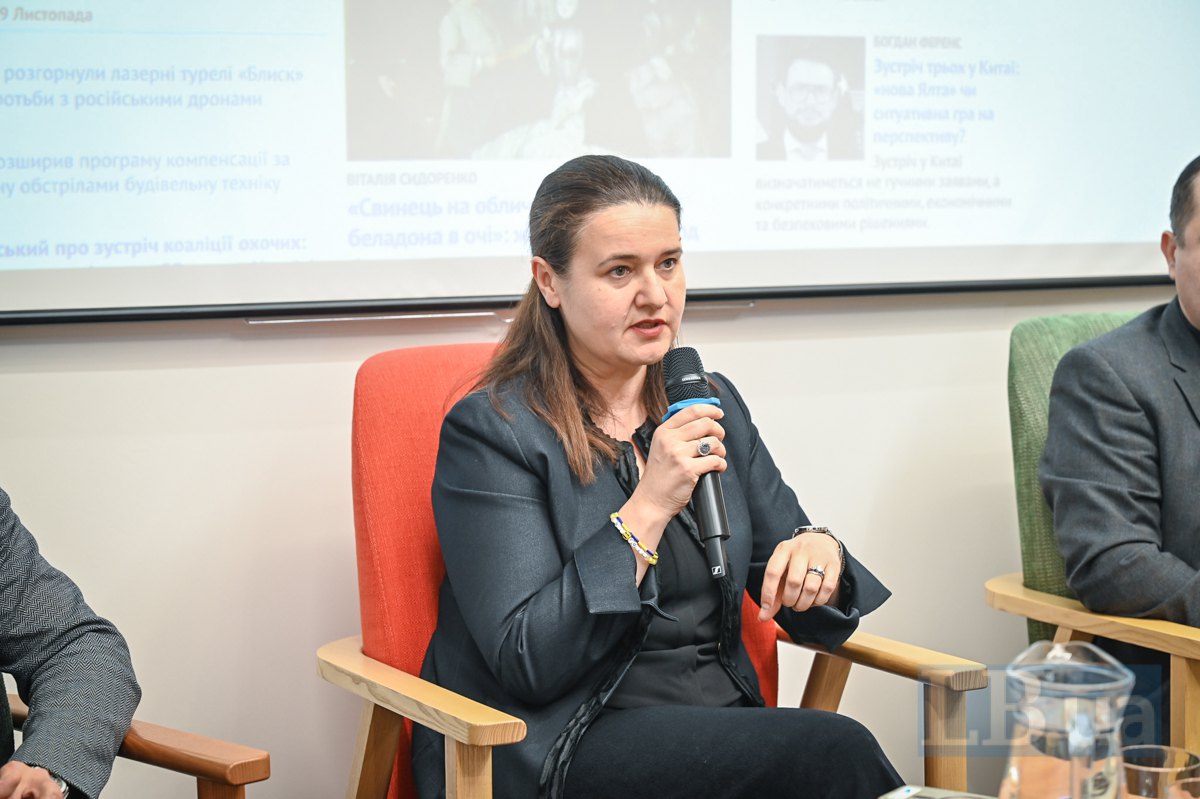
Overall, Ukraine, the diplomat believes, must build strategic co-operation with all transatlantic partners.
“That means we need both the United States and Europe — all partners,” Oksana Markarova emphasised.