





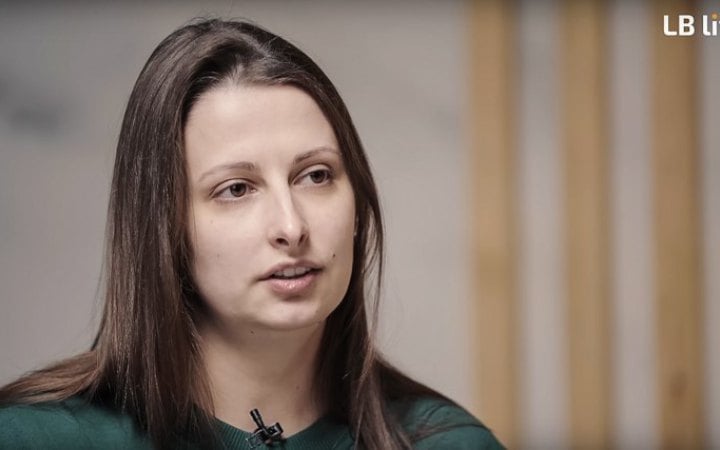
Newly appointed Deputy Minister of Defence of Ukraine Hanna Gvozdiar, responsible for the defence-industrial complex, has outlined the main areas of work in her new role. She wrote about this on Facebook.
According to her, one of the key tasks will be developing a long-term strategy for the Ukrainian defence-industrial complex. She says the Ministry has already reviewed the sector and prepared a draft strategy, which they plan to refine together with the military, manufacturers and other government bodies.
By the way, in recent days Gvozdiar has published an invitation for defence-industry representatives to receive free strategic sessions.
As a separate priority, Gvozdiar named insurance for defence-industry enterprises and their supply chains. This involves creating a mechanism that will allow production to be restored more quickly after Russian attacks.
She also listed among the priorities the development of protected underground production infrastructure.
“We have developed comprehensive amendments to Cabinet of Ministers Resolution No. 1494 to create the legal conditions for building protected underground production infrastructure. The new model should allow private developers and investors to build such facilities using their own or raised funds, and then transfer them to defence-industry enterprises for ownership, use or lease,” she said.
In addition, the Ministry of Defence plans to expand defence enterprises’ access to financing. According to Gvozdiar, the volume of concessional lending to the defence-industrial complex has already exceeded UAH 10bn. The proposals include increasing the maximum working-capital loan amount from UAH 100m to UAH 500m and launching financial leasing of up to UAH 500m.
Another area is developing the Defence City regime. At present, 51 defence companies are residents, and their combined qualifying income exceeds UAH 93bn. The Ministry is working on a new package of decisions to expand manufacturers’ opportunities.
Gvozdiar also stressed the importance of international cooperation for Ukraine’s defence-industrial complex — exports and joint production, as well as attracting financing, technology and engineering expertise. According to her, after the EU-Ukraine Defence Industry Forum (a forum on developing defence cooperation between Ukraine and the EU, held in Kyiv on 13–14 July), new opportunities opened up for Ukrainian companies in EU programmes, and support for Ukraine’s defence-industrial complex of €300m was also предусмотрено.
At the same time, she says, the unconditional priority remains meeting the needs of the Defence Forces.
“Communication between the military and the manufacturer must be fast. The Ministry must just as quickly see changes in needs, problems with equipment, breakdowns and cases of poor-quality supply — and respond. That is why, together with colleagues from other departments of the Ministry of Defence and the Defence Procurement Agency, we have developed the ‘Feedback’ project. We want to hear the serviceman as quickly as possible when a problem arises, systematically assess product quality and work with manufacturers to improve it,” she said.
Gvozdiar also paid particular attention to staffing for the defence-industrial complex. According to her, within the “Talent Arsenal” around 70 veterans received consultations, and through Defence Expo Day, 1,400 students and 600 school pupils have already familiarised themselves with Ukrainian defence developments. A course and textbook, “Smart Power”, have also been prepared for upper-secondary pupils.
Among other priorities, the deputy minister highlighted work on localising the production of weapons components in Ukraine.
“Changes to a number of resolutions are being agreed, which should simplify manufacturers’ access to municipal property and regulate certain issues related to settlement deadlines for import operations,” she noted.
Hanna Gvozdiar is a volunteer and civic activist. Since 2014, she has helped wounded fighters and the families of fallen defenders.
From July 2015 to April 2016, she was an adviser to the head of the Luhansk Military-Civil Administration.
In May 2021, she joined Serhii Prytula’s Charitable Foundation, initially as deputy director on a part-time basis. From August 2021 to September 2022, she served as the Foundation’s deputy director, and from September 2022 to September 2023 as director of Serhii Prytula’s Charitable Foundation.
She became Deputy Minister for Strategic Industries in September 2023.
Later, Gvozdiar became Deputy Minister of Defence under Denys Shmyhal. She was dismissed after Mykhailo Fedorov was appointed minister, but became his adviser.
On 8 September 2026, Hanna Gvozdiar was appointed Deputy Minister of Defence under Yevhen Khmara.