





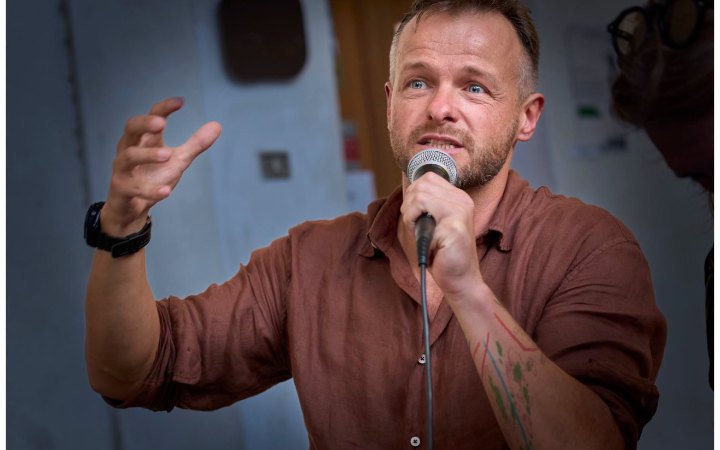
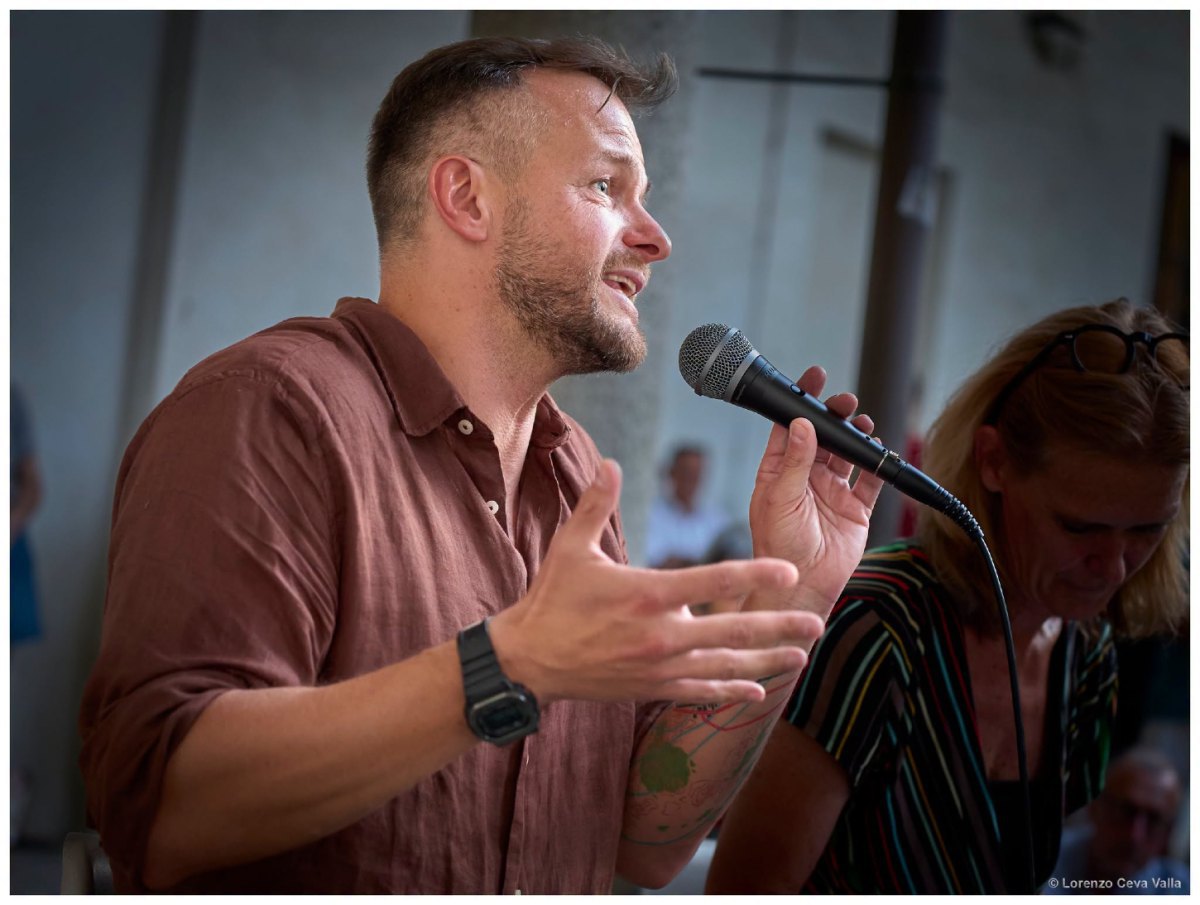
In the first half of September you toured Italy with the translation of Ordinary People Don't Carry Machine Guns. Judging by the photos and feedback, it was a success. What were your impressions of talking to Italian readers?
Someone told me that I think, speak, behave and even look like a young Italian. And of course the nicest word in that is “young”.
I think Ordinary People Don't Carry Machine Guns did so well in Italy because there are a great many people there with left-wing views who, for some reason, still confuse Russia with the Soviet Union. Even if they don’t confuse the two, they think in terms of “the enemy of my enemy is my friend” and mistakenly believe that if they oppose Europe rearming or NATO rearming, then they must also refrain from supporting Ukraine. But precisely because there are many people who think like that, there is a big internal debate, because many sensible people think differently.
And so it turns out the book became part of that debate to such an extent that its first presentation took place even before I arrived — in the Senate of the Italian Republic, with the participation of the Ukrainian ambassador and senators from different political forces. And of course, for us — for Ukraine — and for me, this book is about the fact that if you don’t want to arm yourselves, then arm Ukraine — it will be more useful both for us and for you.
I was genuinely very impressed by how well the book landed. I joke that for two weeks in Italy I felt like Zhadan. You come to an event in a classic Italian opera theatre for 350 people, tickets are completely sold out, and there are still people outside who want to get in. It’s really pleasant and shows how important books like this are for foreign audiences — books that talk about Ukraine not from an official point of view, but from the perspective of ordinary people.
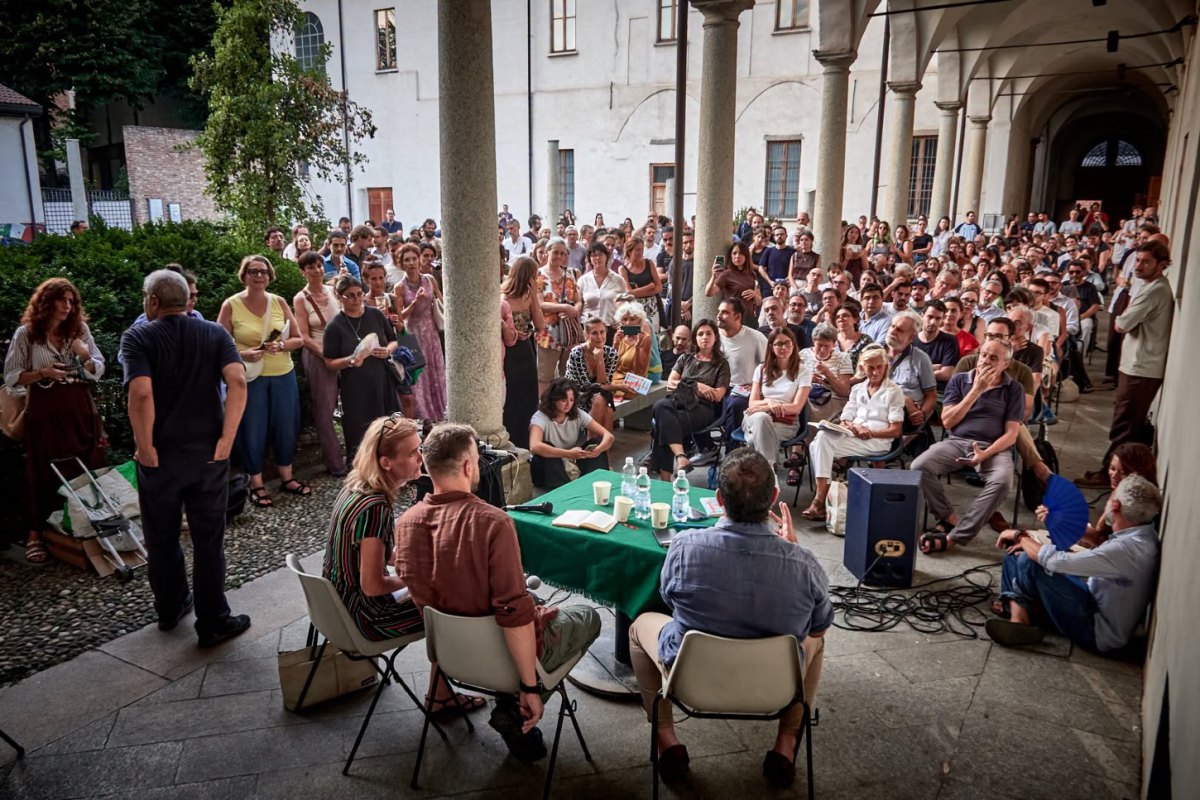
In conversations with Italians I often came across a pacifist position — the idea that the more weapons there are, the longer the war will be. Meanwhile, in discussions with Ukrainians I heard the view that we lacked a Ukrainian left-wing voice that could speak to foreigners in the same language. Have you ever been asked questions that surprised you? Or seen the book and the discussion around it change someone’s mind?
First of all, there’s no point idealising it — the people who come to events are, in the end, more or less inclined to support Ukraine; you won’t meet the proverbial Stalinists there.
And I think it’s not only a question of whether someone is left-wing or not, but rather a genuinely flawed discourse of pacifism, which boils down to: I, personally, this particular European, will never take up arms. That leads to paradoxes where they are ready to support occupied Palestine and occupied Gaza, but don’t understand that it would also be advisable to support Ukraine so that Ukraine does not become yet another occupied territory. Unfortunately, people sometimes don’t see that contradiction.
In my view, Ordinary People Don't Carry Machine Guns matters precisely because Italians themselves, without me, are sharing the book with one another. I see how some video clips and interviews I gave have gone viral in Italy, racking up hundreds of thousands of views. In one such interview I had to respond to a politician’s claim that in the event of war everyone should become deserters. I think it went viral precisely because there are people who can still change their minds. And it seems to me that, as you rightly say, they found someone who thinks in their terms.
When I talk to foreigners, I don’t go too deeply into the overall history of Ukraine and Russia; I speak more in the categories they think in — colonialism and decolonisation, the struggle against occupation. If we’re in Italy, I say: look, when in 1943 the Nazis invaded Italy, which had refused to remain on their side, you didn’t say you would fight only without weapons — you had partisans. In France, accordingly, I cite the example of the Resistance.
Do your expectations of foreign readers differ from those of Ukrainian readers overall?
Abroad there’s this thing that a sociologist friend of mine called the burden of representation. That’s when I can be very cautious, because I understand: whatever I say, however much I stress that it’s just me, it’s perceived as the position of a significant part of Ukraine.
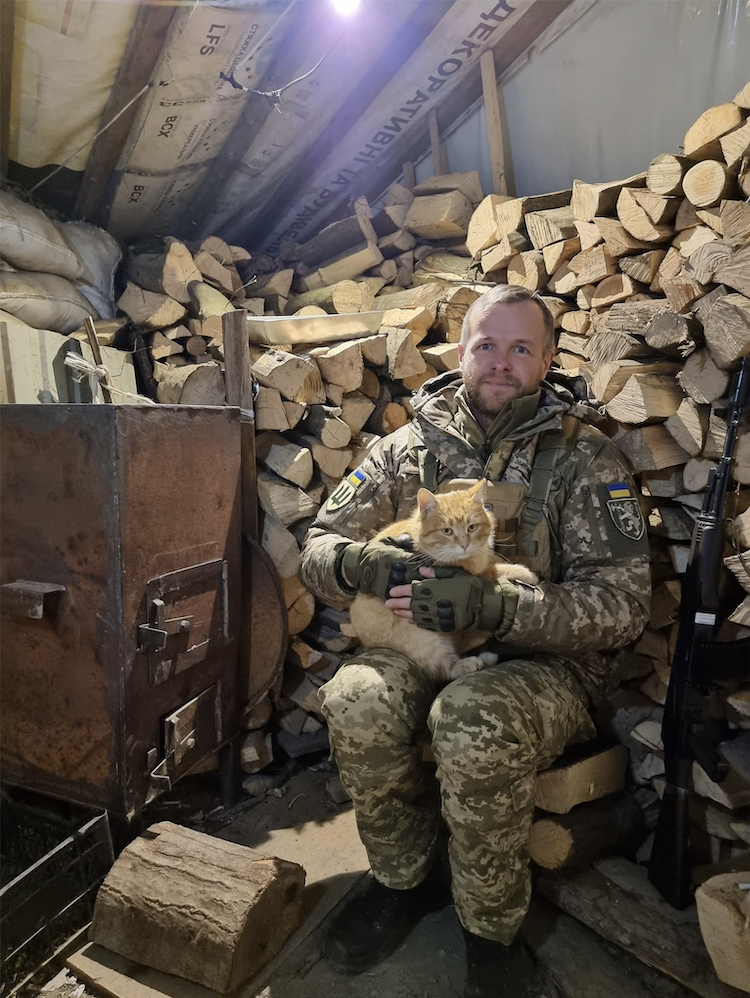
In Ukraine it’s completely different, because here, by and large, all male writers are in the Armed Forces of Ukraine. We all say the same thing, but from slightly different positions.
What topics do you have to self-censor abroad?
I don’t self-censor anything as a matter of principle. When I’m asked, for example, about problems with mobilisation, I talk about problems with mobilisation as I see them — namely, that mobilisation affects the poorest.
At the same time, I constantly stress that my opinion may differ from that of the majority of Ukraine’s population. For instance, I always say that left-wing views in Ukraine are fairly marginal, but I also emphasise to European leftists that almost all Ukrainian leftists, one way or another, are in the defence forces.
The difference is that in Ukraine we focus more on inequality in the issue of mobilisation, because it’s a topic that concerns both soldiers and those who try never to become soldiers — just from different perspectives. In Europe, they think more about how, personally, to reconcile their idealistic views with reality.
In Europe there are idealistic notions of abstract pacifism: that I will never, under any circumstances, fight with a weapon in my hands; I will fight only by peaceful means. And I have to respond that in the Second World War, unfortunately, if only peaceful methods had been used, there would still be concentration camps where Jews would be dying.
Is there still a belief abroad that the war will not cross Ukraine’s western border?
If we’re talking about Italy, it’s a specific problem of Italian idealists who have very good intentions but, unfortunately, think wrongly. I told those same Italians that in the Baltic states or Finland they already understand perfectly well that Ukraine must be supported, because they too were once under occupation — either by the Russian Empire or the Soviet Union.
Books change the debate very strongly, that’s true. But it should also be noted that policy makers are already fairly well informed. The other question is whose interests they act in. But it’s also about the views of those who will decide who to vote for.
Do you already know how many copies of the book have been sold in Italy?
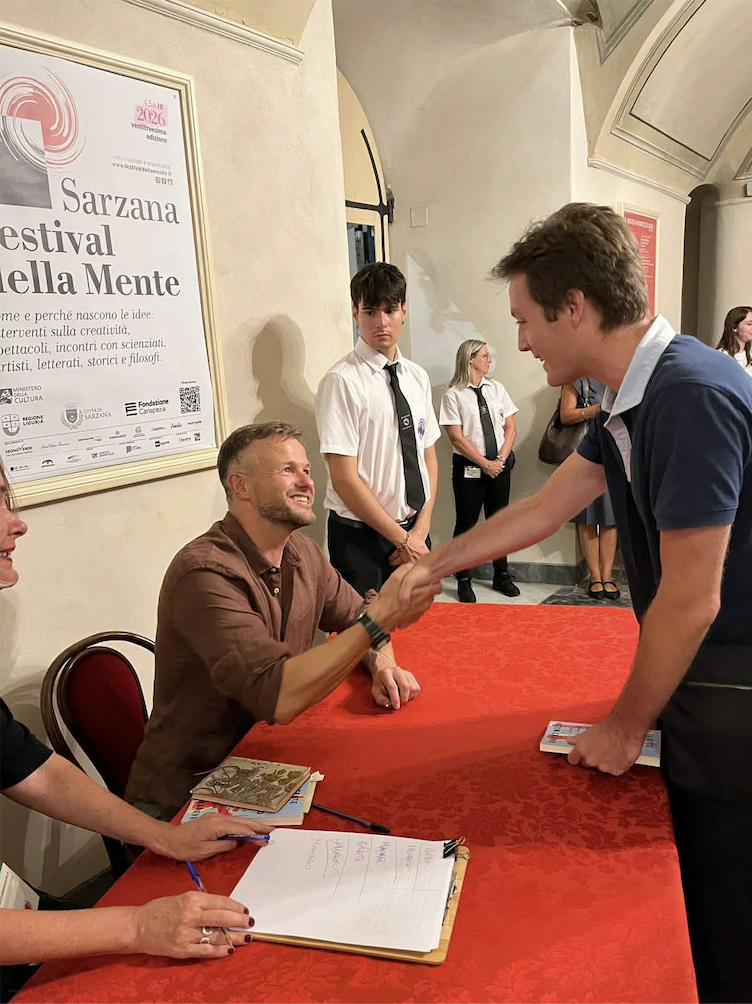
I think about five thousand. They say that’s very good for a translated documentary non-fiction book. I don’t know all the figures, but I do know that in the Netherlands — which is completely different and where practically everyone supports Ukraine — they’re already selling a fifth print run. At one point the book made the top 10 non-fiction bestsellers.
In our conversation Andriy Kurkov named you among those Ukrainian writers who have already become established in the minds of foreign audiences. What do you think contributed to that?
Perhaps the fact that I think like a young Italian too (smiles. — Ed.). In general, I think people with my views are much closer to Europe than more radical nationalists, because they, as a rule, know only their own country well and don’t see the international context. I have always consciously lived in an international context, under the influence of literature from different countries. So it’s not hard for me to refer to Sartre, Camus or Böll — I really grew up on them. And it’s not only books that have been translated for us, because I read in foreign languages.
If we’re talking about the concrete work, it started with the fact that in 2022, out of the stories by very many writers, it was my story that The New Yorker chose (in March 2022 the magazine published a translation of Chapeye’s story “The Ukraine” from his book of the same name. — Ed.), and that publication is considered the most top-tier in the world. I was noticed, and then the work began.
Because I’m in the army, that work is handled by Emma Shercliff, one of the best literary agents in the United Kingdom.
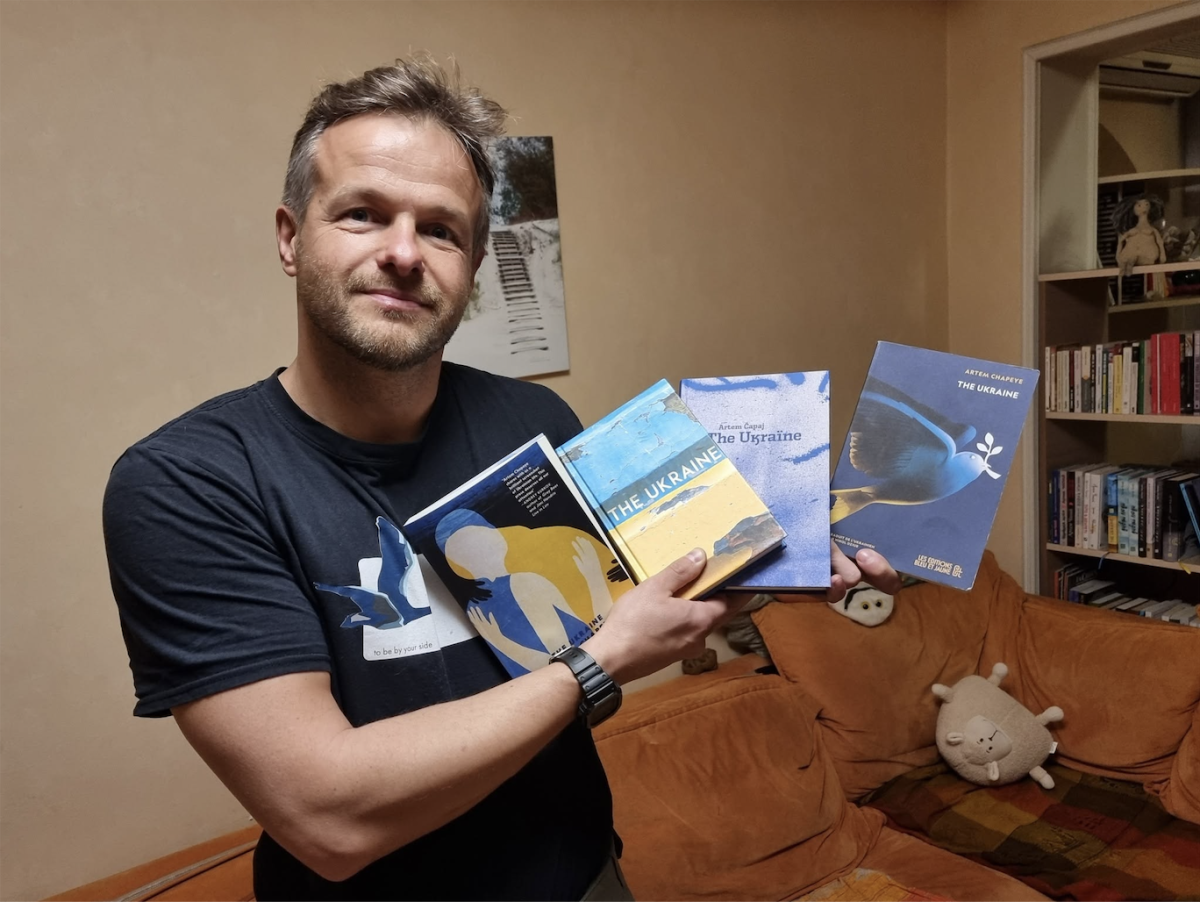
Ordinary People Don't Carry Machine Guns first came out in English translation. It made the rankings of The Washington Post. After that, different publishers, with the chance to read it in English, could decide whether to translate it into other languages.
Recently the book came out in Danish and in Taiwan. I know that in Taiwan they will see something quite different in the book than Italians do, because their question is probably not what abstract pacifism is, but what to do if they become the object of aggression from a dangerous, large neighbour.
Besides Ordinary People Don't Carry Machine Guns, three more of your books have been translated. Did that happen after or before the success of Ordinary People ...?
No, the other way round. The Ukraine was translated in 2022. As I understand it, that happened because abroad the question arose: what is Ukraine? The whole book was translated after that first publication in The New Yorker.
Now T-Happiness, my latest book, is already being translated into several languages.
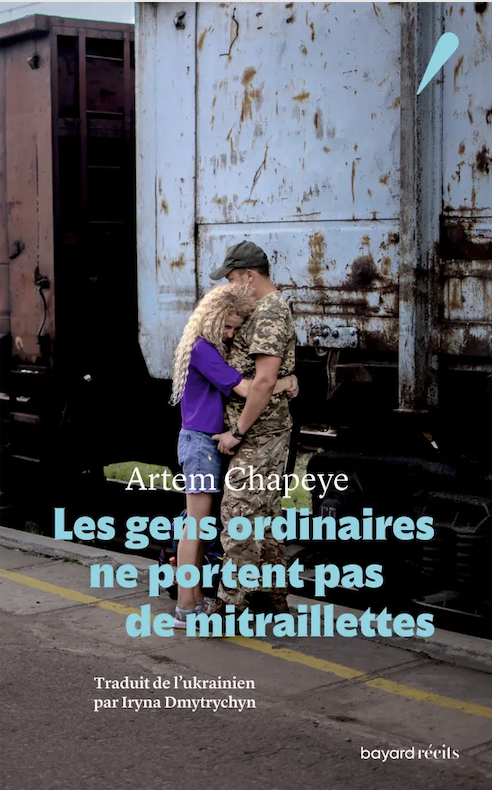
The largest number of my books have been translated into French. I think that’s because in Ordinary People Don't Carry Machine Guns I refer to French writers. And in general, there’s evidently a similar mentality. That is, I don’t fully understand why, but something in my books appeals to them.
During the process, do translators communicate with you? Do they ask many questions?
It depends a lot on the style of the particular translator; I adapt to them. It’s especially important when it comes to the title. For example, in Chinese, as in English, the book is titled Ordinary People Don't Carry Machine Guns, but in Chinese there are verbs of different strength for carrying a weapon. To be honest, I never did understand which one they ended up choosing.
In the Danish translation they kept Not Born for War, while in the Italian one nobody carries anything — there it’s Ordinary People Don’t Go Around Armed. The Ukrainian title is rooted in our context. Idioms like that are hard to translate. And I trust translators and publishers.
Stephen King once wrote: “To write is human, to edit is divine.” Writing is something human, and editing is something divine. So I’m not such a control freak who thinks it has to be only one way and no other.
You’ve already noted that, as a rule, like-minded people come to the meetings. Have you ever spoken with foreigners whose views radically diverge from yours?
In person — no. I was a bit worried it might happen in Italy. I even had the thought of taking a tourniquet with me in case someone tried to stab me, but in fact everything was very peaceful. As it was explained to me, this lack of support for Ukraine is usually lazy. It’s not so much aggressive support for Russia.
Online it happens. As a rule, it’s very easy to refute them. For example, a man came into my comments calling himself “Goths Against Fascism”, and I simply laid it out for him, following Timothy Snyder, that Ukraine’s armed forces are anti-fascists because they are fighting a fascist Russian regime. But none of this is very serious.
It seems to me these extreme views are very visible online or among people on the fringes of society — you don’t run into them. They’re uneducated people who won’t talk to you, let alone read a book or come to a book presentation. But these people are voters.
Have the messages and ideas you wanted to convey to foreign audiences changed over the course of the full-scale invasion?
At the beginning there was a certain anger. You can see it in my book, directed at those I considered my intellectual mentors and who turned out not to be worthy of that. First and foremost, it’s Noam Chomsky, whom I read and studied at school and university. And now it turns out he’s simply a narcissistic character.
But now almost none of that anger remains, because, in my view, people have more or less made up their minds and you can have a dialogue with them. What remains is a kind of regret about those who don’t understand their own limitations. And also about that stupid conflation of concepts when, for example, someone is against Ukraine because he or she is against NATO.
Otherwise I would say the messages don’t change. You just intuitively speak a little differently in Britain, America or Italy, and pay attention to different aspects.
Have you ever felt that foreigners perceive Ukrainian soldiers with apprehension?
I have the sense they’re not afraid; on the contrary, they’re interested. At meetings I see how people are glad to see not an imagined Nazi or someone with PTSD, but a person who honestly tells what happened to them — who cried when they lost friends or when they couldn’t be with their children. They see that humanity.
They see there’s no militarism, no intense anger or hatred. Just the same kind of person as them, who ended up in a different situation and had to make a choice.
Let’s talk a little about our interaction with international cultural events and institutions. This summer in Ukraine there was heated discussion about changes to the name and funding of the Booker Prize, which now also bears the name of Bukhman, a businessman of Russian origin. What is your attitude to this as a Ukrainian author?
Lately my position has been that we mustn’t give up any platforms, because at any big festival there will be “good Russians” or Belarusians.
As for the Booker–Bukhman situation, at first it made me angry. Now it’s obviously irritating, but more than anything I’d like it to be some hypothetical Roshen Booker Prize — but there isn’t one. On the other hand, if we imagine a hypothetical Pinchuk Booker Prize, there would also be many questions about such a prize. At the same time, I’ve accepted that we can’t avoid witch-hunt pile-ons in Ukraine. Although I still haven’t been caught up in them.
Another debate unfolded this summer when it emerged that the curator of an exhibition at Lviv’s Jam Factory was a man who did not return to Ukraine after leaving with permission and an obligation to come back. In your view, is such cooperation on the part of Ukrainian institutions appropriate? And can Ukraine, for example, be represented by artists who left the country illegally?
I’ll speak for myself. Once I was choosing which rave to go to at the weekend, and I didn’t go to the one whose organiser had fled abroad. Because it would simply have been unpleasant for me to be there.
But again, giving up platforms because of things like that — because someone somewhere is “dirty” and compromised — seems to me like a very big self-limitation. In that case, almost everything becomes impossible.
It seems to me what matters is what you yourself do and what your personal position is. Unfortunately, it’s impossible to avoid all the people you find unpleasant for moral or personal reasons.
And if we’re talking about funding — say, state support or a grant?
I don’t think in those terms, because I don’t give money to anyone and I don’t take money from anyone. But simply refusing, say, to take part in a festival because one of the organisers is “untouchable” seems to me a bit too much.
You are currently working on a film script together with director Maksym Nakonechnyy. Can you already say what the film will be about?
I can say that we’ve been writing the script for a long time, with long breaks. I hope I’ve rewritten it for the last time now. I don’t know whether I’ll work with someone in that format again, but working with Maksym is really great. He’s a very talented person, and very tolerant of other people’s weaknesses.
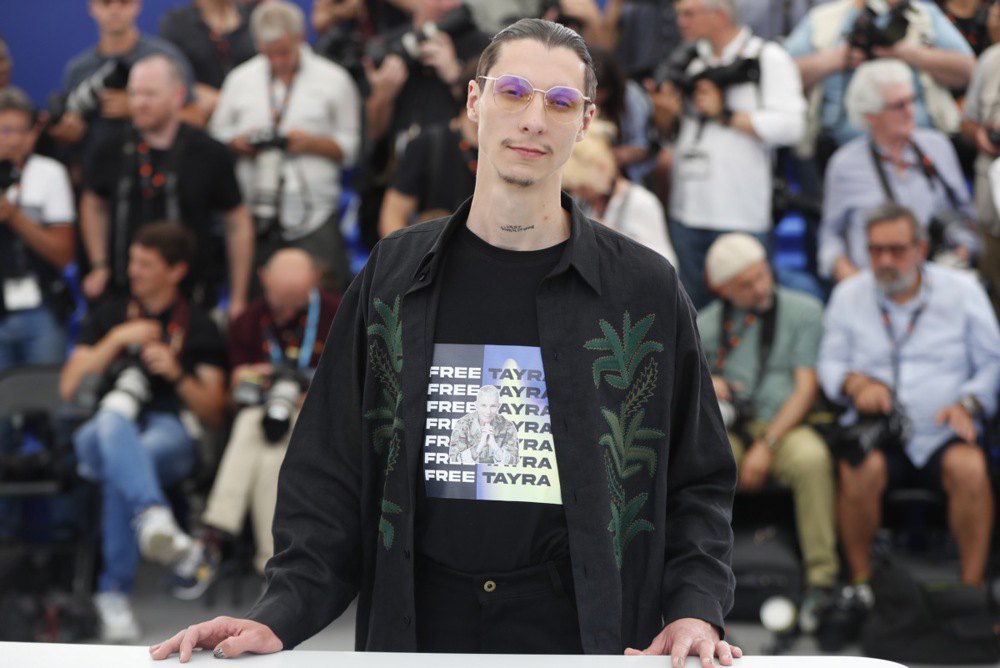
We didn’t know each other before this collaboration. Maksym once said he’d read my book Strange People and said that if anyone could write this script, it would be the author of that book.
And besides that, is there time left for new texts?
Unfortunately, I don’t know how not to miss the deadlines I’ve already agreed to, because there’s a huge amount of work in service. Since finishing T-Happiness, I haven’t started anything. But I really want to get back to writing.