





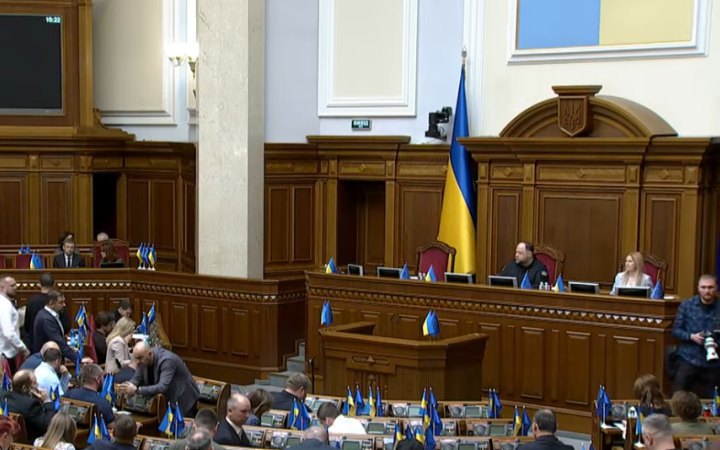
Ukraine’s Verkhovna Rada has adopted as a basis draft law No. 15400, which provides for the targeted allocation of fees for processing and issuing documents in the field of state export control to the needs of the Armed Forces of Ukraine. This was reported by the Ministry of Defence.
The ministry noted that if the bill is adopted in full, 100% of the fees for processing and issuing documents in the field of state export control for military and dual-use goods will be credited to the special fund of the state budget and allocated to the Ministry of Defence. In particular, this concerns additional funds for defence procurement and service members’ pay.
The initiative предусматривает introducing the relevant amendments to the Budget Code of Ukraine. According to the bill, revenues from fees for processing documents in the field of defence exports will be split equally.
50% – for the purchase, modernisation and repair of weapons and military equipment;
50% – for the payment of service members’ pay in the Armed Forces of Ukraine.
The Ministry of Defence said the bill is a continuation of Cabinet of Ministers of Ukraine Resolution No. 875 of 1 July 2026, which introduced a mechanism for controlled exports of Ukrainian weapons and defence technologies with the unconditional priority of meeting the needs of Ukraine’s Defence Forces. The resolution provides for a fee for processing export permits amounting to 20% of the value of finished products and 30% of the value of components.
However, the process has still not been launched as of today. Arms manufacturers are still waiting for the Ministry of Defence to provide a list of critical items that cannot be sold abroad, and manufacturers still do not understand how the Drone Deal procedure, which was supposed to set the framework for which countries weapons can be sold to, will work.
In particular, the executive director of the Ukrainian Council of Arms Manufacturers, Ihor Fedirko, claims that as of August 2026, since the resolution was adopted, the private defence sector has concluded only up to ten small export contracts. In addition, he says only one joint venture of a Ukrainian manufacturer abroad is actually operating. At the same time, under the mechanism provided for by Resolution No. 875, not a single permit had been issued as of August.
The Council of Arms Manufacturers also believes that the provisions on the export permit fee require revision, including its advance payment even before the contract is fulfilled, as well as conditions that create barriers to trial shipments. According to the organisation, the permit fee may amount to 20–30%.
The executive director of Technological Forces of Ukraine, an association of private defence technology manufacturers, Anastasiia Mishkina, also stressed in an interview with LB.ua that the rate for Ukrainian arms exporters is too high.
Read also“Arms export rates should be zero.” TSU executive director on a non-functioning fast track and expectations from the Ministry of Defence
“20–30% of the export contract value is too much and economically unjustified, in our view. TSU expressed by an overwhelming majority that the rate should be zero. The decision on the so-called fast track was meant to make exports administratively easier, but these rates make them economically unprofitable. Because the price on the global market is set not by the manufacturer but by the market and competition. And this additional fee eats up all the earnings, and the contract is highly likely to go to another manufacturer. In other words, through our own regulations we give competitors abroad a price advantage,” she said.
Mishkina added that the association proposes setting an initial zero rate, and before introducing any other rate, first calculating possible scenarios.
As a reminder, on 15 September the Rada did not support draft law No. 15400 on channelling arms export fees to the needs of the Defence Forces.