





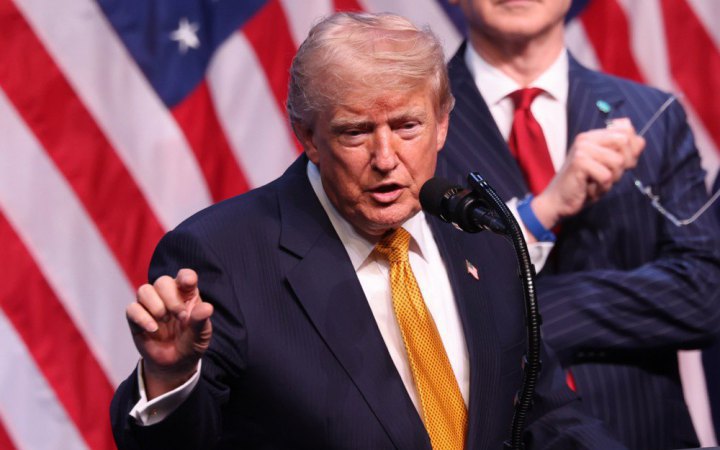
US President Donald Trump believes it is easier to reach an agreement with Vladimir Putin than with Ukrainian President Volodymyr Zelenskyy. In an interview with Newsmax, he said he is not a “big fan” of Zelenskyy and criticised him for the decision to resume strikes on Russian oil refineries in response to the occupiers’ failure to observe the energy ceasefire.
The US President is convinced that Ukrainian strikes on refineries in Russia are driving up global energy prices. Previously, energy experts and reputable media outlets have repeatedly noted that the rise in the cost of diesel and other fuels began as a result of Iranian strikes on oil plants in the Persian Gulf countries this year, rather than after Ukrainian attacks on refineries in Russia, which began two years ago.
“Zelenskyy is not a good guy for us to make deals with. He doesn’t want to make a deal. He says he wants to make a deal, but that’s not true. No, I’m not a big fan of Zelenskyy,” Trump said.
He added that Ukraine could instead strike other targets in Russia.
“But when you hit diesel plants where they make, you know, diesel that we and the whole world need, you’re not doing the world a favour,” he added.
Trump believes the war “needs to end soon”, but that it will be easier to reach an agreement on this with Putin. He also once again spoke about the need to hold elections in Ukraine.
“I think you need elections, because nobody told me that Ukrainians are happy about missile strikes on their homes,” Trump said, without explaining the link between Russian attacks and elections.
Context
In early October, relations between Kyiv and Washington escalated again. Although, according to The Wall Street Journal, Trump began putting pressure on Ukraine as far back as his meeting with Zelenskyy in September.
Talks between the Ukrainian team and Steve Witkoff and Jared Kushner were scheduled for 9–10 October. However, the negotiations lasted only one day. During the teams’ talks, Trump suddenly announced an agreement with Russia regarding diesel.
After that, Trump returned to commenting on Ukraine’s domestic politics and said Ukraine needs to hold elections for a new president. All of this was happening against the backdrop of the approaching US midterm elections and the continuing global energy market crisis that began after Iran’s strikes on refineries in the Persian Gulf countries.
On 12 and 13 October, partners did not notify Ukraine about the launch of ballistic missiles. The missiles were detected only on their approach to the city, although during the dawn attack on 14 October there was already a warning. At the same time, on 14 October the Ukrainian military received speed restrictions on the Starlink satellite communications system. It is relied upon both for carrying out strikes on the occupiers and for the ability to shoot down drones.
After a large-scale Russian attack on the energy sector, Volodymyr Zelenskyy announced on 15 October that Ukraine would now resume strikes on refineries.
Russia, commenting on its own breach of the ceasefire, said that Trump had not specified what exactly it was supposed to cover. During this “ceasefire”, it attacked electrical and gas infrastructure.