





Who Is Rodion Miroshnik?
Some 20 years ago, when Viktor Yanukovych was still Prime Minister of Ukraine, he had a press secretary — Rodion Miroshnik. Later, Miroshnik became a deputy of the Luhansk Regional Council from the Party of Regions and head of the Luhansk Regional State Television and Radio Company. Miroshnik “loved Ukraine” so much that in 2012, during a discussion of the Language Law at a regional council session, he declared: “children who study in Ukrainian are ‘subhuman’.”
After Russia occupied Ukraine’s Crimea and unleashed war in Donbas, Miroshnik quickly switched sides to the occupiers, organised so-called elections in the terrorist “LPR”, and even became the “official representative” of this quasi-entity in the “Contact Group on the peaceful settlement in eastern Ukraine” talks. He served as an adviser on “external relations” to one of the “LPR” ringleaders, Leonid Pasechnik.
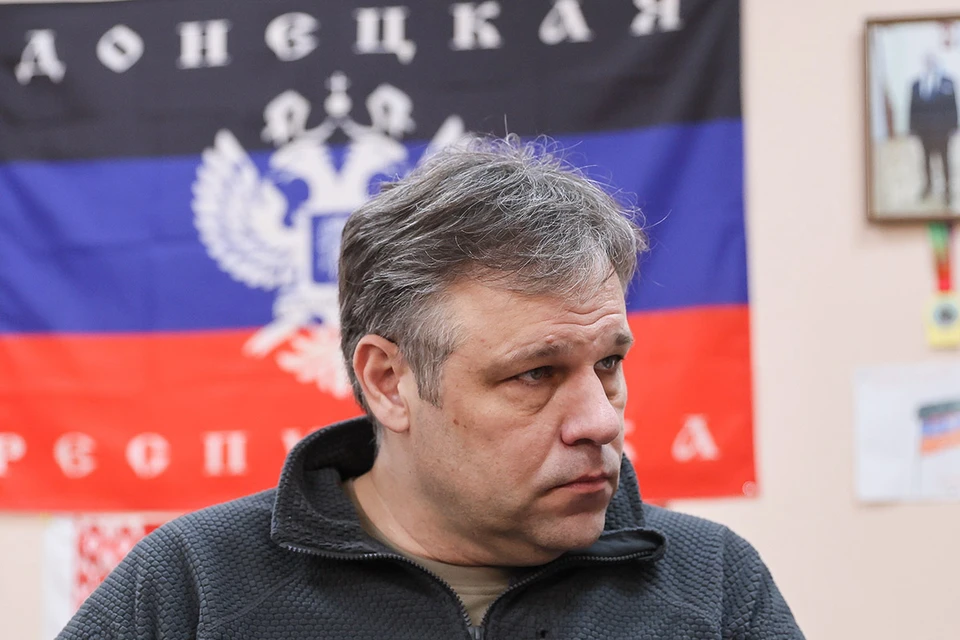
After Russia’s full-scale invasion of Ukraine, Rodion Miroshnik was appointed “ambassador” of the terrorist “LPR” to the Russian Federation.
Then, in Russia itself, in August 2023, he received the status of “ambassador-at-large of the Russian Foreign Ministry on the ‘crimes’ of the ‘Kyiv regime’.” In this role he became a regular on Vladimir Solovyov’s talk show and other Russian media scum.
For such actions, nine years ago the Luhansk Regional Prosecutor’s Office put the “DPR ambassador” on a wanted list. He is charged under Article 109 of the Criminal Code of Ukraine (aiding the overthrow of the constitutional order and seizure of state power), Article 110 (changing borders, territory and the state border) and Article 258-3 (participation in the activities of a terrorist organisation). The penalty is up to life imprisonment.
In January 2023, Rodion Miroshnik was added to Ukraine’s sanctions list. In June 2024, the European Union imposed personal sanctions against him.
What Did Ukraine’s Defence Intelligence Know in Advance About the Russians’ Information Special Operation?
“The aggressor state Russia has prepared and is carrying out another information operation in order to conceal the war crimes it has committed, as well as to discredit the Defence Forces of Ukraine, to weaken support for our state from foreign partners…
The Russians have identified the target audience of the ‘telebridge’ as the diplomatic corps of UN, OSCE, BRICS and CIS countries, as well as representatives of international humanitarian organisations,” Ukrainian intelligence officers reported a few days before the “telebridge”.
Among the participants announced for the event were propagandists from Russia Today, representatives of Russian embassies, as well as “Russian Houses” and branches of Rossotrudnichestvo in Zambia, Kuwait, Uzbekistan, Nigeria, Bulgaria, Venezuela, Mongolia, Malaysia and Armenia.
“The pretext for the Kremlin’s information operation was the need to distract attention from Russia’s war crimes, in particular from the catastrophic humanitarian situation in Oleshky, Kherson region, caused by the Russian occupiers.
Another reason is the strengthening of support for Ukraine from European partners, including the EU Council’s approval of a €90 billion loan and the creation of an EU–Ukraine alliance in the UAV sphere,” Ukrainian intelligence officers informed Ukrainians and our partners abroad about the enemy’s plans.
How Did the ‘Telebridge’ Itself Take Place?
As evidenced by the photo report posted on the Telegram channel of Miroshnik himself — the Russian Foreign Ministry’s “ambassador-at-large” — the “telebridge” looked like an extremely dull spectacle. Even the announced gauleiter of the occupied part of Zaporizhzhia region, Ukraine’s traitor and Party of Regions figure Yevhen Balytskyi, did not show up for the Zoom event.
Instead, those “present” included the occupation-appointed director of the Zaporizhzhia Nuclear Power Plant, Yurii Chernychuk; the acting “minister of energy” of the occupation administration of Zaporizhzhia region, Yevhen Paramonov; Russia’s permanent representative to international organisations in Vienna, Mikhail Ulyanov; the head of the occupation administration of Enerhodar, Maksym Pukhov; military experts; and staged “direct witnesses, participants and ‘victims’ of ‘armed attacks’,” as Miroshnik wrote on his Telegram channel.
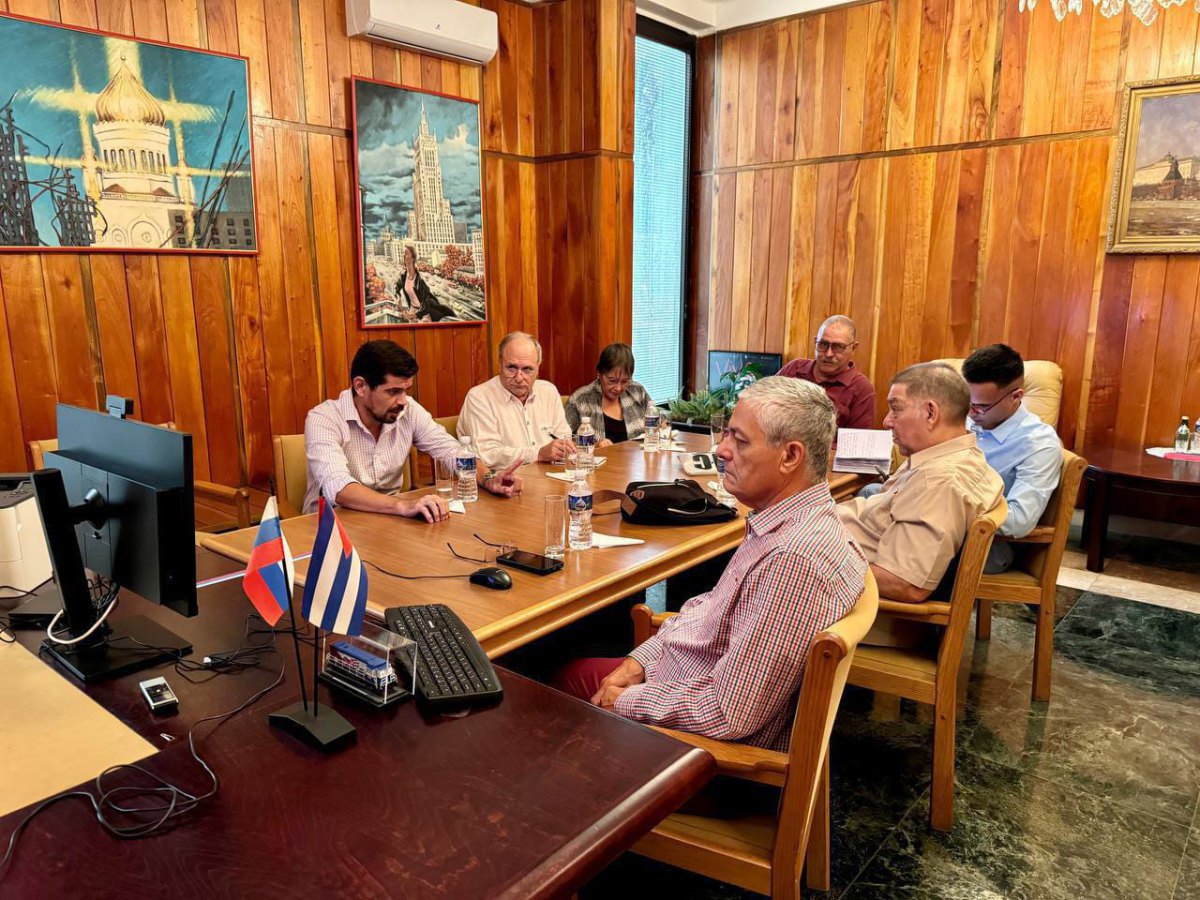
The footage also shows groups of people sitting in Rossotrudnichestvo premises (de facto branches of Russian special services) in several foreign countries — FSB faces and portraits of Putin on office walls.
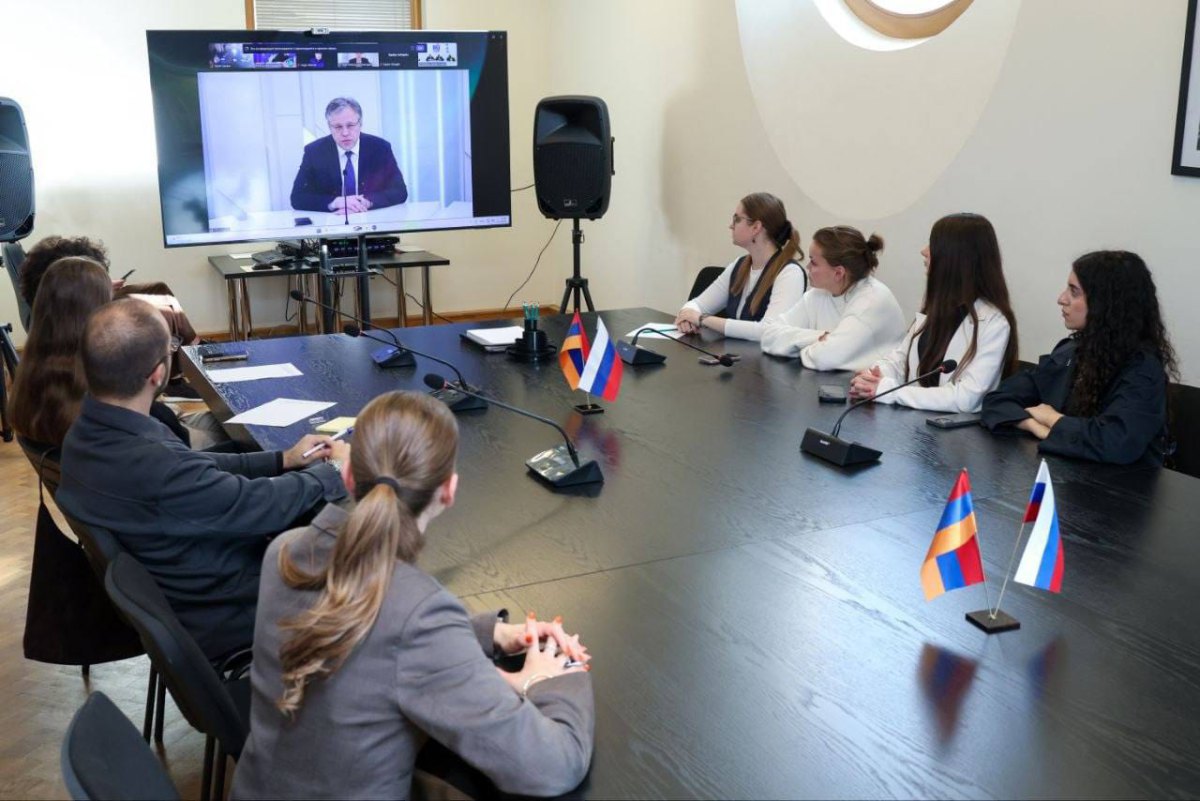
It is hardly surprising that such a pseudo-event failed to spark much interest not only from Balytskyi, the gauleiter of the temporarily occupied part of Zaporizhzhia, but also from the Russian media themselves. There were only a few terse reports. Any “global resonance” from what was seen or heard is out of the question.
How Did Sergey Lavrov’s Ministry Respond?
Nevertheless, Russia’s Foreign Ministry tried to lend this unconvincing Zoom show as much pomp and weight as possible.
“Participants in the discussion emphasised that the long-term financing, arming and training of the Armed Forces of Ukraine by NATO states and the European Union effectively confirms the West’s complicity in the crimes of the Kyiv regime. Responsibility for civilian casualties in the Russian Federation, acts of terrorism and war crimes must be placed not only on the direct executors of criminal orders, but also on Kyiv’s political leadership and Western sponsors, who are increasingly being drawn into criminal projects,” the Russian Foreign Ministry wrote in an information note about the “telebridge” on its official website.
Notably, there is no information whatsoever on the number of “victims of the Kyiv regime” on the Telegram channel of “telebridge” participant Miroshnik. By contrast, such information is laid out at length on the Russian Foreign Ministry website: “since February 2022, at least 2,715 people have been affected by strikes, including 137 children; 508 civilians have been killed, including 23 children,” Russian propagandists “inform” readers about alleged civilian losses in the part of Zaporizhzhia region temporarily occupied by Russia. Of course, there is no documentary confirmation of these figures. It is also unknown whose weapons supposedly killed the civilians mentioned.
Ukrainian Oleshky — the Epicentre of a Humanitarian Catastrophe Caused by the Russian Occupiers
One of the main pretexts for the Kremlin’s information operation, according to DIU, was the need to distract the entire world’s attention from Moscow’s war crimes in the Ukrainian town of Oleshky in Kherson region. There, as a result of the actions of the Russian occupiers, a genuine humanitarian catastrophe has been unfolding for several months. Two thousand civilians, including around 50 underage children, have been left trapped without sufficient food, drinking water, medicines, or stable access to medical care. Only a handful of medics remain at the local hospital, while access to the community by humanitarian organisations, volunteers and evacuation teams has been blocked by Russian troops since May.
Read also“We’ll survive, of course… or maybe not.” What Is Happening in Occupied Oleshky
A month ago, the Council of Europe Commissioner for Human Rights, Michael O’Flaherty, said that the civilian population of the occupied Oleshky community is simply at risk of death.
“I call for an immediate local ceasefire, unhindered access for humanitarian organisations and the safe evacuation of civilians. The unspeakable hardship and suffering of people who have found themselves in occupied territories require international attention and action,” the Council of Europe commissioner said.
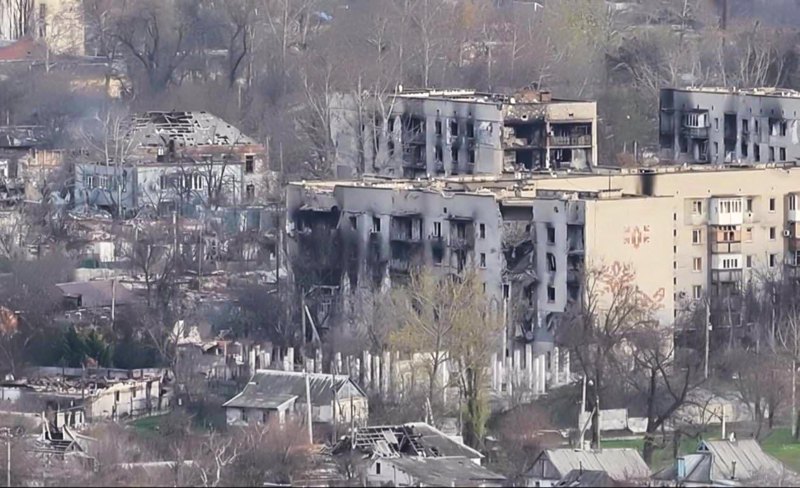
On 16 October, Pope Leo XIV spoke with Putin about the situation in the part of Kherson region occupied by Russia. He called for an end to the humanitarian catastrophe, the unblocking of civilians, and the opening of logistics and evacuation corridors to the Oleshky community.
As the Vatican reported at the time following the conversation with Putin, the Pope “expressed deep concern about the difficult humanitarian situation in the city of Oleshky in Kherson region and called for a ceasefire to enable the delivery of food and medical assistance, as well as the voluntary and safe evacuation of the civilian population”.
The Kremlin responded that it “supports the Vatican’s intention to help create the conditions necessary to guarantee the safety of the city’s population and to organise the delivery of vital supplies”.
However, the Russians still have not unblocked Oleshky. The humanitarian situation in the city and community has only worsened. The Russians continue to engage openly in genocide.
That is why this “Miroshnik telebridge” was needed at short notice — to demonstrate to the “whole world” the “crimes of the Kyiv regime”.
‘Evidence’ for an International Tribunal in The Hague
On 15 and 16 October this year, in Amsterdam and The Hague — the capital of global justice — the documentary film “Evidence” by Ukrainian director Veronika Marchenko was presented. The film was created in cooperation with the Kharkiv Regional Prosecutor’s Office with the support of the GIDNA project (Future for Ukraine Charitable Foundation) and the international non-governmental human rights organisation Project Expedite Justice.
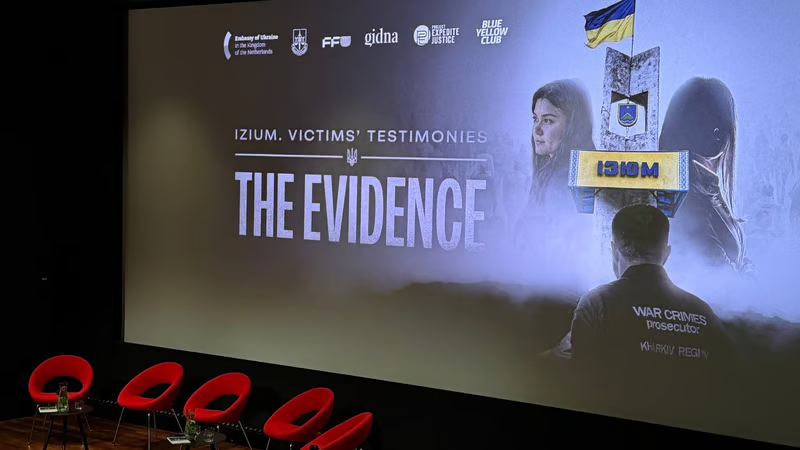
The film came as a real shock to European audiences, because it was made on the basis of real videos, photos, documentary testimony and exclusive materials from the official Ukrainian investigation into Russian crimes in another occupied Ukrainian territory — Kharkiv region — during its seizure by the Russian army in 2022.
Sexual violence, atrocities, torture of civilians, the shooting of peaceful residents of Izium and other towns and villages in the Slobozhanshchyna region — documentary proof of all these crimes formed the basis of the film “Evidence”. These things, “everyday” for Ukrainians living under Russian occupation, were a genuine shock for average Europeans during the premiere screening at the Filmhuis Den Haag cinema in The Hague.
It is clear that the documentary “Evidence”, like the results of the work of Kharkiv prosecutors, constitutes a huge body of evidence for future trials of war criminals holding Russian passports. Punishment for every war crime must be inevitable — from the perpetrators on the ground in temporarily occupied Ukrainian territory to the masterminds in high Moscow offices.
As the film’s creators said at the premiere screenings in The Hague and Amsterdam, Russian crimes must be investigated by a Special War Tribunal. And under international law, these atrocities have no statute of limitations.
P.S. There is no doubt that this latest international “telebridge” by Russian information propagandists was organised and carried out solely to shift attention and “dilute” the world’s response to Russian crimes — the response to past crimes by the Russian army in what was once occupied Kharkiv region, and the response to the current crimes of the Muscovites in still-occupied Kherson region.
The Kremlin’s information clowns worked far too hastily — and badly. It is telling that Miroshnik’s “telebridge” was watched mostly in Rossotrudnichestvo “Russian Houses”, which for a long time have de facto been a network of Russian special services; as a result, their branches have been declared illegal in more than ten European countries. And the process of officially “closing” these “Russian Houses” in Europe has only just begun.
By contrast, Ukrainians’ task today is to document every war crime committed by the enemy carefully, effectively and daily, so that during a future Tribunal the accused Russian criminals have no chance of acquittal or even of having their lawful sentences reduced. Europeans’ reaction to the premiere of the Ukrainian film “Evidence” in The Hague shows that Europe knows and clearly understands which side Good and Truth are on in this terrible existential war for our survival — and for the survival of all Europe…