





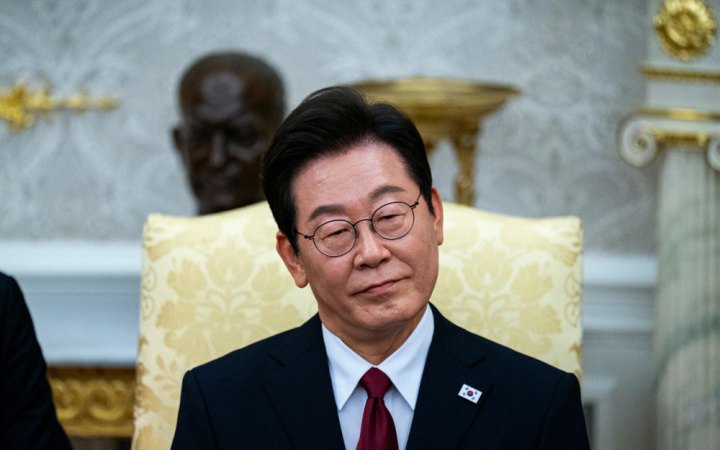
South Korea’s European allies have begun to doubt Seoul’s reliability as a partner because of the gradual restoration of political and economic contacts with Russia. Concerns are heightened by Moscow’s military co-operation with North Korea and the continuation of the war against Ukraine.
Financial Times reports this.
One signal of closer ties with Moscow was the voyage of the container ship PanStar Acro along the Northern Sea Route off Russia’s Arctic coast. After the voyage, South Korean President Lee Jae Myung congratulated the ship’s crew and said he intended to “respond with unwavering action and open a new path for the Republic of Korea”.
This route makes it possible to cut the journey to Europe via the Suez Canal by 10 days, but it requires extensive co-operation with Russia. European diplomats in Seoul viewed the voyage as a diplomatic and commercial step towards Moscow.
Further concern was prompted by information that more than 176,000 tonnes of fuel, mainly diesel, were supplied from South Korea to Russia in July and August. According to the newspaper, it was carried by tankers that are under UK and EU sanctions.
One European diplomat in Seoul said South Korea wants to restore business relations with Russia after the war in Ukraine ends.
“South Korea is not really like-minded. The bet is that the war in Ukraine will not last for ever, and they want to return to doing business with Russia as soon as it ends,” the diplomat said.
At the same time, Financial Times notes that concerns about South Korea’s compliance with sanctions and export controls arose even before Lee Jae Myung’s presidency. In particular, this concerned computer numerical control machine tools, which can be used to manufacture munitions.
In February 2025, two South Korean executives were convicted of illegally exporting such machine tools to Russia. They received one-year suspended prison sentences, and the company was fined $30,000.
Under Lee’s presidency, the concerns have intensified. In November 2025, South Korea’s Institute for National Security Strategy held a closed conference with the Russian International Affairs Council. According to information on the Russian organisation’s website, participants discussed opportunities for political dialogue and expanding economic co-operation. In June, the institute’s president, Kim Sung Bae, also visited Moscow for closed strategic talks with Russian counterparts.
Another factor was the president’s кадрова policy. Lee appointed former Democratic Party leader Song Young Gil as a special adviser on peace diplomacy. Song, who previously served as the president’s envoy to Russia, advocates closer ties with Moscow. In 2013, Vladimir Putin awarded him Russia’s Order of Friendship.
Mason Richey, a professor of international politics at Hankuk University of Foreign Studies in Seoul, noted that administration figures who favour a different approach to security may be losing influence with the president, while Song has access to him.
Russia’s Deputy Foreign Minister Andrei Rudenko said this month that Moscow had received signals from the South Korean authorities of a desire to normalise relations after the war in Ukraine ends.
At the same time, South Korea’s Foreign Ministry, in a response to Financial Times, denied that the country is moving excessively closer to Russia.
“Concerns in some quarters that South Korea is leaning too far towards Russia do not match the facts,” the ministry said.
It also stressed that, as a responsible member of the international community, South Korea supports global efforts aimed at ending the war in Ukraine and restoring peace.
Against this backdrop, relations between Seoul and Kyiv have also deteriorated. After a dispute over the disclosure of information about the transfer of two North Korean prisoners of war to South Korea, Lee Jae Myung accused Ukraine of breaching a confidentiality agreement and demanded an apology. The South Korean government recalled its ambassador and part of its diplomatic staff from Ukraine.
Kim Saeme, a researcher at the Asan Institute for Policy Studies, urged against overstating the significance of Seoul’s rapprochement with Moscow. She said Lee’s administration has moved away from so-called “values-based diplomacy” and is taking a more pragmatic approach focused on national interests.
She explained that South Korea has traditionally viewed Russia as one of four key states alongside the United States, China and Japan. The researcher stressed that, when shaping policy towards Moscow, Seoul must take into account Russia’s assistance in strengthening North Korea’s military capabilities, which increases the threat to South Korea itself.
- Earlier, South Korea recalled its ambassador from Ukraine after President Volodymyr Zelensky, speaking at the UN General Assembly, reported the transfer to Seoul of two captured North Korean soldiers.
- The South Korean side said that making this information public breached a confidentiality arrangement intended to protect the prisoners of war and their families in North Korea.
- After the ambassador was recalled, Ukrainian Foreign Ministry spokesperson Heorhii Tykhyi said Kyiv remained open to constructive dialogue with Seoul despite the decision. He said the Ukrainian side invited the South Korean diplomat to the Foreign Ministry to present its position and find ways to resolve the situation.