





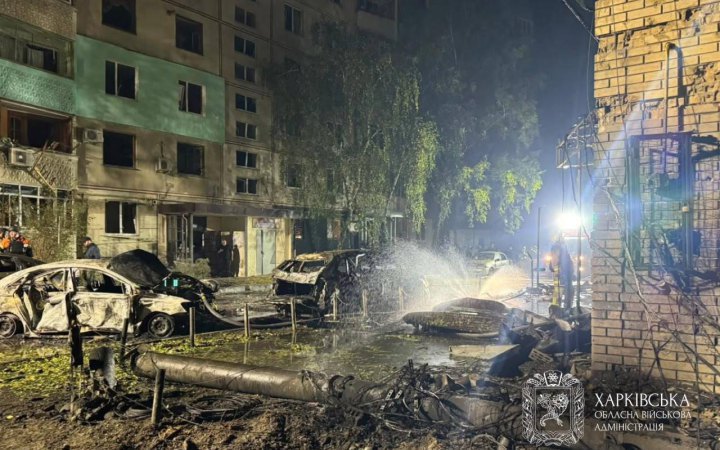
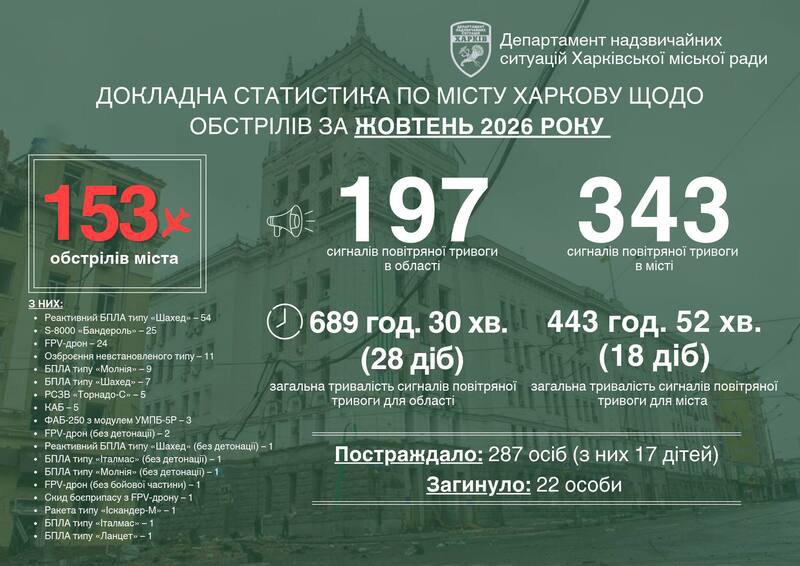
In October, a record number of Russian strikes on Kharkiv was recorded since the start of this year – the city withstood 153 enemy attacks. That is an average of five attacks a day.
Kharkiv Mayor Ihor Terekhov reported this.
Not a single safe corner remained – not one of the city’s nine districts was spared.
Russian terror claimed the lives of 22 people. Another 287 were injured, including 17 children.
The city was hit most often by Shahed jet-powered drones – 54 times. “Banderol” drones (25 strikes) and FPV drones (24) were also used. The city was also attacked with standard Shaheds, “Molniya” drones, drones of an unidentified type, aerial bombs (including FAB-250 and KAB), Tornado-S multiple rocket launchers, and the Iskander-M ballistic missile.
“They struck day and night. Very often they targeted the same locations – returning with repeat strikes to places where our services were clearing rubble and rescuing people after previous hits,” Terekhov noted.
Critical and civilian infrastructure was the focus of the enemy attacks. The Russians deliberately smashed the railway to paralyse our logistics. As the cold weather approached, strikes on the energy sector began again – hitting facilities both in the city and regional capacity, on which it directly depends whether Kharkiv will have electricity and heating.
“In addition, the enemy is systematically burning out business. In October, we finally lost the last Epicentr that was still operating in the city. At the end of the month, the Dafi shopping centre was badly hit,” the mayor added.
Industrial and warehouse premises, sewing workshops and vehicle service stations were also destroyed. The circus, a private lyceum and a city polyclinic were damaged by Russian terror, with the latter hit directly during patient appointments.
As usual, the housing stock suffered extensive destruction. Both the private sector and high-rise buildings were damaged – burnt-out flats, collapsed floors, and windows blown out by blast waves along entire streets.
Over the month, 343 danger alerts sounded in Kharkiv. In total, that is 444 hours – more than 18 days of continuous threat. Thanks to the differentiated warning system, the alert in the city lasted almost 246 hours less than the regional one, which totalled 690 hours.
“This means the main thing: when the siren sounds in the city, the danger concerns Kharkiv directly. I ask you very much: go to shelters, do not wait for the first explosion! Take care of yourselves and your loved ones!” Terekhov added.