





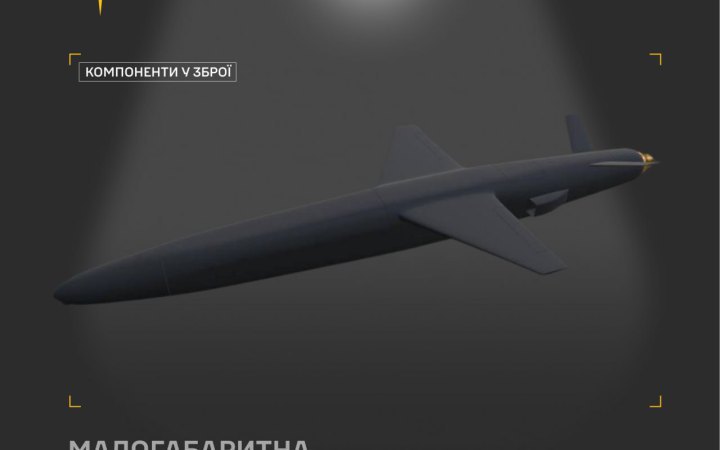
Ukraine’s Defence Intelligence Directorate (HUR) has published an interactive 3D model on the “War&Sanctions” portal, along with information on the assemblies and nearly a hundred foreign-made electronic components of a new modification of Russia’s Geran-5 — the K5-K.
HUR said that at the beginning of this autumn the enemy began using a new modification of the Geran-5 UAV to strike Ukrainian cities — one that, by its aerodynamic layout and tactical and technical characteristics, can already be classified as a small cruise missile.
HUR experts examined one of the samples used by the enemy which, for certain reasons, landed almost intact in the middle of a Ukrainian field.
The Geran-5 K5-K airframe, like its predecessor the Geran-5, is built to a conventional aerodynamic configuration. The straight-tapered load-bearing wing is arranged as a high-wing, while the tail unit is single-fin, with fixed stabilisers and a rudder.
The K5-K is smaller than the standard Geran-5: its length is 4 metres versus 6.5 m, and its wingspan is 3 metres versus 3.2 m. The enemy has also worked to improve the fuselage’s aerodynamic characteristics in order to increase speed and altitude performance. The maximum flight ceiling has increased from 5 to 6 km, cruising speed has risen to more than 450 km/h, and the maximum during certain manoeuvres can reach 1,000 km/h. Range (1,000 km) and warhead weight (90 kg) have remained unchanged.
In the sample examined by HUR experts, a TBBCh-90 thermobaric warhead was installed, among other things.
The avionics are identical to the latest versions of another jet-powered UAV, the Geran-4 Seeker: a flight controller, the SADRA seeker inertial navigation system with the MOX module, a localised copy of the 16-element Harxon GI-006 CRP antenna, a tracker, a mesh modem, and so on.
The examined sample was also equipped with a unit of the new optical-electronic correlation system “Susanin”, which HUR had previously identified in the Geran-4. The system compares images from an optical sensor with a reference image loaded into the microcomputer’s memory to ensure the missile/UAV follows the route from launch point to aiming point. In the examined K5, instead of optical sensors, the Susanin system included a dual-band camera.
The Susanin unit, which is directly responsible for processing information from the camera and comparing it with the reference, is a Coke Pi microcomputer (a Chinese analogue of the Raspberry Pi) in a plastic case with the relevant markings. A similar unit, but under a different name (“Sausage”) and with a different purpose (acquisition and tracking of interceptors), was previously found in the Gerbera-2 UAV.
The powerplant is a TRD-200 turbojet engine, assembled in Alabuga from Chinese components.
Of the 93 electronic components, the largest number are from US manufacturers (52), while China and Switzerland account for 10 each. The enemy continues attempts to conceal the markings of the electronic component base used, including DSP digital signal processors from Texas Instruments and Murata inertial modules.
HUR stresses that such actions by Russia indicate that sanctions are working and creating difficulties for its supply chains: prices, delivery times and the risk of disruption are all rising.