





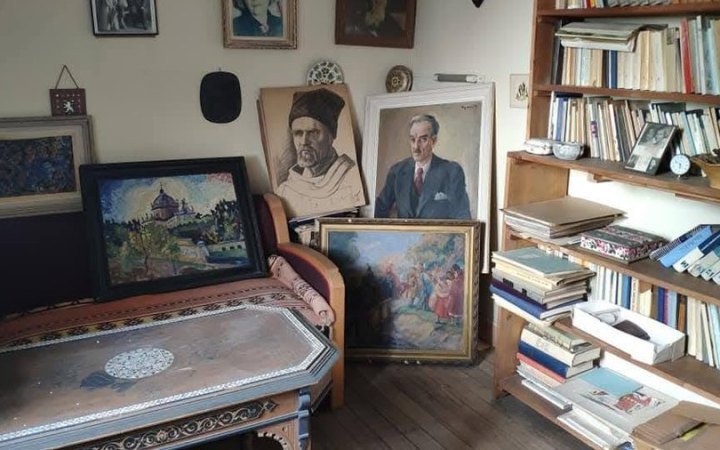
How and why was the Shevchenko Scientific Society founded?
1873. In the part of Ukraine ruled by the Russian Empire, the Valuev Circular banning the Ukrainian language has been in force for ten years. As a result, patrons from central Ukraine raise funds and establish the Taras Shevchenko Literary Society in Lviv. Initially, the new organisation is associated with literary and publishing activity. But later it becomes a kind of academy of sciences, with an emphasis on the study of Ukrainian studies. In 1892, what is now the Shevchenko Scientific Society adopts its new charter.
In the 20th century, the Society faced pressure and persecution. First, in the 1920s and 1930s, from the Polish authorities, and then from the Soviet ones. In fact, the USSR liquidated the Society from the very start of its occupation of western Ukraine—in 1939. And in 1947, the work of the “Shevchenko Scientific Society” was revived in the United States, Canada and Europe. In Europe, France hosted SSS-Europe—the Society settled in the town of Sarcelles, 17 km from Paris. It is worth adding that the Society’s activities were also revived in Ukraine from 1989, but that is another story. Here, we return to the diaspora.
Serhii Shumylo, a historian, scholar of religion and member of the Shevchenko Scientific Society, who drew attention to the problems facing SSS-Europe, said in an interview with Livyi Bereh that the Society had operated as a powerful research centre since the days of Austria-Hungary. Because—and this is important—SSS developed non-Soviet scholarship, meaning research not ideologised by communist dogma. And then something paradoxical happened. Shumylo notes that while the Society worked successfully before Ukraine’s independence, it fell into decline after independence.
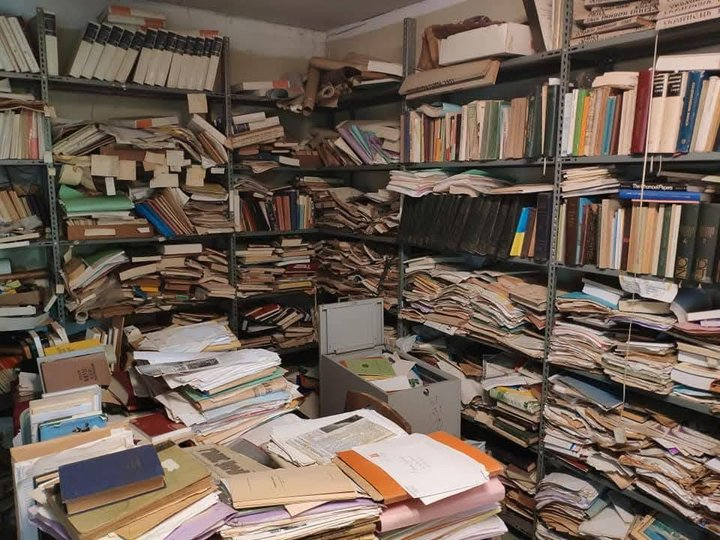
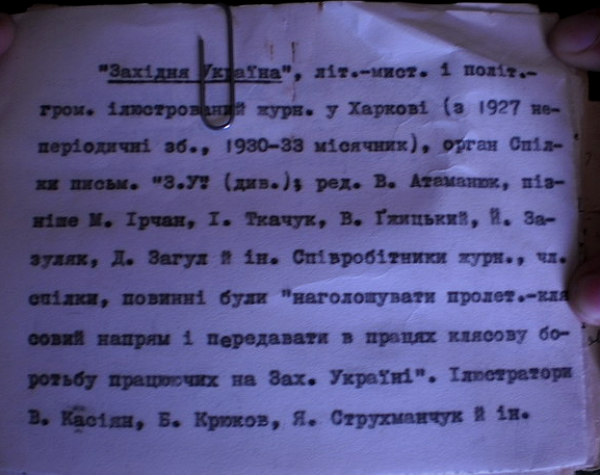
One of the Society’s major projects was the publication of 11 volumes of the “Encyclopaedia of Ukrainian Studies”, compiled over more than 50 years. SSS-Europe also preserves Ukrainian diaspora literature, numbering about 20,000 volumes. In addition to this library, the Society’s archive contains microfilms, card indexes, photographs, correspondence and other materials. After the court ruling requiring the Society to vacate the Sarcelles premises, all these collections will move to London. Whether they will reach the British capital without any losses remains an open question.
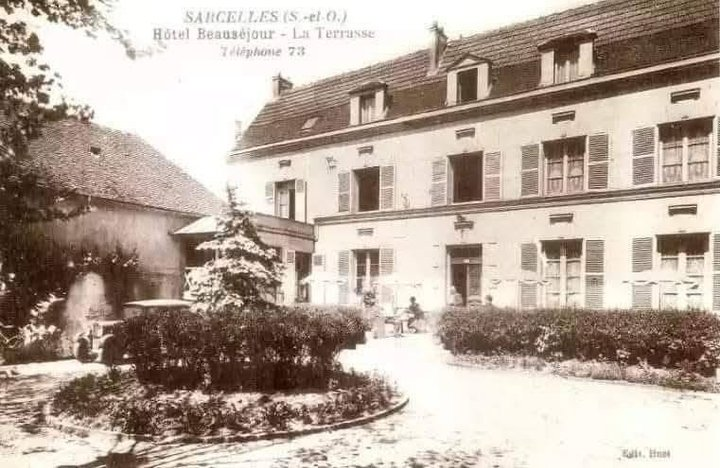
Why is the Society being forced out of the premises?
In Sarcelles, at 29 rue des Bauves, SSS-Europe has been registered since 1949. That year, “with the assistance of the Ukrainian Greek Catholic Bishop Ivan Buchko, via the Vatican, through the Congregation for the Eastern Churches, funding was obtained to purchase this house, where the SSS branch in Sarcelles was then located. Before that, there had been some small private hotel there,” Serhii Shumylo says.
“At that time, SSS in France was not yet registered and could not formalise the purchase of this house, so it reached an agreement with a friendly diaspora organisation, in whose name the building was to be registered temporarily,” he continues. He explains this legally risky step as follows: to avoid losing the premises, “it had to be registered urgently in someone’s name”. “And then they lived amicably and forgot that the re-registration had never been carried out,” Shumylo says.
But evidently not everyone forgot.
The organisation that bought the house turned out not to be as friendly to SSS as the Society had believed. Its name is Service Social Ukrainien en France, or the Ukrainian Social Welfare Service in France—USWSF. This institution was created in 1945 to help Ukrainian migrants. USWSF has official registration, but no online resource where one could ознакомиться with its activities. The name of its head, given to Livyi Bereh—Kateryna Koval-Dahono—is unknown to search engines.
Whoever leads USWSF, the institution began to show activity only relatively recently. “In the 1980s this organisation effectively died, because its founders—elderly émigrés—also passed away. But in 2018 the institution filed a lawsuit to evict SSS-Europe from the house in Sarcelles,” Shumylo notes. “I cannot vouch for every detail, because I am not directly involved in all these disputes, but as I was told, the diaspora in Paris tried to reach an agreement with USWSF. They tried to do so through the Greek Catholic Church, and even Borys Gudziak, while in Paris, contributed to this, but they still failed to come to terms.”
It is particularly bitter because the land tax and rent (at least for a certain period) were paid not by USWSF, but by SSS-Europe itself.
And what does the current head of SSS-Europe, lawyer Stefan Dunikovsky, who has led the Society since 2011, say about this? In fact, nothing. At one time he was active in the media and, in the year of his appointment, even gave Istorychna Pravda a tour of the Society’s premises and gave Ukrainian journalists an interview, but now Dunikovsky avoids speaking to the press. In any case, Livyi Bereh was unable to obtain his comment.
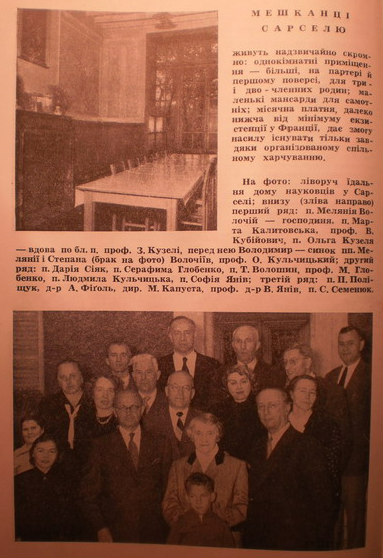
In 2024, in issue No. 70 of the “SSS Bulletin”, Dunikovsky reported that a legal dispute was ongoing over the house that legally belonged to the Ukrainian Social Welfare Service, but in practice had become the home of the Shevchenko Scientific Society. The Versailles Court of Appeal put an end to it in 2026. The verdict of the French courts has been mentioned repeatedly above: under the court decision, SSS-Europe must move out and vacate the premises, which it had maintained at its own expense for a long time.
Who is to blame for this situation?
Livyi Bereh contacted Vitalii Chernetsky, head of the Taras Shevchenko Scientific Society in the United States. Chernetsky noted that although the US branch is closely following events in Sarcelles, it has no leverage over the situation.
“We are very sad, but the Shevchenko scientific societies are autonomous and independent of one another. We are not subordinate to each other. Historically, the parent society was the one in Ukraine, which was closed in Soviet times. But then, after the Second World War, new Shevchenko scientific societies emerged, continuing this tradition in the States, Canada, Europe and Australia,” he says.
Chernetsky adds: as regrettable as it is, today’s diaspora shows declining interest in Ukrainian affairs. “This is a broader problem for all diaspora institutions, not only Ukrainian ones. Often, after 2–3 generations of emigrants work actively, they do not fully understand what they are supposed to pass on to the next generation. The burden of financial and legal complications arises,” he observes.
Serhii Shumylo says almost the same. But he adds another nuance: historically, the European diaspora has been institutionally weaker than America’s. “After the Second World War, the entire diaspora that ended up in Western Europe gradually migrated further—to the United States or Canada. And already in the 1960s and 1970s the European diaspora was shrinking, because the most active people were leaving. And the final decline came in the 1990s, because the old diaspora essentially died out, while the new diaspora was represented by people of a completely different type—mostly economic migrants rather than political ones,” he says.
“As a result, today SSS is led not by those who once left Ukraine, but by those who were already born abroad, that is, descendants of the old emigrants. They are assimilated into the new environment and are not as active. With the ideas their parents invested in to the very end, these people do not know what to do. And that is the specificity of any diaspora,” Shumylo says.
Asked who bears responsibility for the situation that has developed, Vitalii Chernetsky answers as follows: it is impossible to identify a single culprit or a single group of culprits. Part of the responsibility lies with the Ukrainian academic community abroad, which should have been interested in preserving institutions such as SSS. This community failed to maintain unity, and not only because of generational differences—even among peers there were misunderstandings that had fatal consequences.
“In the specific case of SSS-Europe, there were high hopes at the end of the 1990s, when the late Professor Danylo Struk from Canada, from the University of Toronto, took over the chairmanship. He took early retirement, moved to Paris, and was ready to take care of the Society’s affairs, but unfortunately died suddenly. And after Professor Struk’s death, discord and decline set in, which has continued in SSS-Europe for a quarter of a century,” Vitalii Chernetsky says.
Serhii Shumylo sees the situation differently: “People came to expect the diaspora to provide something. It was a kind of post-Soviet syndrome: the diaspora is rich, so money should be pumped out of it. At first the diaspora helped actively—investing in the development of Ukrainian culture and scholarship up to the 1990s. But then the last enthusiasts died. And the treasures of SSS-Europe, accumulated, collected and preserved over more than 70 years, have ended up in a very difficult position.”
Without excusing the leadership of SSS-Europe, Shumylo places a significant share of responsibility on the Ukrainian state as well. “We did not lose Crimea in 2014. We lost it much earlier—when Russian universities appeared there, funded from Moscow, and we were happy they were getting funding for free. We were losing Crimea gradually through the loss of education, scholarship, cultural centres and so on. And as for abroad, it is not even worth mentioning. Supporting the diaspora, which had actively supported Ukraine, was never a priority at all,” Shumylo concludes.
What if SSS-Europe’s archives were moved to Ukraine?
Based on his view of the diaspora’s role, Serhii Shumylo does not support the idea of moving SSS-Europe’s documents to Ukraine. “Yes, the Ukrainian side proposed taking all this and transporting it to Ukraine. On the one hand, it is logical. But on the other, put yourself in the owner’s place. Why should we give everything away and close down? Is that a state-minded approach? Look, for example, at how Polish research institutes operate. They have branches, representations, archives and libraries all over the world. Polish scholars go to Paris and stay free of charge at the Polish Institute. They go to London—and stay there too. Because it is a single network funded by Poland. Russia operates the same way—it has its cultural centres everywhere. And Ukraine? Ukraine has nothing like that. For all 35 years, Ukraine has not funded humanitarian fields abroad. Not to mention that it did not fund them at home either. Our scholarship and education were being systematically destroyed,” he says bitterly.
Of course, if the choice is between the complete destruction of the archives and moving them to Ukraine, the second option is better. “But even better for the Ukrainian state would be to find ways to maintain institutions like SSS-Europe abroad, so that they bring benefits. And so that we spread Ukrainian ideas and influence among other peoples,” our interlocutor is convinced.
Joining the long-distance discussion with Shumylo is Anatolii Khromov, head of the State Archival Service. He explains that the system does not work the way Shumylo would like. In comments to Livyi Bereh, Khromov says he contacted Stefan Dunikovsky—including through the Ministry of Foreign Affairs of Ukraine and the Ukrainian Embassy in France. He proposed cooperation to preserve SSS-Europe’s existing holdings.
“We proposed organising the arrangement, restoration and digitisation of the documentary heritage. Our arguments are these: despite the difficulties, Ukraine’s archivists are working, the reading rooms of state archives are open to researchers, and large-scale digitisation of documents from Ukraine’s National Archival Fund is under way. The Central State Archive of Public Associations and Ukrainica has a strong material and technical base and holds part of the archives of the Ukrainian emigration. The archive is equipped with repositories and a reading room, so the documents of SSS-Europe’s archive would be properly preserved and accessible to users,” Anatolii Khromov describes the proposals made to Dunikovsky.
However, he adds, SSS-Europe refused. The refusal was motivated, first, by security considerations and, second, by SSS-Europe’s desire to keep the collection and instead receive state support. “For us, such a format is impossible, because our service can spend its already limited budget on preserving documents that are part of Ukraine’s National Archival Fund and are state property. That is, an act of transfer of the collection is needed,” Khromov says.
At the same time, he emphasises that diaspora institutions trust the State Archival Service and cites as an example the personal archive of Mykola Plaviuk, the last President of the Ukrainian People’s Republic in exile. This archive, Khromov says, was transported by diplomatic mail from the United States; it is in Ukraine and is now state property.
Vitalii Chernetsky calls the decision to transfer SSS-Europe’s archives to Ukraine a difficult one. “Should diaspora heritage continue to be kept abroad and be accessible to representatives of the diaspora, or should it be transferred to the archival institutions of the parent country when such an opportunity arises? There is no unambiguous answer. Ideally, I think, the documents should be digitised. Then the originals could be kept in one place, and digital copies in both places at once.”
But there is no point talking about digitising SSS-Europe’s holdings now—there is not enough money for it. So the archives are slowly being prepared for a journey across the Channel—they will go to London.
Why London?
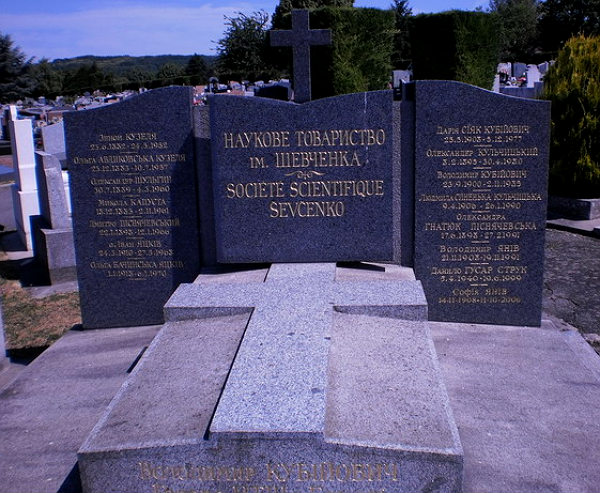
London was chosen because the Taras Shevchenko Library operates there under the Association of Ukrainians in Great Britain, Serhii Shumylo explains. However, “some of the materials were previously transferred to Canada. It was simply important that an organisation like SSS-Europe be preserved in Europe. And the Association of Ukrainians in Britain is sufficiently strong. Plus, it actively cooperates with SSS-Europe. In fact, the Society includes a person who, in London, looks after the Ukrainian library. So London emerged as part of internal agreements between the Association of Ukrainians and SSS-Europe,” our interlocutor says.
Meanwhile, we ask Vitalii Chernetsky whether the American Shevchenko Scientific Society faces similar problems. “Fortunately, things are going well for the Scientific Society in America,” he replies. “We own our building, and it is well maintained. Our archives are safe and stored according to all the rules.” A worse situation, he says, is being experienced by UVAN—the Ukrainian Free Academy of Sciences.
“After the Second World War, our two institutions opened in the States almost simultaneously. Only SSS-Europe was mostly represented by Galicians, while UVAN by people from eastern Ukraine. Yet many people took part in the work of both organisations. But we, in the American SSS, managed to bring the younger generation into the work and develop a new vision for our activities. UVAN has certain difficulties with the transfer of leadership… At the same time, UVAN has its own building, which houses valuable archives and a library. They also received assistance from Ukraine to digitise these archives, although I do not know how far this work has progressed, because we are no longer in such close contact as we once were,” Chernetsky says.
But even if things at SSS-Europe and UVAN are going more or less well, at the Ukrainian Free University in Munich—another European institution—everything is far from rosy. “They had much larger premises, but they did not have the means to maintain them, so they were forced to sell the property and move to a smaller one. And that could not accommodate all the holdings and libraries. So, once again, this is a question for our state policy—why do our leaders still hope that the diaspora will preserve everything and then hand it over intact to Ukraine?” Serhii Shumylo asks.
He once again stresses that Ukrainian centres abroad are deprived of state support. “So everything is preserved thanks to the enthusiasm of diaspora members. And if there is no enthusiasm, or if there are no diaspora members themselves, then everything slowly dies,” he says bitterly.
And although SSS-Europe is not dying yet, but for now is changing its registered address, the story is indeed alarming and unpleasant. And above all, it is one that certainly does nothing for Ukraine’s pride and prestige.