





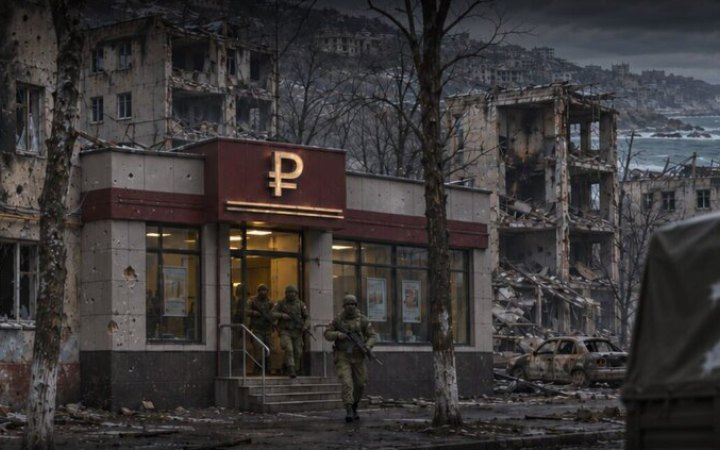
The “War&Sanctions” portal has published details of 11 Russian banks operating in the temporarily occupied territories, involved in Russia’s centralised sanctions-evasion schemes, and servicing enterprises in Russia’s military-industrial complex.
This was reported by the Defence Intelligence of Ukraine (HUR) of the Ministry of Defence.
It is noted that Russia uses banking services in the temporarily occupied territories as one of the instruments of forced integration of Ukraine’s temporarily occupied territories, in particular through the government programme “State Programme. New Territories”, under which preferential mortgage loans and property-backed lending are issued in Ukraine’s temporarily occupied territories.
Such activity is aimed at artificially and forcibly introducing the rouble zone, encouraging illegal passportisation (as services are provided exclusively to Russian citizens), and legalising the unlawful seizure and circulation of Ukrainian citizens’ real estate in favour of the occupiers.
Russian banks in the temporarily occupied territories service the occupation authorities and the Russian army, and process payments for enterprises cooperating with the aggressor.
The publication includes, in particular:
- the commercial bank “RostFinance”, which has rolled out a network of offices in the temporarily occupied territories of Donetsk, Luhansk and Zaporizhzhia regions and is involved in implementing the above mortgage programmes;
- Genbank, which after 2014 moved its operational activities to temporarily occupied Crimea, becoming a key financial institution for the occupation administration (with direct ownership stakes held via the occupation authorities of Crimea and Sevastopol);
- the “Black Sea Bank for Development and Reconstruction”, which uses the assets and property of a Ukrainian financial institution illegally expropriated by the Russian authorities after the annexation of Crimea.
In addition, the list includes banks involved in implementing Russian government schemes aimed at overcoming international financial isolation, operating regional clearing platforms, servicing the state defence order, and supporting enterprises in Russia’s defence industry.
- The section already contains 40 banks, financial institutions and payment systems that, to varying degrees, support Russia’s aggression.