





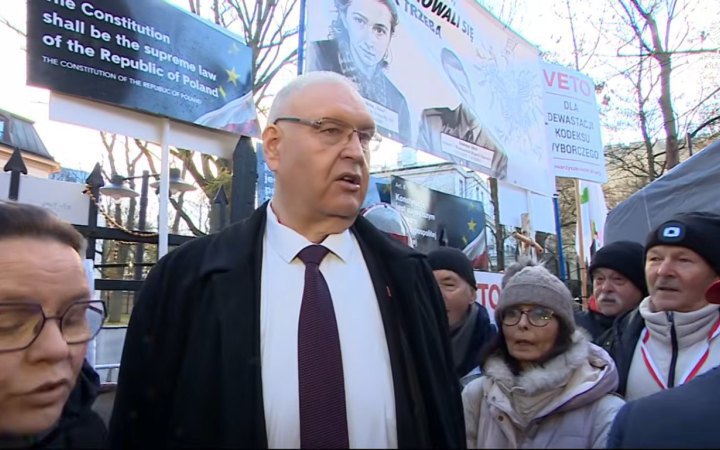
The General Assembly of judges of Poland’s Constitutional Tribunal has authorised criminal proceedings against the Tribunal’s President, Bogdan Święczkowski, and his deputy, Bartłomiej Sochański.
The relevant motions were submitted by the Minister of Justice and Prosecutor General, RMF24 reports.
The judges adopted four resolutions lifting Święczkowski’s immunity in four cases, while at the same time refusing the prosecution permission to detain him and place him in pre-trial custody. Both officials were suspended from performing their duties: Święczkowski’s salary was cut by 50%, and Sochański’s by 25%. At the same time, Judge Korwin-Piotrowska, acting as head of the Tribunal, rejected two further motions concerning Święczkowski due to formal deficiencies.
The allegations against Święczkowski concern the period when he served as National Prosecutor in 2016–2022, as well as his current activities. In particular, prosecutors suspect him of abuse of power and violations of employees’ rights through the repeated reassignment of nine prosecutors, as well as of disclosing legal professional privilege while overseeing operational and investigative activities as part of an inquiry into the Pegasus system. In addition, Święczkowski and Sochański are accused of preventing five lawfully elected Tribunal judges, who took the oath in the Sejm, from taking up work because President Karol Nawrocki did not invite them to the Presidential Palace. Święczkowski is also accused of using physical force against Judge Maciej Berek in the Tribunal building on 14 October this year.
During the hearing, both judges were due to be heard at the Warsaw District Court, but they did not appear, and their representatives cited procedural violations.
Scandal Around Poland’s Constitutional Tribunal: What We Know
- On 30 October, reports emerged of an order to suspend the performance of duties of Constitutional Tribunal President Bogdan Święczkowski and his deputy.
- Instead, Anna Korwin-Piotrowska was appointed to the post as the judge with the longest service.
- Święczkowski was a nominee of the Law and Justice party, which, after moving into opposition following Tusk’s election victory, gained the ability to block decisions by his government and even the parliamentary coalition.
- Following Korwin-Piotrowska’s information about the possibility of a threat to the life or health of judges and Tribunal staff, police arrived. A crowd gathered outside the Tribunal attempted to force its way onto the premises.
- President Karol Nawrocki, who was en route to Senegal, interrupted his flight, returned to the country and appeared at the Tribunal building.
- Nawrocki had previously refused to attend the swearing-in of three of the six judges appointed by parliament. Meanwhile, Święczkowski, a PiS nominee, refused to allow judges elected by the current parliamentary majority to take up their duties. These steps by the President blocked the Tribunal’s work.
- The opposition accuses Tusk’s government of attempting a coup. The government, in turn, insists it is carrying out necessary reforms to restore the rule of law after years of interference in the judicial system by the Law and Justice party (PiS).
- In a video address, Tusk accused President Karol Nawrocki, his predecessor Andrzej Duda and the PiS party of undermining the rule of law. The Prime Minister stressed that political figures have no right to interfere in the work of the courts or put pressure on judges.
- The European Commission said it is monitoring the situation. In Brussels, officials stressed that the Polish authorities must ensure the Constitutional Tribunal operates in line with the country’s constitution and the case law of the EU Court of Justice.