





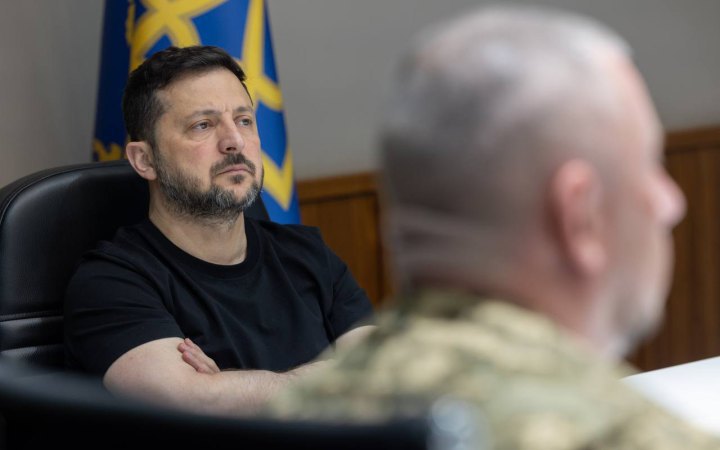
Ukraine must now prepare for a very difficult winter. How difficult it will be is hard to imagine at this point: it depends both on Ukraine itself and on its partners. In this context, it was necessary to appoint a new prime minister who understands the energy sector very well, President Volodymyr Zelenskyy said in an interview with Sky News in response to a question about whether he intends to return Mykhaylo Fedorov to the post of defence minister.
Problems in the dialogue between the army leadership and the leadership of the Ministry of Defence had lasted not days or weeks, but months, the head of state said. Some things can be resolved only through joint work by the ministry and the army.
“You know that a major challenge is mobilisation—understanding and assessing that in October [Russia will begin a new wave of mobilisation], we may get, maybe not, but we may get another 500,000 people from Russia. We need a new approach to mobilisation, new steps—perhaps new, perhaps not very quickly, perhaps not very radically. But we must find a way. We need unity between these two institutions. Second, we do not have enough missile defence. I don’t have time for conversations,” he said.
The president noted that he does not have time to hear each side separately because they are not ready to meet.
“They need to meet every hour until our sky is closed,” he said.
He added that he does not want to disclose who is right and who is not. He has the constitutional right to make decisions for the sake of unity. The president hopes the new leadership will resolve the necessary issues.
“Sometimes challenges move faster than you do. That is why you have to make strong decisions,” the president added.
He said he respects both former commander-in-chief Oleksandr Syrskyy and former defence minister Mykhaylo Fedorov. But successful deep strikes are not the work of one person. First and foremost, it is the army, the Security Service of Ukraine, and special forces. A significant number of operations were carried out by the Defence Intelligence of Ukraine.
“The defence minister must provide everything for these operations. But the operations are carried out by the military, not someone else,” Zelenskyy said.
If you do not have troops on the battlefield and think you can rely only on drones and do not need soldiers, then you will lose, the president stressed. Russians infiltrate populated areas, and if you have no troops at the front, you will lose these towns and villages one by one.
“So the military are number one. People who pay taxes are number two. Otherwise we will not be able to pay those troops,” he added.
The military, civilians, and partners who help fight the Russian military—all of them are waging the war, the president believes.
“With all due respect to Syrskyy and Fedorov, they must work together; otherwise they will not be able to send the right signals to the army, the right signals to our team, and also to partners. It is very important to me that they choose to continue working. But that depends on their choice. So we are where we are,” the president said.
Mykhaylo Fedorov’s dismissal
This month, President Volodymyr Zelenskyy unexpectedly announced plans to reshuffle the government. Serhiy Koretskyy, who had headed Naftogaz, replaced Yuliya Svyrydenko as prime minister. The president said he is the best prepared for the premiership in the context of preparing for a very difficult winter. Some ministers kept their posts in the new government, but not Defence Minister Mykhaylo Fedorov. After seven months in office, the president decided not to submit his candidacy for reappointment.
At first, according to sources at LB and other media outlets, Ihor Klymenko, who headed the Interior Ministry, was considered for the post of defence minister. Against the backdrop of protests, Klymenko was never put forward for the Defence Ministry post. The president decided that the duties of defence minister would be carried out by General Yevhen Khmara, head of the Security Service of Ukraine’s Alpha Special Operations Centre. Khmara led the Security Service of Ukraine in an acting capacity, and later the government appointed him acting defence minister. For a full appointment, he will need to be discharged from military service.
Ihor Klymenko ultimately did not receive a new post in the government and became secretary of the National Security and Defence Council.
Volodymyr Zelenskyy held several conversations with Fedorov. The president also held numerous consultations with brigade commanders and force commanders. Since 16 July, protests have been ongoing in Ukrainian cities demanding that Fedorov be returned to the Ministry of Defence.
The president did not communicate the exact reason for the decision to replace the head of the Defence Ministry, but said there had been a conflict between the ministry and the army leadership that prevented them from establishing cooperation. Fedorov himself accused Syrskyy of issuing an ultimatum demanding his dismissal. The former minister said that instead he had proposed to the president replacing the commander-in-chief and the head of the General Staff.
Last week, the Armed Forces received a new commander-in-chief—Mykhaylo Drapatyy. The head of the General Staff also changed. The president offered Mykhaylo Fedorov various positions, from adviser to deputy prime minister for military innovation. However, he said he would agree only to the post of defence minister.