





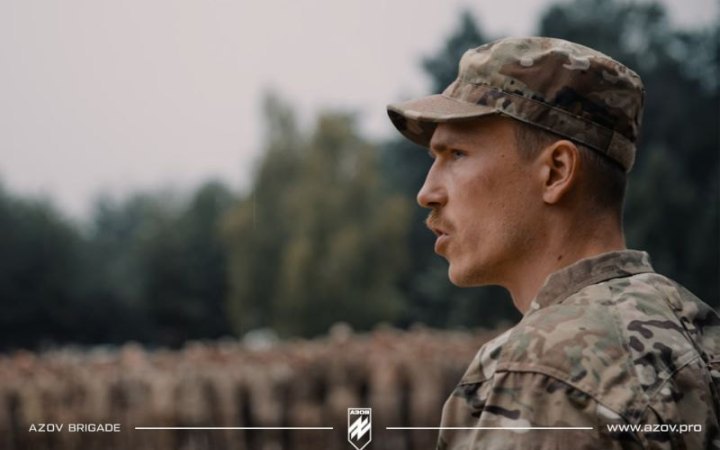
The situation on the Donetsk axis remains extremely difficult, and over the past summer campaign the enemy still failed to accomplish any of its strategic objectives. This was stated by Denys Prokopenko, commander of the 1st Corps of the National Guard of Ukraine’s Azov, during a live online link-up at the annual Yalta European Strategy (YES) conference.
“The situation on the Donetsk axis is extremely difficult. We are facing three armies, the 56th Air Assault Division, and a grouping of the Russian Federation’s naval infantry. In fact, the balance in terms of the military units we are dealing with is quite significantly in the enemy’s favour. It is roughly one to six if you compare the strength of the units, the number of personnel, and the stocks of munitions the enemy is using,” Prokopenko said.
He noted that the enemy has around 1,200 Rubikon teams, and a third of them are deployed specifically on the Donetsk axis.
“As of now, the enemy has not fulfilled its strategic task of capturing Dobropillia by the end of the summer. It has failed in its summer offensive campaign. It achieved only minor tactical successes,” the commander said.
According to him, after the operational offensive actions carried out by the corps, including jointly with General Valerii Zaluzhnyi, the enemy over the course of a year was unable even to regain the positions it had been forced to abandon last summer.
Prokopenko said he expects open mobilisation in Russia at the end of March, after the elections.
“Before the start of winter, the enemy can quite quickly mobilise up to 600,000 servicemen, rapidly redeploy them, and we may already see this on the line of contact in the near term, by the end of this year. Accordingly, the strategic goal will be the full occupation of Donetsk and Luhansk regions. The enemy has been unable to accomplish this task for at least five years now,” the commander noted.
In his assessment, the enemy will try by the end of the autumn campaign to gain a foothold in at least one of the settlements along the notional line of Dobropillia – Kostiantynivka – Druzhkivka – Kramatorsk – Sloviansk – Sviatohirsk, in order to create a bridgehead for further actions.
“We will not let it do that. It has no chance of success. The enemy’s losses to date are colossal,” Prokopenko said.
The commander added that they expect the enemy’s summer offensive campaign to reach its climax in September, and that in October they already forecast a change in tactics due to worsening weather conditions — rain, fog and shorter daylight hours.
“The enemy will be forced to move from the tactics of small infantry groups to heavy armoured vehicles and try to carry out mechanised breakthroughs deep into the defence. That is, in fact, what it was doing last winter and in the autumn as well, but it achieved no significant success. All columns were detected while still in assembly areas and on approach routes; strikes were delivered deep to more than 40–50 km,” he noted.
According to Prokopenko, the corps is capable of destroying up to 50 pieces of the enemy’s combat and transport equipment every day thanks to reconnaissance assets and unmanned aerial vehicles.
He also suggested that the enemy may use part of the mobilised reserve formed in Belarus to tie down the efforts of Ukraine’s Armed Forces on the northern borders — with the aim of creating a buffer zone in Sumy and Chernihiv regions and continuing the terror against Kyiv.
Prokopenko stressed that Russia is fighting not only Ukraine, but the entire civilised world.
“This is not a war between two armies; it is war and terror against the civilian population. It is the daily destruction and devastation of our physical infrastructure. It is the torture to death of our prisoners of war. It is the forced mobilisation of the Ukrainian population in the temporarily occupied territories. And, to our great regret, all of this awaits European countries if Ukraine stops resisting,” he concluded, adding that Ukraine is currently buying the world the most precious resource since the start of the full-scale war — time, which must be used to develop the army, technology and civil defence.