





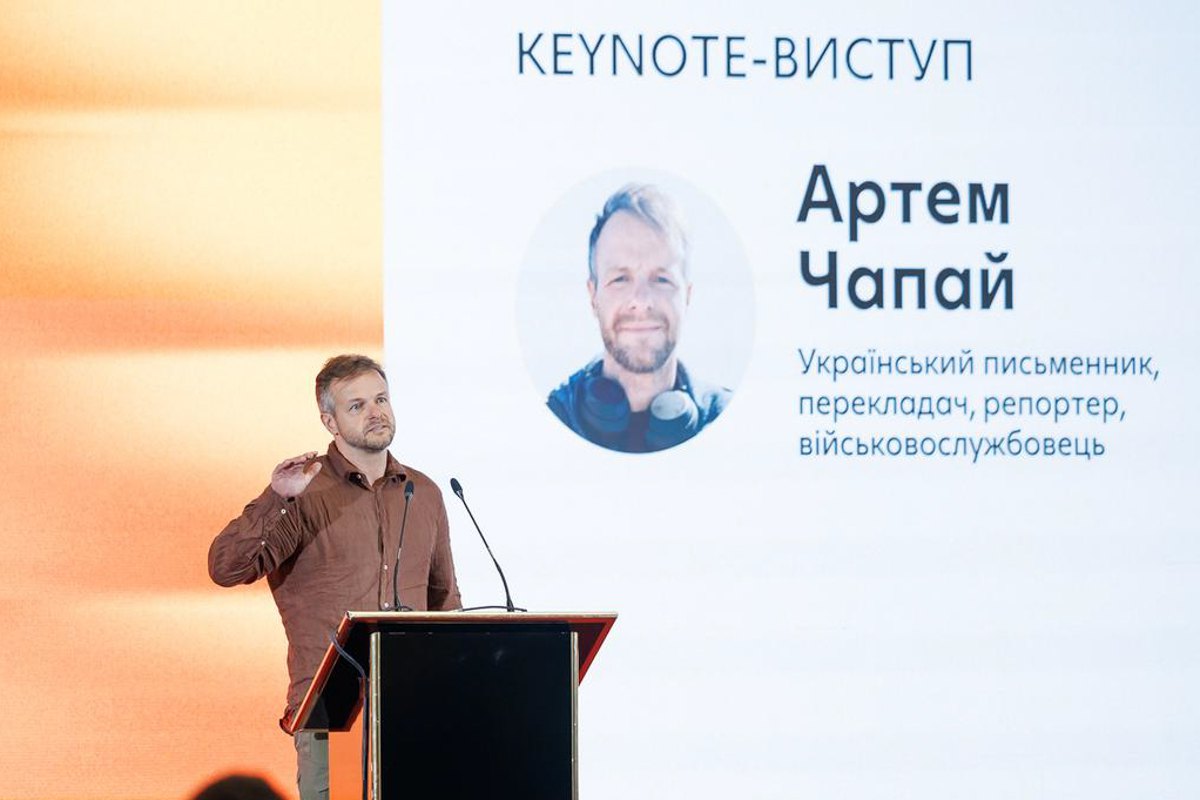
“Every artist speaks differently. And every artist speaks differently to different audiences”
In three weeks I wrote a very short book, which in Ukrainian is called Not Born for War. I want to stress that it is not propaganda — it contains a lot of criticism of Ukrainian society. I think that is something artists can allow themselves — which is why it is important to send artists abroad.
At the artistic level, everyone speaks differently. What is more, the same artist will also speak differently to different audiences. When I travelled to France, the book was translated as Les gens ordinaires ne portent pas de mitraillettes — that is, “Ordinary people don’t carry machine guns”. I drew many comparisons with the French la résistance (the Resistance. — Ed.) during the Nazi occupation.
On the other hand, in Italy I spoke about what happened to us, Ukrainians, on the first day of Russia’s full-scale invasion. All Italians know the lines: “Una mattina mi sono alzato e ho trovato l'invasor” — the first line of the song Bella Ciao. It translates as: “One morning I woke up and found the invader.”
If I go somewhere [abroad], I speak from the standpoint of a notional European left-winger or European social democrat. I speak from the standpoint of a pacifist — and that is what often resonates with Europeans. I speak as a pacifist who has taken up arms. I can also speak a little from an anti-colonial perspective, because I translated Edward Said (an American literary critic of Palestinian origin. — Ed.).
On the other hand, we have Artur Dron, who will speak about exactly the same thing — about his choice, about why we are fighting — but from a completely different standpoint. For example, from the standpoint of a Christian. Pavlo Kazarin might come and speak about the same thing from a more analytical standpoint, yet he is also excellent at having an emotional impact. One of our best examples is Yaryna Chornohuz — a woman who has a child. Imagine her choice and think about how foreigners will perceive it. After all, they often say: “How is it that you’re being forced to fight?” — and here they see different people: those who are not being forced, and those who can explain on a personal level why they are doing it.
Of course, as someone in the Armed Forces of Ukraine, I am biased. I believe, first and foremost, it should be those who chose to fight. For example, the director and screenwriter Olena Apchel, who can talk about this [the choice to fight] from a woman’s perspective. And also Kateryna Zarembo — a writer who can likewise explain why she, as a woman, voluntarily went to fight.
“In some countries you find yourself in a ‘warm bath’, in others in a ‘sparring match’”
As for how different cultural diplomacy is in different countries — from my limited experience — the president of Ukrainian PEN, Volodymyr Yermolenko, and I joked that in some countries you find yourself in a metaphorical “warm bath”, where people already understand you, and you merely confirm what they want to hear. In my case, that was the Netherlands — in my view, one of our most consistent allies, where everything is very straightforward.
But there are other examples. I call them, relatively speaking, “sparring”. When they say: “I don’t think so, but our audience does — so what do you say to that?” Here the artist’s role is important, because they are not ultimately perceived as a representative of the state. They can, in particular, criticise their own state. If I am asked, “What about corruption in your country?”, I can answer, “Yes, we have problems with it,” but as a private individual I can also say, “But look at your country too” — something a diplomat cannot say.
As an artist, I do not replace a professional diplomat. Depending on the audience, I can allow myself to be more or less sharp. I can remind them: “We Ukrainians, returning to our families, do not want to become like the Jews before the Second World War — a people without a country of our own. Because then you will treat us as foreigners.”
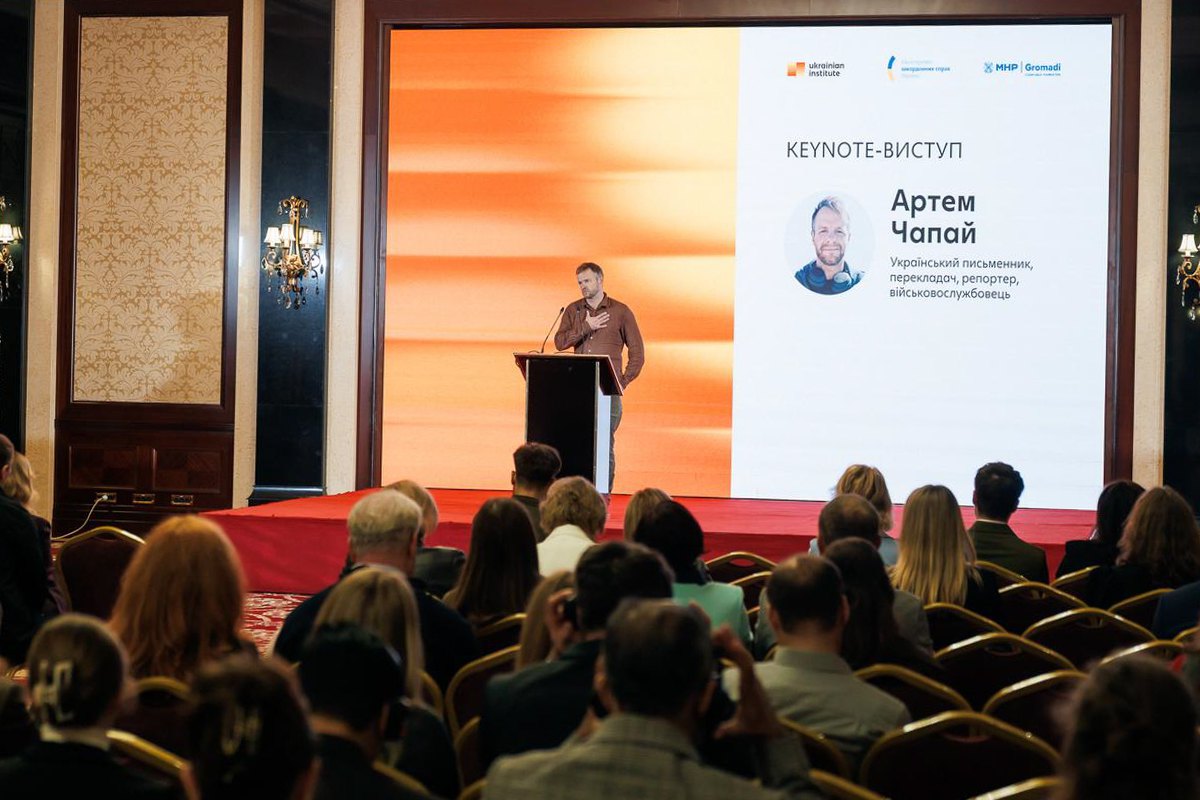
“An artist is in a position where they are perceived as a representative of the people”
I want to emphasise this duality: on the one hand, an artist has far greater freedom. But on the other, you understand what the burden of representation is. Whether you want it or not, you are still in a position where, in some respects, you are perceived as a representative — not so much of the state as a representative of the people, of society. And accordingly, you think carefully about what you want to say.
In a certain sense, I am a representative of the Armed Forces of Ukraine. I cannot assess the Supreme Commander-in-Chief or the Commander-in-Chief of the Armed Forces of Ukraine.
“We must take a proactive stance on the question ‘Why do we keep fighting?’”
Soon it will be the fifth anniversary of Russia’s full-scale invasion. There was a case in Italy. A book came out — and I went to Italy for two weeks. Now the main question is: “Why don’t you, bluntly speaking, just surrender? Why shouldn’t we stop supplying you with weapons?”
It seems to me we must ourselves begin to take a proactive stance and raise questions such as: “Why are we fighting? Why do we keep fighting? Why can’t we surrender?". I began to answer that personally I am not fighting for an imagined future. I don’t know what the future will be. I can see that, for me personally and for my family, it is better to fight already now.