





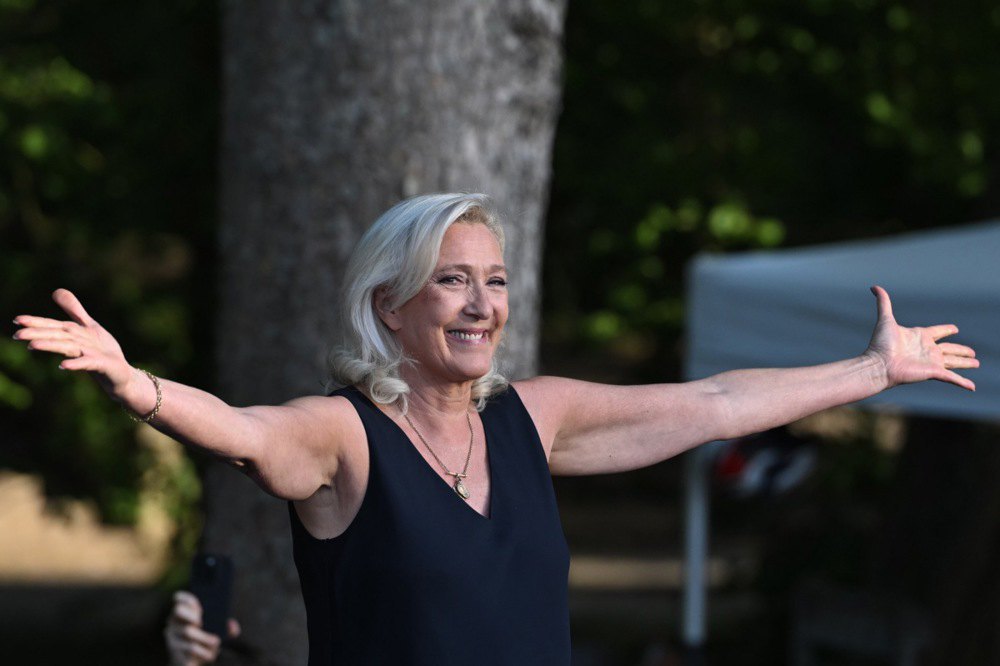
Opinion polls show Marine Le Pen holding a clear lead in the presidential race. The politician, who represents the right, is polling at around 35% in the first round. Her rivals are far behind. In second place is Édouard Philippe, leader of the centre-right liberal-conservative party Horizons and prime minister in 2017–2020, with support of around 20%. However, his place in the next round is not yet guaranteed. In some polls, the centrist politician even trails the far-left leader of La France Insoumise, Jean-Luc Mélenchon. The remaining candidates — Gabriel Attal from the centrist-liberal Renaissance party and Raphaël Glucksmann from the centre-left Socialist Party — could still add some intrigue to the race. However, they are unable to shake Le Pen’s lead.
Hopes that, in the run-off, voters will once again unite and back another candidate to prevent the far right from coming to power may not be borne out this time. Modelling of the second-round outcome shows Marine Le Pen defeating Édouard Philippe by a margin of more than 10%. Pollsters predict a similar result in a Le Pen–Attal match-up. If, however, Marine Le Pen’s opponent in the run-off is Jean-Luc Mélenchon, the National Rally candidate would win with 69% to 31%.
Under Emmanuel Macron’s presidency, France has taken a consistent pro-Ukraine stance and supported our country in its fight against Russian aggression. However, there is every reason to believe that after Marine Le Pen comes to power, official Paris’s policy will change. The question is how radical and far-reaching those changes would be.
Before Russia’s full-scale aggression, Marine Le Pen repeated many pro-Russian talking points. She did not recognise the annexation of Crimea and claimed that Ukraine belongs to Russia’s sphere of influence. She expressed admiration for Putin as a strong leader who defends “his country’s sovereignty and Christian values”. Le Pen also criticised sanctions against Russia and opposed Ukraine’s accession to NATO and the EU.
However, after the start of Russia’s full-scale invasion on 24 February 2022, Marine Le Pen’s rhetoric changed. She called the war against Ukraine an act of aggression and an obvious violation of international law. She spoke of solidarity with the Ukrainian people, while warning of the risks of a Third World War. She made certain efforts to shed the image of a pro-Russian politician. Even so, she remained sceptical about supplying Ukraine with offensive weapons and voiced doubts about new sanctions against Moscow. One can debate how sincere the National Rally leader’s public change of views is. But it should not be ignored entirely.
Le Pen’s position on Ukraine is now very similar to Donald Trump’s 2024 campaign rhetoric. She points to the lack of spare funds in the national budget for financial support for Kyiv and argues for achieving peace through negotiations. At the same time, Le Pen tries to avoid an overtly pro-Russian stance, stressing that her approach should not be seen as an act of hostility towards Ukraine. She claims that France can continue training Ukrainian soldiers and military leadership, as well as supplying equipment and material assistance.
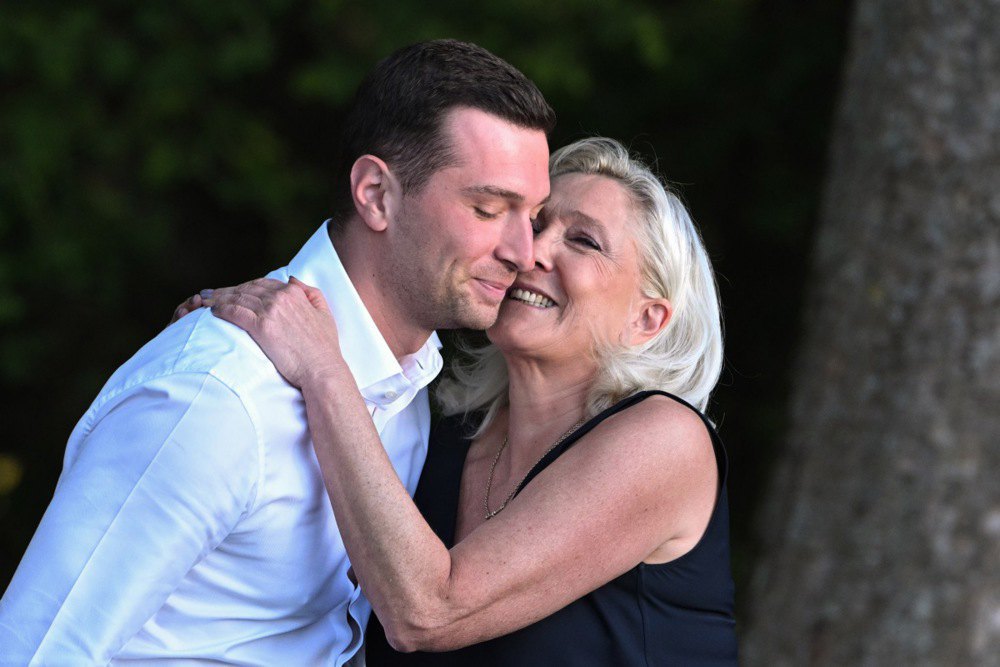
The party leader and candidate for prime minister, Jordan Bardella, holds a similar view. On the one hand, he assures that France will not abandon Ukraine. On the other, he proposes limiting financial support and adopting the American approach. Bardella is seen as representing the pro-Ukraine wing of the party and is more favourably disposed towards continuing limited assistance, albeit without supplying long-range missiles or sending French troops to Ukraine. Le Pen, by contrast, takes a more sceptical position. Even so, the differences between the two politicians are conditional rather than fundamental. It is also worth noting that Le Pen and Bardella are opposed to our country joining the EU and NATO.
A Le Pen victory in the French presidential election could significantly affect support for Ukraine. But the scale of the risk is debated. Under the worst-case scenario, France would end its contribution to assistance (both bilateral and via the EU), block planned arms deliveries, oppose the extension of anti-Russian sanctions, and systematically obstruct pro-Ukraine initiatives in the EU and NATO. Nor should one rule out increased diplomatic pressure on Kyiv to accelerate talks with Moscow and end the war on terms close to the Kremlin’s position.
According to another forecast, Paris’s policy will not undergo radical change, although financial aid to Kyiv will almost certainly stop or be sharply reduced. At the same time, military and material assistance may remain, but on a limited scale. However, a complete break with Ukraine and overt indulgence of Russia are unlikely.
At present, the assumption that Le Pen would pursue a pro-Russian policy and return to her pre-invasion-era rhetoric is somewhat exaggerated. Unlike Alternative for Germany, the French far right has, at least publicly, condemned Russian aggression and distanced itself from the Kremlin. French society is indeed divided on the issue of military support for Kyiv. And yet almost half of French people support continuing military assistance to Ukraine. Meanwhile, 40% of respondents approve the idea of deploying French peacekeepers on our country’s territory (among National Rally supporters, 27% share this view). Another public opinion study found that 60% of respondents consider Russia a threat to France. Among National Rally voters, 55% hold the same view. Therefore, fears of a pro-Russian pivot in Paris are partly overstated.
It is more appropriate to speak of the geopolitical risks of a victory by the National Rally candidate — not in the sense that Paris would take a pro-Russian stance, but in the sense of a noticeable cooling of relations with Ukraine. France’s warm attitude towards Ukraine in recent years has been largely driven by the personal contacts between Macron and Zelenskyy. After a hypothetical Le Pen victory, that factor would disappear. The Ukrainian authorities would have to build communication with the new leadership. As the example of dealing with Donald Trump shows, this task may prove too difficult for our diplomacy and take up a great deal of precious time. But it must be done, even despite Le Pen’s past sins.
Finally, French military and financial assistance to Ukraine should not be overstated. France’s contribution is indeed tangible. But it is not as significant as it may seem at first glance. Therefore, even if it were completely halted, it would not have catastrophic consequences for Kyiv. According to the Kiel Institute, since February 2022 France has allocated €7.9bn in bilateral aid to Ukraine, of which military assistance accounts for €6.2bn, humanitarian aid €876m, and financial aid €799m. If France’s share of EU assistance — more than €18bn — is added to these figures, the total exceeds €26.2bn. That is roughly 1% of the country’s GDP. At the same time, some European states with significantly smaller economic capacity have allocated a share exceeding 3% of GDP to support Kyiv.
In a joint statement on 19 September, Le Pen and Bardella strongly condemned Russia’s attempts to influence French politics through intimidation and said that no Russian provocation would force Paris to advance Russia’s military objectives in Ukraine. The National Rally leaders also expressed support for European countries that have fallen victim to Russian hybrid attacks. Of course, this statement is above all a political declaration. But it may also mean that Kyiv has diplomatic room for manoeuvre. Rather than pre-emptively consigning Le Pen and all National Rally members to the pro-Russian camp, it may make sense to establish contacts with a political force that has a real chance of coming to power — and to try, at least in part, to reduce its scepticism about supporting Ukraine.