





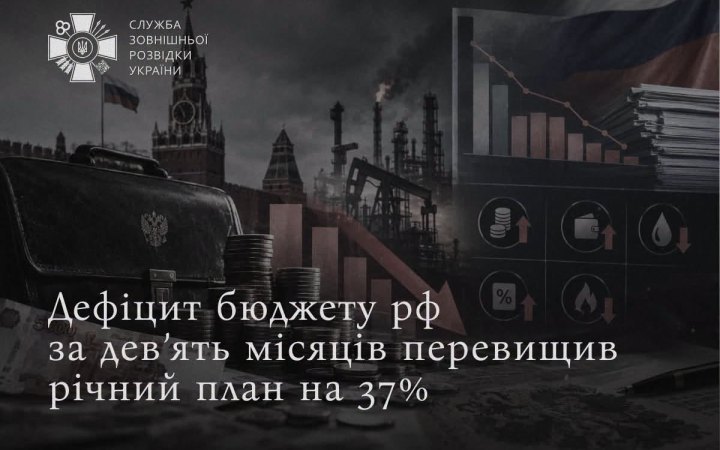
Russia’s federal budget deficit for the first nine months of 2026 totalled 5.186 trillion roubles ($61.08bn), or 2.2% of GDP. That is 37% more than the Russian authorities had planned to spend above revenues for the entire year.
This was reported by Ukraine’s Foreign Intelligence Service.
At the start of the year, the Kremlin had budgeted for a deficit of 3.786 trillion roubles ($44.59bn), or 1.6% of GDP. In September, Russia’s Ministry of Finance raised its forecast for the whole of 2026 to 7.345 trillion roubles ($86.51bn), equivalent to 3.2% of GDP.
From January to September, Russia’s budget spending rose by 14.5% compared with the same period last year, to 34.825 trillion roubles ($410.19bn). Revenues increased more slowly—by 10%, to 29.639 trillion roubles ($349.1bn).
The sharpest fall was in receipts from the oil and gas sector—down 17.2%, to 5.471 trillion roubles ($64.44bn).
At the same time, non-oil-and-gas revenues rose by 18.8%, to 24.168 trillion roubles ($284.66bn). In particular, value added tax receipts increased by 27.4% to 13.467 trillion roubles ($158.62bn).
However, the growth in tax revenues did not offset the decline in oil and gas income and the rise in budget spending.
According to Ukraine’s Foreign Intelligence Service, the Russian authorities have to cover the deficit using accumulated reserves or borrowing.
Going forward, the Russian government may seek additional revenue by raising taxes, increasing public debt, or cutting budget spending.
- In Russia, the financial position of businesses is deteriorating: from January to July 2026, the share of loss-making large and medium-sized companies rose to 33.4%.