





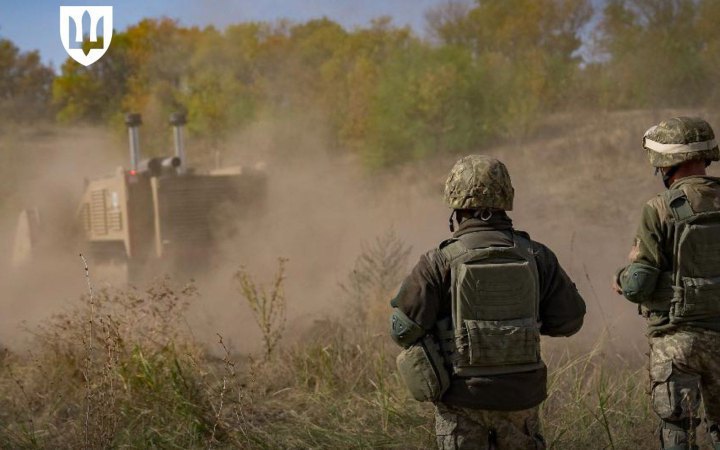
The National Mine Action Authority has decided to restrict the planning of new humanitarian demining activities in certain areas near the front line and Ukraine’s state border with Russia.
The decision was taken at an extraordinary meeting of the National Mine Action Authority chaired by Ukraine’s Deputy Defence Minister Vasyl Shkurakov, the Defence Ministry reports.
The restrictions apply to contaminated and potentially contaminated areas in Donetsk, Dnipropetrovsk, Kherson, Mykolaiv, Kharkiv and Sumy regions, located within 20–50 km of the line of contact and the state border with Russia. This concerns sites where humanitarian demining has not yet begun.
“Humanitarian demining remains a priority even in frontline areas. But we must act on the basis of a risk-based approach in order to strike a balance between the safety of the people carrying out demining and the needs of communities in frontline areas,” Vasyl Shkurakov said.
The decision was made in view of the current security situation and the heightened risks to mine action operators’ personnel and the civilian population.
The restrictions introduced do not envisage a complete halt to humanitarian demining in frontline areas. Work on sites where it has already started should be completed, provided the security and operational situation allows and it does not hinder tasks carried out by Ukraine’s Defence Forces.
Quality assurance of demining will also be carried out on cleared sites, and the results of the work will be formally documented.
In addition, initial non-technical surveys of community areas within 50 km of the line of contact and the state border with Russia are being suspended.
Instead, targeted non-technical surveys will be conducted in this zone by government mine action operators. If their resources are insufficient, non-profit non-governmental operators may be involved in the work with consent.
Unscheduled measures may also be carried out following substantiated requests from regional military administrations, the Humanitarian Demining Centre and mine action operators. This will be permitted provided the security situation is conducive to the work and it does not interfere with tasks of Ukraine’s Defence Forces.
Within the 50-kilometre zone, priority will be given to rapid-response measures aimed at protecting the life and health of civilians and reducing the risk of harm from explosive ordnance.
In particular, priority will be given to work needed for:
- the safe evacuation of the population;
- conducting emergency rescue and other urgent works;
- ensuring access to civil defence shelters;
- providing medical and humanitarian assistance;
- rapid response to threats related to explosive ordnance.
Colonel Ruslan Berehulia, Head of the Main Directorate for Mine Action, Civil Protection and Environmental Safety, stressed that in conditions of constant change in the operational situation, the key task remains protecting mine action operators’ personnel and the civilian population.
The further organisation of humanitarian demining in frontline areas will be determined with account taken of ongoing analysis of the security and operational situation. Coordination is also envisaged between state authorities, Ukraine’s Defence Forces, regional military administrations, mine action operators and international partners.