





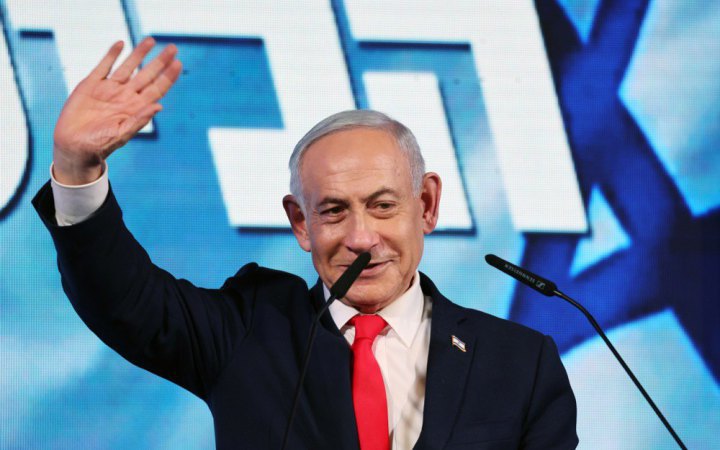
More than half of the votes have been counted in Israel’s parliamentary election, the BBC reports.
After 60% of the votes were counted, neither of the two main blocs has a chance of securing a majority.
Gadi Eizenkot, the former Chief of the General Staff of the Israel Defense Forces, leads the newly formed Yashar party and is a key figure in the “change bloc”.
According to the latest results, Prime Minister Benjamin Netanyahu’s Likud party is set to become the largest single political force.
Netanyahu is calling for the formation of a “strong” right-wing government, while Eizenkot insists that Israel has voted to end the Netanyahu era.
As Radio Liberty writes, citing the website of Israel’s Central Election Commission, Likud is in the lead with 21.45% of the votes counted — 732,001 voters.
Yashar has the support of 16.24%, or more than 554,000 voters.
Third place is held by the Together party, led by the country’s former prime minister Naftali Bennett, with the support of 322,000 voters — 9.46%.
As of 09:16, ballots from 3.4 million citizens had been counted. The total number of eligible voters is 7.3 million.
The vote will allocate all 120 seats in the Knesset — Israel’s parliament — but no party has ever won a majority on its own, so in the past governments have always been formed on a coalition basis. Exit poll results released after polling stations closed predict 24 or 25 Knesset seats for Likud, while Yashar would win 21 or 22 seats.
How a Coalition Is Formed
The coalition-building process begins after the votes are counted: Israel’s president holds consultations with party leaders and then asks the one he believes has the best chance of success to form a government.
The candidate then has 28 days to form a coalition; if necessary, this period can be extended by a further 14 days.
If negotiations fail to produce a result within that time, the president may choose another candidate to try to form their own coalition.
If that attempt also fails, Knesset members may ask the president to give a third leader a chance. If this does not succeed either, new elections will be called.
Between 2019 and 2022, Israel held five election campaigns, as parties repeatedly struggled to reach workable agreements.
In the 2022 election, Likud, led by Netanyahu, became the largest political force, winning 32 of the 120 seats in parliament. Netanyahu later formed a coalition with several far-right parties, giving him and his allies a majority of 64 seats.
- Turnout in Sunday’s election was the highest since 1973 — more than 74%. Long queues formed outside polling stations. These were the first elections since Hamas’s attack on southern Israel on 7 October 2023 and the wars in the Gaza Strip and Lebanon, as well as the military conflict with Iran.