





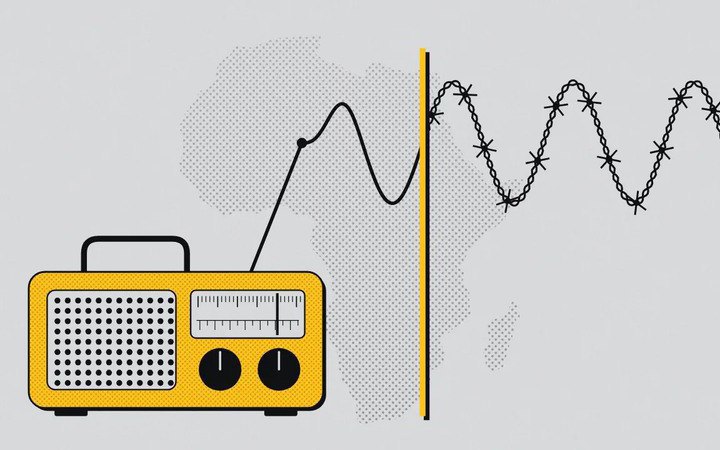
Russia is opening editorial hubs in Africa, striking deals to broadcast on local radio stations, launching digital platforms and engaging local journalists and bloggers. Through these platforms, Moscow is recruiting for its army, the Defence Ministry’s Main Intelligence Directorate (HUR) reports.
Behind talk of culture, language and the “friendship of peoples”, professional propagandists push Kremlin narratives: anti-Western, anti-Ukrainian and justifying Russia’s criminal aggression.
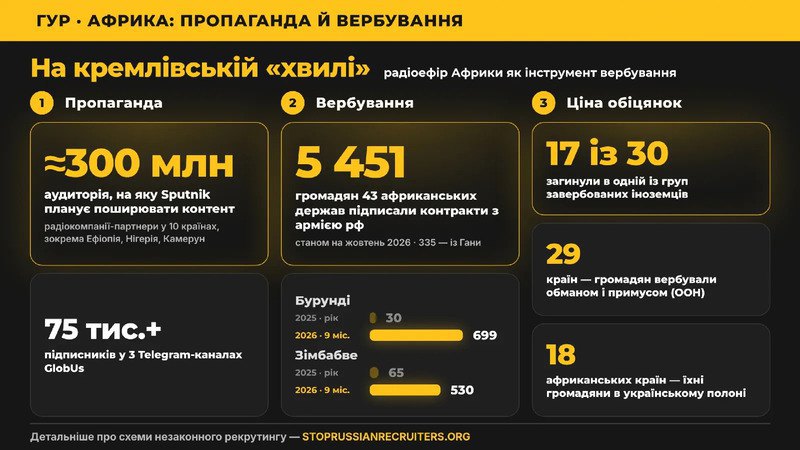
The Russian state news agency Sputnik is building a network of presence across the African continent. Its editorial centres operate in Johannesburg (South Africa) and Dar es Salaam (Tanzania). Through local journalists and partner radio stations, the Kremlin plans to distribute content in several languages to an audience of nearly 300 million people. Radio companies in Ethiopia, Botswana, Malawi, Uganda, Nigeria, the Central African Republic, Mali, Niger, Guinea and Cameroon are being brought into the broadcast network.
“The substance of this information expansion is not limited to news — Moscow is promoting narratives about fighting neo-colonialism, confronting Western countries and supposedly defending the sovereignty of African states,” the intelligence service said.
Another tool of information interference is the GlobUs digital platform. A report by the French state service VIGINUM exposes the activities of this Russian influence network linked to the former structures of Yevgeny Prigozhin. It is headed by Russian political strategists Yuliya Berg and Andrey Gromov, who organised information campaigns, including in Cameroon and the Republic of the Congo.
GlobUs engages local journalists, bloggers and political figures to spread anti-Ukrainian and anti-Western material. The network has three Telegram channels with a combined audience of more than 75,000 subscribers.
The Vozrozhdenie foundation, previously set up by Gromov, spread Russian narratives about the war against Ukraine, organised trips by foreigners to temporarily occupied territories and supported the production of propaganda films about Donbas.
Moscow is also expanding the recruitment of Africans into its own army, seeking to offset colossal losses in the war against Ukraine.
HUR adds that information influence is only part of Russia’s presence on the continent. In parallel, Moscow is expanding the recruitment of Africans into its own army, trying to compensate for losses in the war against Ukraine.
According to Ukrainian intelligence, as of October 2026, the personal details of at least 5,451 citizens of 43 African states who have signed contracts with the Russian Armed Forces have been identified. Among them are at least 335 citizens of Ghana.
In some African countries, the scale of Russian recruitment has risen sharply. In the first nine months of 2026 alone, Russia recruited 699 citizens of Burundi and 530 citizens of Zimbabwe. By comparison, for the whole of 2025 the respective figures were 30 and 65 people. This trend points to a deliberate expansion of recruitment networks in countries whose populations are particularly vulnerable to promises of quick earnings.
To attract people, recruiters use offers of well-paid civilian work, large sign-on payments, Russian citizenship and social benefits. Men are lured with vacancies as drivers, security guards, builders and logistics workers. Often, they learn the true purpose of the trip only after arriving in Russia. Instead of the promised work, they face military contracts written in Russian that many do not understand, followed by deployment to the front line in Ukraine.