





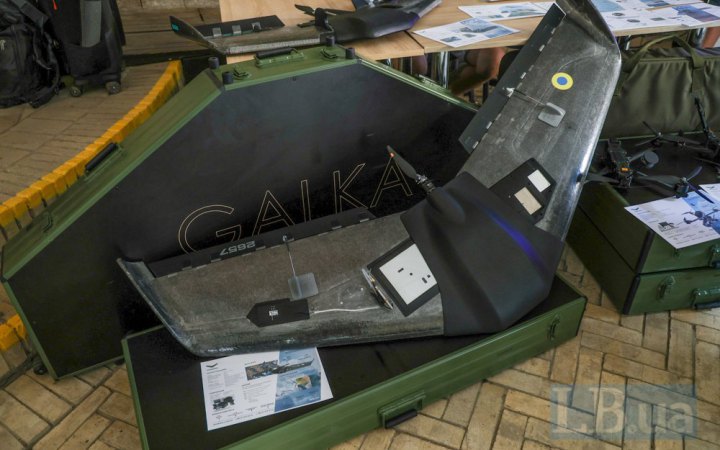
Ukrainian company Warbirds is upgrading its Soika and Halka reconnaissance drones. In particular, the manufacturer will focus on improving their resilience to electronic warfare (EW) systems, autonomy and the accuracy of GPS-denied navigation. This is reported by the publication Oboronka, citing a company representative.
For the Halka drone, Warbirds has introduced wideband antennas. They enable operation across a broad frequency range and allow pseudo-random changes of the working frequency, making it harder for EW systems to counter it. According to the company representative, even in the most challenging sections of the front line during a three-hour flight, the total time without telemetry is about 20 seconds.
For the Soika reconnaissance aircraft, the developers have created interchangeable antennas that operate in other frequency bands. They can be replaced independently before take-off depending on the conditions in which the drone will be used. At the same time, the company continues to work on specific design solutions for this system in order to preserve its compact dimensions and aerodynamic characteristics.
According to the manufacturer, both drones can also carry out missions autonomously. If the enemy suppresses the control channel, the drone will continue along a pre-defined route and will be able to return with photographs and other collected data.
Another area of modernisation is navigation using radio beacons. Warbirds has already integrated this technology into Soika and both current versions of Halka — Mk2 and Mk3. It makes it possible to determine the drone’s location in the absence of a satellite signal. In addition, the developers added odometry which, combined with visual navigation, improves positioning accuracy and reduces the risk of the drone losing orientation.
The developers also plan to improve the drones’ optical equipment. For Soika and Halka Mk2, they are preparing a switch to full-frame sensors. And for the Halka Mk3 version, the developers plan to install a module with better optical characteristics, increased optical and hybrid zoom.
Separately, Warbirds is testing technologies for detecting and countering the interception of drones in the optical, acoustic and radio-frequency spectra. While developing these solutions, the company is gathering feedback from service personnel to assess their effectiveness in combat conditions and their suitability for crews’ needs.
Among the developer’s further plans are extending the flight range of the reconnaissance aircraft, improving the quality of photo and video capture, and automating flights.
As a reminder, Warbirds recently unveiled a new long-range FPV drone, the DZYGA-17S. The drone is currently undergoing trials with two military units, while its codification is continuing in parallel.