





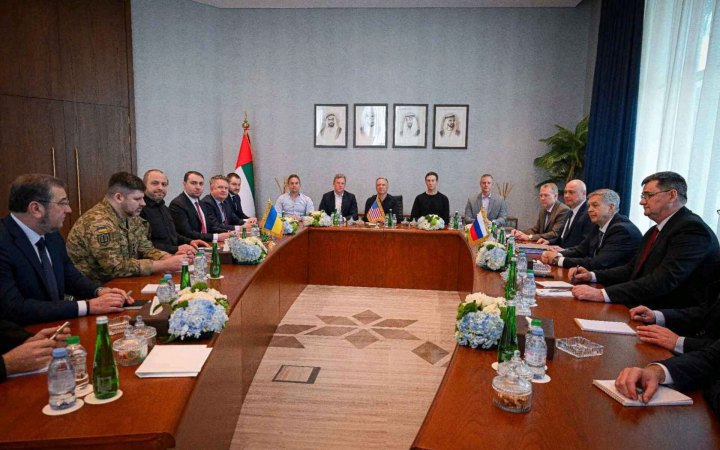
Two-day talks between the teams of Ukraine, the United States and Russia begin in Abu Dhabi today. This is the first in-person trilateral meeting between the countries since February.
On 9 November, Rustem Umerov of the Foreign Intelligence Service said that he and the other negotiators were already on their way to the UAE. He described Ukraine’s goal as a long-term and sustainable peace, guaranteed security, and real opportunities for post-war recovery.
Three parties will take part directly in the talks, but European partners will also be present in the Emirates. These include representatives of Germany, Italy, France, the United Kingdom, as well as the European Commission and NATO.
“For us, it is essential to maintain close coordination with all our key partners, ensure alignment of positions and a shared understanding of the next steps in the negotiating process. As defined by President Volodymyr Zelenskyy, we are doing everything to ensure that Europe is a participant in the diplomatic process,” Umerov said.
Delegation line-ups
During previous rounds of talks in January, Volodymyr Zelenskyy approved by decree a 10-member delegation: Umerov; the head of the President’s Office, Kyrylo Budanov; the head of the Servant of the People parliamentary faction, Davyd Arakhamia; the President’s adviser Oleksandr Bevz; and representatives of the Defence Intelligence of Ukraine and the Security Service of Ukraine, the General Staff and the National Security and Defence Council. There has been no information about approval of a new line-up.
Russia, as before, will be represented by Vladimir Medinsky, an aide to Vladimir Putin, along with two representatives of the Foreign Ministry and two representatives of the General Staff of the Russian Armed Forces.
The United States will be represented by special envoy Steve Witkoff and presidential adviser Jared Kushner.
Talks in 2025–2026
Until last summer, trilateral talks were held in Turkey. The most recent was in July 2025. The only outcome of those discussions was several rounds of prisoner exchanges. The desired result—a trilateral meeting of the presidents of Ukraine, the United States and Russia and an end to the war—was never achieved, and Russia did not budge on its demands.
Last year’s talks were the first contacts between Ukraine and Russia beyond humanitarian issues since 2022. Back then, at the very start of the full-scale invasion, representatives of the countries also met in Turkey. Before that, there were meetings in Belarus.
In autumn 2025, the United States brought a peace plan to Kyiv, some provisions of which were categorically at odds with Ukrainian interests. The 28-point proposal envisaged limiting the size of Ukraine’s Armed Forces to 600,000 personnel, enshrining in the Constitution a ban on joining NATO, relinquishing the entire Donetsk region and recognising it, as well as Crimea and the Luhansk region, as de facto Russian at the global level.
This plan emerged after secret consultations between the Trump administration and the Russians, Axios wrote. According to the outlet’s sources, it was inspired by President Trump’s successful push for a deal on Gaza. Both Ukraine and its European partners spoke out against the plan, and Kyiv stepped up diplomacy to ensure trilateral meetings ultimately began.
Ukraine passed its proposals to the United States, which discussed them with Moscow. Moscow also passed its proposals to the Americans for them to discuss with Ukraine. Over several rounds of talks, a framework for an updated plan was developed. No consensus was reached on territorial issues: Russia continued to demand that Ukraine withdraw its troops from the free parts of the Donetsk and Luhansk regions and, in effect, закрепить for itself the territory it had managed to occupy in Crimea, the Donbas and the south. Ukraine was prepared to negotiate a ceasefire along the current front lines, but not to cede free territory. As a compromise, the United States proposed a so-called demilitarised zone in the parts of the Donetsk and Luhansk regions that the enemy had not managed to occupy.
As of the end of December, Volodymyr Zelenskyy said that 90% of the peace plan had been agreed and 100% of security guarantees for Ukraine. Discussions on the guarantees and Ukraine’s post-war recovery plan were held with the United States and Europe.
In February, after the start of the war by the United States and Israel against Iran, the meetings were suspended. Ukraine repeatedly called for them to resume, but the United States focused on the Middle East and domestic issues, while Russia, as before, showed no readiness for constructive engagement.
Ultimately, after Steve Witkoff visited Ukraine and then Russia, it was agreed to resume the trilateral format.