





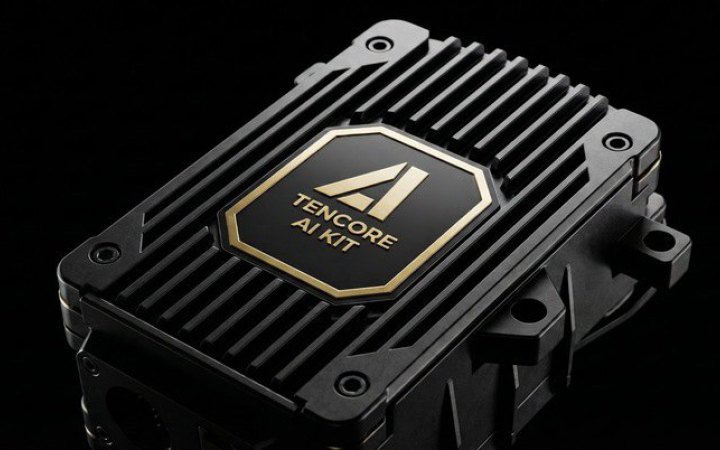
Ukrainian company Tencore is preparing its AI KIT artificial intelligence module for UGVs for mass production and scaling up. The system’s capabilities were demonstrated at the European Defence Innovation Forum 2026 in the Netherlands. This is reported by Militarnyi, citing Tencore CEO Maksym Vasylchenko.
According to him, an earlier version of AI KIT has already been tested directly in combat conditions. More than 20 kits were delivered to military units for practical use. This was preceded by in-house and field-range trials conducted by the developer.
The company is currently preparing a larger shipment—210 modules. According to Maksym Vasylchenko, they will be received both by units that have already tested the system and by those that were recommended it by other servicemen.
AI KIT is an entirely in-house development. All components of the system are combined into a single autonomous unit. The module was first publicly presented in July 2026.
The system’s main purpose is to ensure a UGV can continue its mission after losing contact with the operator and navigation coordinates. If the signal is jammed by the enemy or other interference occurs, the UGV can independently detect the loss of communications and continue moving in line with pre-programmed algorithms. This makes it possible not to interrupt a mission because of circumstances that cannot be accurately predicted when planning the route, the company said.
Read alsoRobotisation of the kill zone: the story of UGV use and today’s challenges and tasks
The first combat use of a UGV with AI KIT took place in the summer of 2026. According to Tencore’s CEO, the robot successfully covered the required distance and completed the assigned task. Over the year, developers refined the computer-vision algorithms, adapting them to different seasons and terrain types typical of the front line.
At the initial stage, the system was trained to distinguish snowy tracks and off-road terrain. In spring, the focus shifted to movement along forest roads, through shelterbelts and over damaged routes. Engineers are now working to expand object-recognition capabilities. In particular, AI KIT must learn to identify potential obstacles along the route and assess the likelihood of mine hazards. The system should not only identify an unknown object but also inform the operator exactly what it has detected. Based on the probability assessment, the algorithms will be able to determine the next actions.
Recently, the company reported that the module has become part of the Tencore Ecosystem technology environment, which brings together four classes of serially produced ground robotic platforms for military and civilian tasks.
In addition, Tencore added support for daytime RGB cameras to the module, allowing it to be used both in low light and during the day.
Tencore’s next area of work will be integrating AI KIT into ground robotic systems made by other Ukrainian manufacturers. The company plans to install the module first on its own Matilda and TOR platforms, after which it will offer it to other developers and military users.
A presentation of the major update—AI KIT 2.0—is scheduled for spring 2027. The new version will have expanded functionality and a significantly larger memory capacity. This will make it possible to run more complex artificial intelligence models directly on board ground robotic platforms, Maksym Vasylchenko noted.