





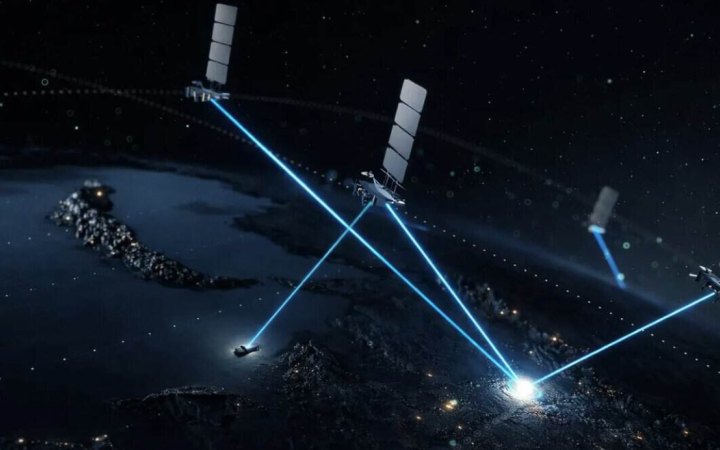
Russia is trying to speed up the deployment of its own low-Earth-orbit satellite communications system, “Rassvet”, which it presents as an analogue of Starlink. However, the project is facing technological and manufacturing difficulties.
This is reported by the Main Intelligence Directorate of Ukraine’s Ministry of Defence.
The occupiers’ problems have arisen due to dependence on foreign components; there are difficulties with placing the spacecraft into the planned orbit and with developing subscriber terminals.
According to intelligence, Russia has already placed 30 satellites into orbit in two batches: on 23 March and 19 July 2026. Two spacecraft later deorbited. Of the remaining 28 satellites, 26 are at an altitude of about 500–520 km, although the project envisages operation at an altitude of 800 km.
The other spacecraft continue manoeuvres to reach the target orbit. A third satellite launch planned for 2026 has, according to preliminary information, been cancelled or postponed.
The occupiers plan to increase the number of spacecraft in orbit to 48 in 2026
By the end of 2026, the Russians expected to increase the satellite constellation to 47–48 spacecraft. In 2027, they plan to launch a further 240 satellites. This is intended to provide coverage of 94% of Russia’s territory with data transmission speeds of up to 150 Mbit/s.
They also want to scale up the system further: by 2031 the constellation is to comprise 408 satellites, and by 2035 — 924.
Each satellite weighs about 280 kg, and its dimensions are 2.7 × 1.8 × 0.6 metres. One of the system’s key technologies is inter-satellite laser communications. This allows information to be transmitted between spacecraft without constant reliance on ground infrastructure.
Russia Depends on Chinese Electronics
Russia is also working on creating terminals for connecting to satellite internet. In September 2026, tests were completed on the “Ultra” model which, according to the developers, can provide download speeds of up to 650 Mbit/s. By the end of the year, they plan to produce about a thousand of these devices.
The system’s main developer is the company “Bureau 1440”. The project involves 46 Russian and three Belarusian enterprises. At the same time, Russia depends on Chinese electronics needed to manufacture antennas, ground equipment and terminals.
The project is overseen by Roscosmos head Dmitry Bakanov. Previously, he led a company that cooperated with the British firm OneWeb. After the start of the full-scale invasion and the termination of cooperation with Russia, the British side withdrew from the project. The Main Intelligence Directorate suggests that the Russians may have used some of OneWeb’s technological developments to create their own system.
- Reuters previously reported that Russia is already using “Rassvet” for military communications over Ukraine. According to the Main Intelligence Directorate, the system enables Russian drones to transmit reconnaissance data in real time, change routes during flight and adjust strikes. At the same time, the current number of satellites is still insufficient for continuous coverage of Ukraine’s territory.
- Andrii Yusov, a spokesperson for the Main Intelligence Directorate of the Ministry of Defence responsible for strategic communications, noted that the connection is available intermittently, when satellites pass over the relevant areas. In the longer term, expanding the constellation could improve the accuracy of Russian strike drones and make them harder to intercept using Ukrainian air defence and electronic warfare assets.