





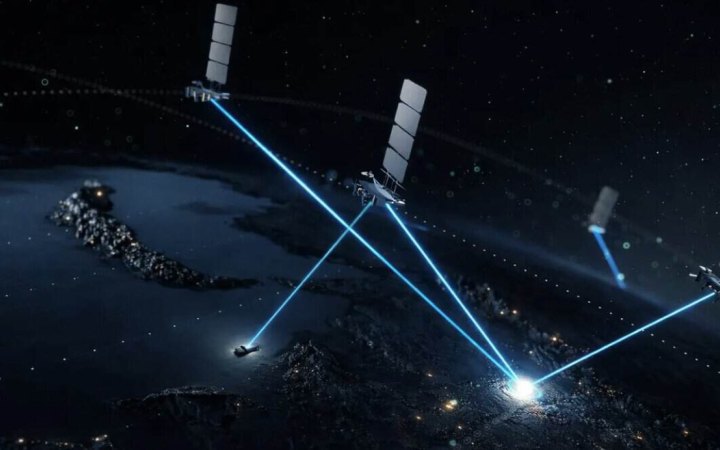
Russia is already using its own “Rassvet” satellite network, billed as an analogue of Starlink, for military communications over Ukraine. The system is expected to improve the accuracy of Russian strike drones and make them less vulnerable to electronic warfare.
Reuters reported this, citing Ukraine’s Defence Intelligence (HUR).
According to the Main Intelligence Directorate, Russia has put 32 “Rassvet” satellites into orbit this year in two batches – in March and July. Last month, the Russian authorities said they had launched more than 30 satellites.
In Moscow, further launches are planned through to the end of 2026 to expand geographic coverage and gradually deploy a fully fledged low-Earth-orbit communications system.
HUR spokesman Andrii Yusov confirmed the network is being used for military purposes in Ukraine. At the same time, he said, the current number of satellites is insufficient for continuous coverage.
“The current constellation is not enough to provide continuous coverage of Ukraine: communications are available intermittently, when satellites pass over the relevant areas,” Yusov said.
By comparison, SpaceX founder Elon Musk’s Starlink network has more than 10,000 satellites. Its military version, Starshield, operates in Ukraine but is not available to Russia. Access to SpaceX systems has significantly helped Ukraine in conducting combat operations.
According to HUR, “Rassvet” can provide two-way data exchange with drones over Ukraine. This would allow reconnaissance drones to transmit information in real time, and strike UAV operators to change routes while already in flight. In particular, drones would be able to respond to changes in a target’s location or bypass Ukrainian air defences.
In the longer term, this could increase the effectiveness of Russian strike and reconnaissance drones and make them harder to intercept using electronic warfare and intelligence capabilities, Yusov believes.
Kyiv-based security expert Mykola Zentsev also reported signs that “Rassvet” is already affecting the accuracy of strikes by Russian jet-powered drones. According to him, Russia has at least two periods of high-quality satellite communications each day, each lasting more than an hour.
Reuters also notes that Ukrainian military commanders encountered temporary Starshield speed restrictions, which made it harder to intercept Russian strike drones and led to the cancellation of some strike operations. Those restrictions were later lifted, but no explanation was given for why they were introduced.
Russia has also stepped up attacks on Ukraine’s energy infrastructure and cities, using a new generation of jet-powered drones that are harder to intercept.
Last week, Ukrainian President Volodymyr Zelenskyy imposed sanctions on 10 companies involved in the development of “Rassvet”. Among them is the Russian bureau “1440”, which coordinates the state project. The company plans to create a constellation of more than 900 satellites by 2035.
Earlier, HUR deputy chief Major General Vadym Skibitskyi said Russia is deploying the system faster than planned, and Ukraine is already discussing ways to counter it.
Ukraine’s intelligence service has also published a list of 49 Russian and Belarusian companies which, it says, are involved in the project. Ukraine has also urged the United States to impose sanctions on enterprises supporting the development of Russia’s Starlink analogue.
According to Ukraine’s chargé d’affaires in Washington, Russia is developing the system using Chinese components.