





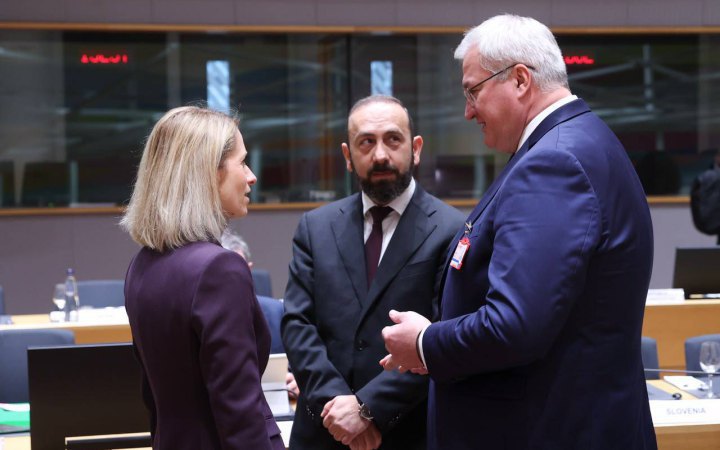
Ukraine’s Foreign Minister Andrii Sybiga called for a joint effort to protect the Black Sea’s maritime routes and critical infrastructure. He stressed that Russian aggression threatens international trade, transport links and global food security.
This is stated in a statement by the press service of Ukraine’s Foreign Ministry following Sybiga’s participation in the first session of the ministerial meeting on implementing the EU Black Sea Strategy, held on 16 November.
“Russia is turning the Black Sea into another Hormuz. The consequences for global food security could be as devastating as the impact of the situation in the Strait of Hormuz on oil prices,” the minister said.
According to him, as a result of Russian aggression, more than 1,600 port facilities have been damaged, and more than 260 civilian vessels have been hit. Disruption to maritime routes could drive global food prices up by as much as 25%, with the poorest countries suffering the most.
Sybiga outlined three key priorities for Ukraine in regional connectivity: security; the development of transport and energy infrastructure; and integrating these areas into Ukraine’s recovery and its accession to the EU.
He described security as the first and decisive priority. The minister stressed that without protecting maritime routes and critical infrastructure, it is impossible to develop transport links.
“There is no connectivity without security,” the foreign minister emphasised.
He also called for a food ceasefire in the Black Sea.
Sybiga said the second priority was developing resilient, diversified and interconnected transport and energy infrastructure. According to him, Russia has carried out more than six thousand attacks on Ukraine’s railway infrastructure and, since mid-summer, has been striking Ukraine’s energy system virtually every day.
“Diversification is the key to independence. And the more options you have, the stronger you are,” the minister noted.
Among the important areas, he highlighted the development of the Middle Corridor via the South Caucasus, the creation of a single multimodal transport space in the Black Sea and Danube regions, and integration into the trans-European transport network TEN-T.
This includes modernising ports, expanding European-gauge rail lines, speeding up border crossings and introducing digital procedures. Ukraine also supports the Trans-Caspian International Transport Route and is ready to ensure its connection to European markets via the Black Sea, the Danube and the Solidarity Lanes. To diversify energy supplies, Sybiga noted the potential of the Trans-Balkan Gas Corridor.
The minister identified the third priority as integrating regional connectivity into Ukraine’s recovery and its accession to the European Union.
“Every port we rebuild and every railway line we connect to Europe is an investment in Europe’s shared future,” Sybiga stressed.
He proposed deepening coordination with the European Commission, international financial institutions, Turkey, the countries of the South Caucasus and Central Asia to deliver joint infrastructure projects.
Summing up his remarks, the foreign minister emphasised the need for joint efforts to change the Black Sea’s role in the region.
“Russia wants to turn the Black Sea into a space of fear and blockade. Together, we can make it a space of security, development and shared opportunities,” Andrii Sybiga said.