





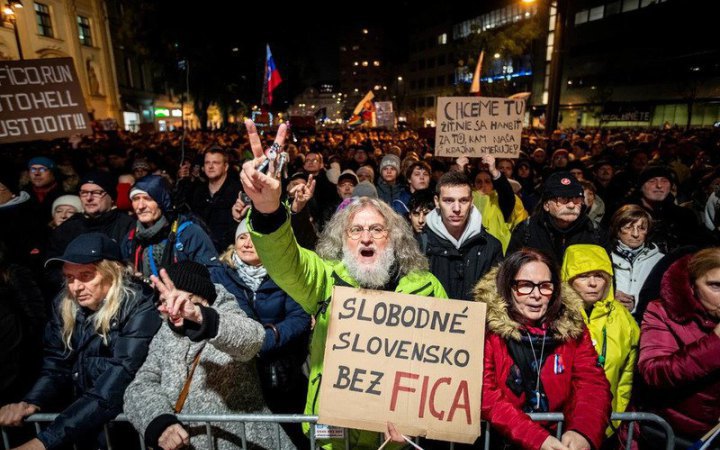
Yesterday, protests took place in Slovakia against Prime Minister Robert Fico and his pro-Russian government, DW reports.
The demonstrations were organised by opposition parties and non-governmental organisations (NGOs).
The largest protest was held in the capital, Bratislava, in SNP Square, where the main anti-communist rallies took place during the 1989 “Velvet Revolution”. According to organisers, 25,000 people gathered there.
Rallies were also held in other cities, including Košice and Banská Bystrica.
The protests took place on the anniversary of the “Velvet Revolution”, which brought decades of communist rule in the country—then known as Czechoslovakia—to an end. Protesters commemorated the fall of the communist dictatorship that had dominated Czechoslovakia for 41 years. They also called for stronger support for Ukraine.
However, demonstrators focused primarily on Slovakia’s prime minister, chanting slogans such as: “We’ve had enough of Fico!” One placard told the prime minister to “go to hell”.
Europe’s Most Pro-Russian Leader
After Hungarian Prime Minister Viktor Orbán lost power in April, Fico became the most pro-Russian leader in Europe.
He opposes providing military aid to Ukraine and supports close ties with Russia’s President Vladimir Putin, despite European Union sanctions against the Russian Federation.
Fico, who has served as prime minister four times over the past more than two decades, has faced numerous protests since returning to power in 2023.
In addition, Fico has repeatedly clashed with the EU. Last year, amendments were made to Slovakia’s Constitution stipulating that national legislation takes precedence over EU law.
He is also criticised for attempts to tighten control over the media and the cultural sector, as well as for restricting the rights of the LGBTQ+ community.