





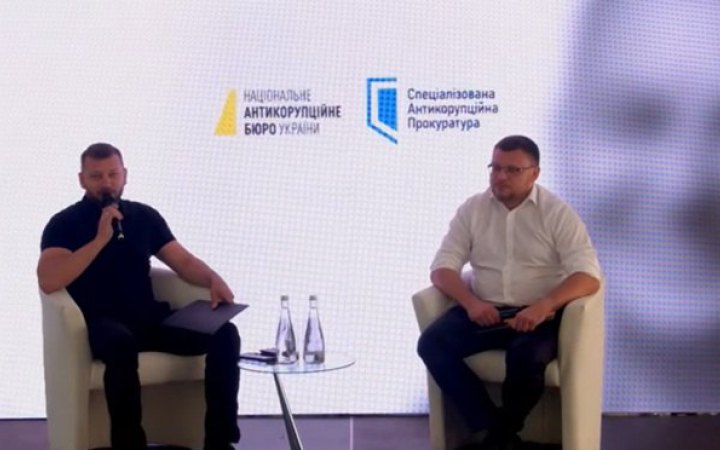
NABU Director Semen Kryvonos said that corruption in the defence sector directly undermines Ukraine’s defence capability. According to him, one of the risks is the emergence of influential beneficiaries in large companies that supply weapons.
Kryvonos and SAPO head Oleksandr Klymenko said this at a briefing on the results of the first half of the year.
“Without a doubt, corruption undermines the country’s defence capability. That is an absolute fact,” Kryvonos stressed, adding that the defense sector remains one of the top priorities for NABU and SAPO.
“If we talk about crimes in the defence sector, defense is in the focus of our attention. It is one of the highest priorities to which NABU and SAPO direct the most resources for investigations,” the NABU director said.
Kryvonos drew attention to the changing nature of corruption risks in defence procurement.
“Right now, a certain transformation of corruption is taking place. Influential beneficial owners may suddenly appear in large weapons-supplying companies,” he said.
According to the NABU director, senior officials may end up among the beneficiaries of such companies.
“Based on agreements or some unknown sources, senior officials from law enforcement agencies, parliament, or other state bodies end up among them. In effect, they become co-beneficiaries of certain companies,” Kryvonos said.
He noted that outwardly such situations may look like ordinary large contracts to supply effective weapons. At the same time, NABU is interested in how exactly the company obtained the contract and whether competition was eliminated in the process.
“What matters is how the company obtained the contract and whether competition was eliminated in the process,” the bureau director emphasised.
Kryvonos explained that investigating such cases is difficult because detectives have to identify the ultimate beneficiaries and track a significant number of financial transactions.
“NABU has to track hundreds of financial transactions abroad, identify the ultimate beneficiaries, and document their influence,” he said.
Separately, the NABU director emphasised that corruption risks are not limited to weapons procurement.
“This also concerns procurement and the construction of shelters and systems to protect critical infrastructure, because corruption makes the state apparatus ineffective,” Kryvonos noted.
SAPO head Oleksandr Klymenko added that NABU and SAPO cannot, on their own, cover all possible violations in the defence sector.
“NABU and SAPO cannot independently overcome corruption in the defence sector because of the scale of the defence budget and the number of procurements,” Klymenko said.
According to him, effective anti-corruption efforts require joint work by law enforcement agencies and the Ministry of Defence.
“Results are possible only in such a symbiosis, when the Ministry of Defence also takes measures to reduce corruption risks,” the SAPO head stressed.
Klymenko also added: “We can investigate specific cases and show how corruption schemes work, and then the ministry must make administrative decisions to prevent their further spread.”
According to him, transparency in procurement should be an important tool.
“Corruption in defence procurement must be reduced through consistent steps, including transparent tenders and procurement, so that contracts go to companies that offer a quality product at a lower price, rather than those who secure them through kickbacks,” Klymenko said.
He also reported that over the past six months, the Ministry of Defence for the first time approached NABU with a request to analyse corruption risks in the defense sector. The bureau, he said, provided the relevant analysis.
- During the briefing on the results of the first half of the year, SAPO head Oleksandr Klymenko said that the level of corruption in Ukraine is not decreasing and is even rising at the highest level. According to him, the state is currently showing insufficient political will to properly fight corruption.