





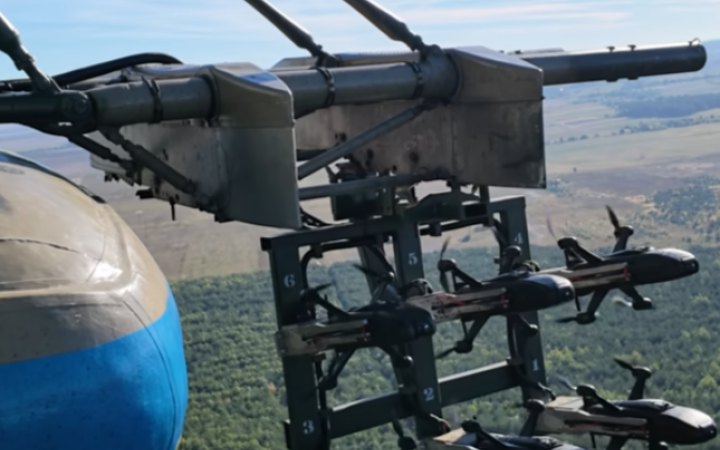
The US newspaper The New York Times has released footage showing Ukrainian F7 Litavr anti-air interceptor drones being deployed from a Mi-8 helicopter on the front line. The video was published in a report on countering Russian jet-powered drones.
The published videos show F7 Litavr interceptors mounted on the helicopter’s hardpoints; they were developed by the Ukrainian company F-Drones. According to an assessment by Defence Express, up to 12 such drones can be carried on a Mi-8 — two on each mounting point.
❗️Additional footage of the use of Ukrainian F7 “Litavr” interceptor drones launched from a 🇺🇦Mi-8 helicopter https://t.co/9PZvq08wzC
— 🪖MilitaryNewsUA🇺🇦 (@front_ukrainian) October 23, 2026
This could potentially allow the helicopter to intercept up to 12 enemy UAVs in a single sortie using interceptor drones alone. The emergence of such systems is important given the appearance of Russian Shahed-type strike drones with online control, Defence Express notes.
The outlet explains that using the F7 Litavr from helicopters could potentially make it possible to intercept guided Russian UAVs at distances of tens of kilometres, without closing to a dangerous range. At the same time, the actual interception range depends on the drones’ characteristics, operating conditions and target-detection capabilities.
Earlier, the use of anti-air drones from a helicopter was shown in a message by Volodymyr Zelenskyy marking Independence Day in August 2026.
The Ukrainian company F-Drones began developing the Litavr interceptor UAV in autumn 2024, and in summer 2025 the drone was successfully tested and codified. Serial production and deliveries to the military began in autumn 2025.
The drone is designed to destroy aerial targets and engage ground objects. Litavr has an automatic terminal guidance system (Last Mile or Pixel Lock). It identifies the target and independently guides the drone into the attack: during the final approach, the pilot controls only the speed, while the rest of the process is handled by the automation.
The stated maximum speed of the system is 350 km/h. According to the company, the operational radius is 40 km, and the maximum flight altitude is 9 km. The drone is equipped with both a daylight and a thermal-imaging camera — the pilot switches between them in flight depending on conditions and the time of day.