





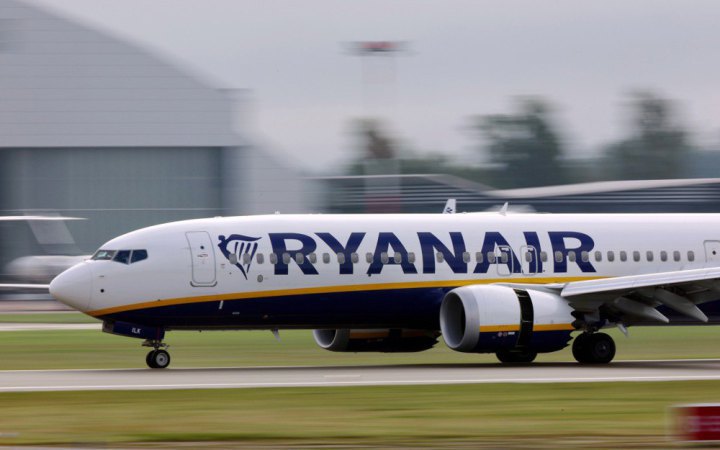
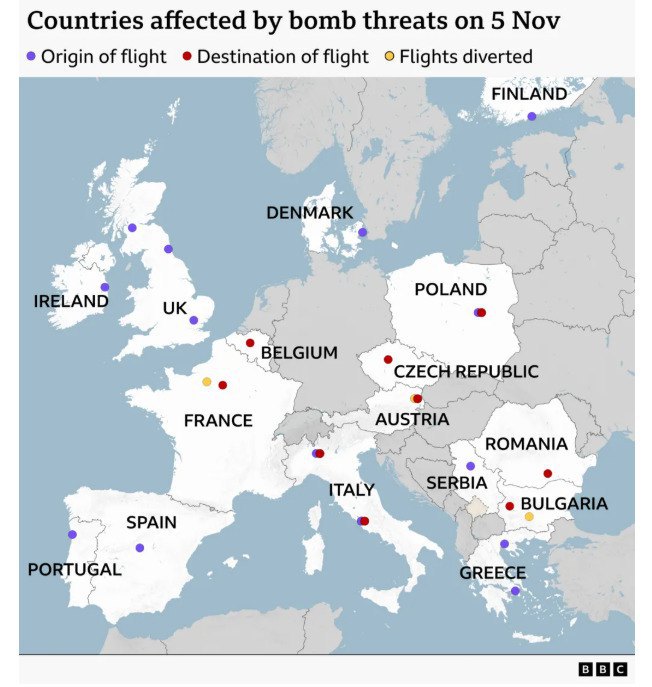
At least 21 flights and several airports in Europe received threats yesterday claiming explosive devices had been planted, the BBC reports.
In almost all cases — with the exception of London Heathrow Airport — the threats were considered serious enough to reroute the aircraft concerned.
In Italy, fighter jets were even scrambled to escort them.
“All of these messages turned out to be false, which of course does not guarantee that the next threats will not be real. It is hardly surprising that, given the simultaneous and co-ordinated nature of these hoax threats, as well as other hostile actions in Europe, some are beginning to suspect Russia,” the outlet notes.
This year, Europe has recorded a series of cyberattacks, the appearance of drones over key sites, remote hacking of cooling systems in supermarkets and a blood bank, as well as a suspicious incident on the Polish-Russian border. In August, there was also a drone incident at Leipzig/Halle Airport in Germany, responsibility for which the country’s Chancellor Friedrich Merz publicly blamed on Moscow.
Many argue, relying solely on circumstantial evidence, that these events are yet another example of “hybrid” warfare — war in the “grey zone”, or actions that fall short of the threshold of full-scale conflict.
This refers to measures that damage a state’s infrastructure or society but typically remain anonymous, allow plausible deniability, and do not reach the level that would trigger Article 5 of the NATO Charter and, as a result, provoke a response from the West.
However, as of Thursday evening, no credible evidence had emerged linking these false threat messages to airlines with Russia, Iran or any groups under their control.
Yesterday morning, the administration of an airport in Rome received a threatening email sent in the name of the “Fighters of the Male State” (Fighters of the Male State). “This name likely alludes to the Russian group the ‘Male Legion’ — an ultra-right organisation whose views were so radical that a Moscow court banned its activities in 2021,” the BBC writes.
National police services, airport authorities and transport ministries are now trying to establish who is behind these fake messages and how best to minimise their impact in future.