





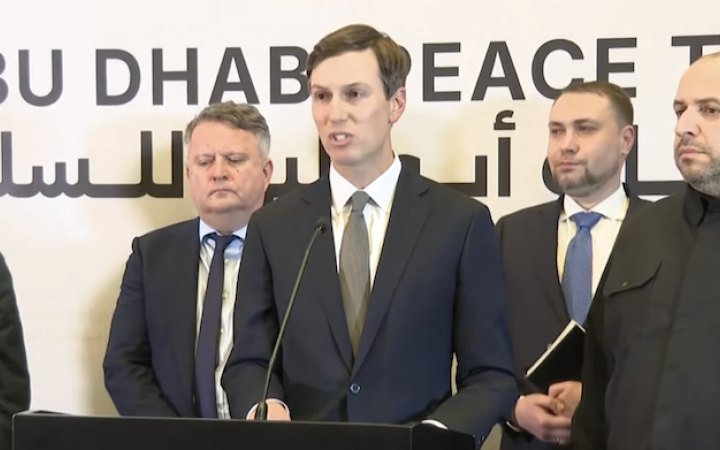
On 11 November in Abu Dhabi, the second day of talks between Ukraine and Russia took place with US mediation. The sides agreed on a prisoner exchange and discussed security issues. The most difficult item on the agenda was territory.
This meeting was the final one in this round.
Live
15:21. The President of Ukraine received information on the outcome of the talks from the Ukrainian delegation.
“First: an important humanitarian agreement to prepare a new exchange. Second: the sides discussed their views on ensuring security, and the first step must be ending this war and providing security guarantees for Ukraine. Third: they discussed broader formats for further work with the participation of Europeans,” he said.
The American team will travel to Moscow for a meeting with the Russian president, after which on 12 November it will meet Volodymyr Zelenskyy in Ireland and brief him on the results of the conversation.
14:05. The head of the Ukrainian delegation, Rustem Umerov, said there had been significant progress on security guarantees and post-war reconstruction.
Davyid Arakhamia, who has been taking part in talks with the Russians since 2022, said this was one of the toughest rounds.
Kyrylo Budanov, answering a question about whether Russia had dropped its demand that the Ukrainian army withdraw from the free part of Donbas, said that if agreements were reached there would be an announcement.
13:54. At a joint briefing, US presidential adviser Jared Kushner said there were topics on which compromises had been reached, but others still required further work.
“We are going to carry out the largest humanitarian release of prisoners,” he said, adding that this would be discussed with Vladimir Putin.
They also discussed post-war security and ways of ensuring the war does not resume after it ends.
“We need security guarantees, and we have actually made quite good progress in understanding how we will carry out the disengagement of forces, how we will monitor the ceasefire, and then ensure we have the right agreements and the right understanding to truly achieve serious de-escalation in the post-war period,” Kushner said.
The issue of territory will be the most difficult and remains open.
13:40 After talks in Moscow, US President’s special envoy Steve Witkoff and Jared Kushner plan to meet President of Ukraine Volodymyr Zelenskyy in Dublin. This was reported at a press conference by a member of the Ukrainian negotiating delegation, Davyid Arakhamia.
According to him, after these meetings the sides must set the date for the next round of talks.
“We have good momentum to find a solution by the New Year,” Arakhamia noted.
He also said the Russians had come with extremely tough conditions that were difficult to soften. He also confirmed the agreement on a prisoner exchange.
13:37 Jared Kushner said Europe should designate a single representative who could speak on behalf of all European countries. In his view, that would be a greater achievement than securing Russia’s agreement to Europe’s participation in the talks.
According to Kushner, the Russian side believes more progress in the talks is needed before a face-to-face meeting between Vladimir Putin and Volodymyr Zelenskyy.
“There is neither love nor trust between the leaders,” he said, commenting on the prospects of their meeting.
13:30 US President’s special envoy Steve Witkoff and Jared Kushner plan to visit Moscow on 12 November to discuss with Vladimir Putin the results of the Abu Dhabi talks. The American side said it sees opportunities to move the diplomatic process forward.
“Steve Witkoff and I will travel to Moscow tomorrow to meet Putin and discuss what we discussed today. We see certain opportunities and prospects,” Kushner said.
13:19 The Foreign Intelligence Service reported that talks between the Ukrainian delegation and European representatives had concluded.
13:09 The head of the Russian delegation, Vladimir Medinsky, told journalists that the sides had agreed on a large-scale prisoner exchange.
He also noted that the Russian delegation had not spoken with the Europeans in Abu Dhabi; their status in the negotiating process, he said, supposedly “remains unclear” to Russia.
According to Medinsky, during the discussions the sides managed to find common ground on some issues relating to the European security system.
13:00 Media in the aggressor state reported that the talks in Abu Dhabi had ended. There is currently no official information from the Ukrainian side.
12:05 During a visit to Denmark, President Volodymyr Zelenskyy named three key essentials regarding the Abu Dhabi talks: involving Europe in the diplomatic process, prioritising discussion of ending the war, and then moving on to security issues.
Among possible next steps, he mentioned a ceasefire at sea and in the energy sector, a prisoner exchange, and a leaders’ meeting.
“The most important thing now is to stop the war, because people are dying. And only after that to talk about the security architecture and prosperity,” Zelenskyy stressed.
10:38. The head of the Ukrainian delegation, Rustem Umerov, announced the start of the day’s talks.
“First, a trilateral format together with the US and Russia. After that, we will hold a separate meeting with our European partners,” he said.
First Day of Talks
On the first day of talks, Russia raised the issue of territory. Ukraine insists that territorial issues must be discussed at the level of the countries’ leaders.
“When I received the second report from our negotiating group after the meetings in Abu Dhabi, they said the Russians believe and claim they have already occupied half of Donbas that is in fact under our control,” the President said.
He added that the American side had confirmed Ukraine’s assessment of the situation on the battlefield.
“Putin lives in a different reality. Of course, he will tell the Americans that he needs one or two months to fully occupy eastern Ukraine. I can also draw him a picture in which I fully occupy Russia. But that is not true,” Zelenskyy said.
On the second day of talks, Ukraine will raise the issue of a leaders’ meeting, although it assumes Russia is still not ready.
“For example, we talked about the city of Kherson, where the line of separation runs along the river. The Russians control one bank, we control the other. But people want to live together on both banks. This is a Ukrainian city. These issues are sensitive, but we have to talk about them,” the head of state said.
Purpose of the Talks
The head of the Ukrainian delegation, Foreign Intelligence Service chief Rustem Umerov, set out the following goal: “Our key priorities are a cessation of hostilities, reliable post-war security guarantees, Ukraine’s economic recovery and development, as well as humanitarian steps.”
Jared Kushner and Steve Witkoff, representing the United States, said this round would focus on post-war security concerns for both Ukraine and Russia.
“An important part of this process is encouraging all sides to start thinking seriously about what comes after the war,” Kushner wrote on X.
According to him, the work is focused on four interconnected priorities: ending hostilities; developing reliable post-war security guarantees and arrangements that reduce the risk of the conflict resuming; preparing a comprehensive plan for Ukraine’s economic development and prosperity; and advancing humanitarian measures intended to ease suffering and address the human consequences of this war.
Three sides will take part directly in the talks, but European partners are also present in the Emirates. These are representatives of Germany, Italy, France, the United Kingdom, and the European Commission and NATO.
“For us, it is essential to maintain close coordination with all our key partners, ensure alignment of positions and a shared understanding of the next steps in the negotiating process. As defined by President Volodymyr Zelenskyy, we are doing everything to ensure Europe is a participant in the diplomatic process,” Umerov said.
Delegation Line-Ups
Ukraine is represented by Foreign Intelligence Service head Rustem Umerov, who also effectively serves as a national security adviser (NSA), Presidential Office head Kyrylo Budanov, his deputy Serhii Kyslytsia, Servant of the People parliamentary faction leader Davyid Arakhamia, and Defence Intelligence representative Vadym Skibitskyi.
Russia, as in previous rounds, is represented by Vladimir Medinsky, an aide to Vladimir Putin, two representatives of the Foreign Ministry, and two representatives of the General Staff of the Russian Armed Forces.
The United States is represented by special envoy Steve Witkoff and presidential adviser Jared Kushner.
Talks 2025–2026
Until last summer, trilateral talks were held in Turkey. The most recent was in July 2025. The only outcome of those discussions was several rounds of prisoner exchanges. The desired result—a trilateral meeting of the presidents of Ukraine, the United States and Russia and an end to the war—was not achieved, and Russia did not budge on its demands.
Last year’s talks were the first contacts between Ukraine and Russia beyond humanitarian issues since 2022. Back then, at the very start of the full-scale invasion, representatives of the countries also met in Turkey. Before that, there were meetings in Belarus.
In autumn 2025, the United States brought a peace plan to Kyiv, some provisions of which were categorically at odds with Ukrainian interests. The 28-point proposal involved limiting the size of Ukraine’s Armed Forces to 600,000 personnel, enshrining in the Constitution a ban on joining NATO, relinquishing the entire Donetsk region and recognising it, as well as Crimea and the Luhansk region, as de facto Russian at the global level.
This plan emerged after secret consultations between the Trump administration and the Russians, Axios wrote. According to media sources, it was inspired by President Trump’s successful push for a Gaza deal. Both Ukraine and its European partners spoke out against the plan, and Kyiv stepped up diplomacy to ensure trilateral meetings finally began. They were held in Switzerland and the UAE.
Over several rounds of talks, a framework for an updated plan was developed. Consensus could not be reached on territorial issues: Russia continued to demand that Ukraine withdraw its troops from the free parts of the Donetsk and Luhansk regions and effectively закрепить for itself the territory it had managed to occupy in Crimea, Donbas and the south. Ukraine was ready to agree to a ceasefire along the current front lines, but not to hand over free territory. As a compromise, the US proposed a so-called demilitarised zone in the part of the Donetsk and Luhansk regions that the enemy had not managed to occupy.
As of the end of December, Volodymyr Zelenskyy said that 90% of the peace plan had been agreed and 100% of security guarantees for Ukraine. Discussions on the guarantees and the plan for Ukraine’s post-war recovery were held with the US and Europe.
In February, after the start of the US and Israel’s war against Iran, the meetings were suspended. Ukraine repeatedly called for them to resume, but the US focused on the Middle East and domestic issues, while Russia, as before, showed no readiness for constructive engagement.
Ultimately, after Steve Witkoff visited Ukraine and then Russia, it was agreed to resume the trilateral format.