





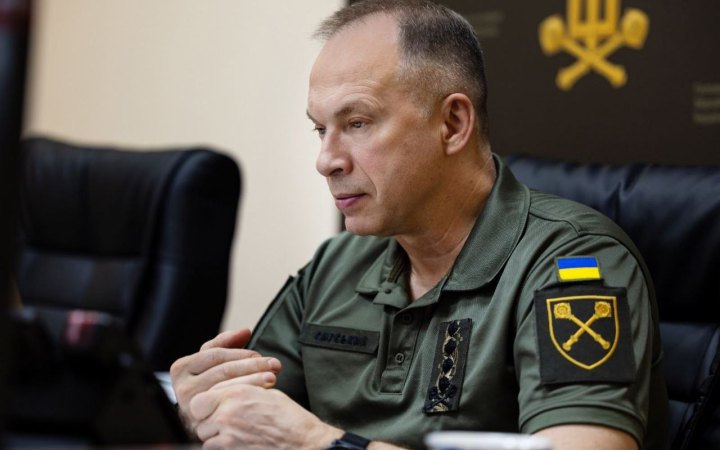
Oleksandr Syrskyy published a farewell post before handing command to Mykhaylo Drapatyy. He said he would leave the post as early as today.
Syrskyy said he has witnessed this war since its first day in 2014 and that, in February–March 2022, he had the honour of commanding the defence of Kyiv, where joint efforts enabled the capital to withstand the Russian assault. That same spring, the threat of a complete encirclement of Kharkiv was lifted.
“Then came the offensive in Kharkiv Region, when in a matter of weeks we liberated Balakliia, Izyum and Kupyansk. Later, in Donetsk Region, we destroyed the most combat-ready part of the Russian army — the Wagner PMC. I took command of the army in February 2024, at a very difficult time. The defence of Avdiyivka was ongoing. Our units were in a semi-encirclement. One of my first orders in the post was to withdraw from the city in an organised manner. It was a hard decision. But I made it because one priority guided me above all others: preserving people’s lives,” said Oleksandr Syrskyy.
He described the following year as a period of major change in the war, citing the halting of Russia’s offensive in Kharkiv Region, the prevention of an offensive in Sumy Region, and the Kursk operation, which marked the first time combat operations were transferred onto Russian territory. Syrskyy stressed that occupying foreign territory was never the objective. The operation was intended to disrupt a planned Russian offensive against Sumy and Kharkiv and draw away some of Russia’s most combat-ready troops. Syrskyy also highlighted the creation of the world’s first separate branch of service dedicated to unmanned systems, the development of a new air defence system, and the effective closure of the Russian Black Sea port of Novorossiysk.
“About some of the operations we carried out over these years, I have no right to speak even today. History will tell of them. I will say only this: the enemy remembers them. And the main thing is the condition in which I am handing over the battlefield. This year, under my command, 700 square kilometres of our land have been liberated. An army that two years ago was waging a hard defence is advancing today,” said Oleksandr Syrskyy.
He added that he is handing over to his successor an army that not only holds the line, but is also capable of offensive action – with initiative, structure and personnel who know how to strike the enemy. Oleksandr Syrskyy expressed hope that this momentum would continue. In closing, he thanked every soldier, sergeant and officer with whom he had served over these years and paid tribute to the families of the fallen.
“I said this before and I will repeat it today: my work is war. Positions change, but this principle does not. Whatever my status, I will serve Ukraine until Victory,” Oleksandr Syrskyy concluded.
Change of Commander-in-Chief
Oleksandr Syrskyy is the second commander-in-chief of the Armed Forces of Ukraine during the full-scale war. He replaced Valeriy Zaluzhnyy, who had led the Armed Forces since 2021.
President Volodymyr Zelenskyy appointed Oleksandr Syrskyy commander-in-chief on 8 February 2024, describing him as the most experienced among Ukraine’s commanders.
Oleksandr Syrskyy has commanded Ukraine’s Ground Forces since 2019. Since the same year, he has also served as commander of the Khortytsya Operational-Strategic Group of Forces.
He was born on 26 July 1965 in Novynky, Vladimir Region, Russia. In 1982, he graduated from the Moscow Higher Combined Arms Command School. In 1996, he graduated with honours from the Academy of the Armed Forces of Ukraine (operational-tactical level), and in 2005 from the National Defence University of Ukraine. Since 2017, he had commanded the Anti-Terrorist Operation, and in 2019 became commander of the Joint Forces. He is a Hero of Ukraine.
Public calls for the replacement of the commander-in-chief began this summer following the president’s decision to dismiss Mykhaylo Fedorov from the post of defence minister.
The president did not publicly explain the reasons for the decision, but said disagreements between the military leadership and the Ministry of Defence had led to a breakdown in cooperation. Fedorov accused Syrskyy of sabotaging his decisions and claimed that the commander-in-chief had issued an ultimatum demanding his dismissal. The former minister said he had, in turn, proposed to the president that both the commander-in-chief and the chief of the General Staff be replaced.
Oleksandr Syrskyy briefly commented on the former minister’s statements, saying he was pleased that the Kyiv operation had made it possible to defend the capital, where such briefings are now being held.
Dissatisfaction with some of the commander-in-chief’s decisions also grew because of the situation surrounding assault regiments, particularly Skelia, where reports of violence and non-combat losses are currently under investigation.
Following calls for Oleksandr Syrskyy’s resignation, the president held numerous meetings with senior military commanders. He met with Mykhaylo Drapatyy several times.
On 21 July, in his evening address, the president announced that the new commander-in-chief would be Mykhaylo Drapatyy, commander of the Joint Forces Group and formerly commander of the Ground Forces.